Classroom · Game Theory
The hawk-dove game: when to fight, learned as a flock
A fish lands on the pier between two gulls. A hawk fights for it; a dove shares it, or backs off from a hawk. Your class plays the hawk-dove game in pairs, twice: the second time in nesting season, when losing a fight costs twice as much.
- In pairs
- About 40 min
- 2 acts
A practice run with fictional students. No real classroom or join code is created.
Try an answer on the phone. Lead the lesson from the screen.
On their phone
You are presenting

Setting up the room…
Lesson deck
Teach it as a ready-made lesson
Hook, how it works, the live game and takeaways. Edit anything.
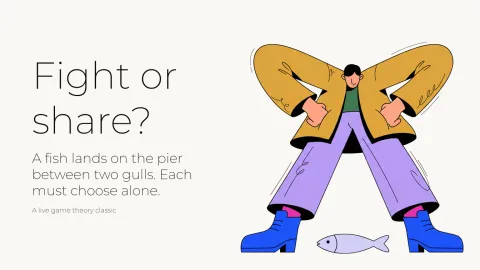
Fight or share?
A ready-to-teach lesson deck: a hook, how it works, the live game and takeaways for the debrief.
6 slides · 1 activity
What it teaches
Students meet the evolutionarily stable strategy as a flock rather than a formula. When most of the room fights, a dove expects more than a hawk; when few do, a hawk expects more; so a large flock is pushed toward one share of hawks, the fish's value over what losing a fight costs: 1 in 2 when losing costs 20, and 1 in 4 when it costs 40. They test the rule on their own room, then see whether dearer fights thinned the hawks.
- Evolutionarily stable strategies
- Nash equilibrium
- Mixed strategies
Debrief, while the boards are still up
- 01
Add up what the hawks took on the board, then the doves. Who did better, per bird? Would a gull that copied the winners next season fight more, or less?
- 02
If a hawk expected more than a dove in your room, and next season's gulls copied whoever did best, which way would the share of hawks move?
- 03
If a hawk and a dove expected the same, why would no gull gain by switching?
- 04
Who you happened to meet matters in one round. What does “expects” mean?
- 05
A whole room of doves shares every fish. What would one hawk among them get? A whole room of hawks fights every time: what would one dove get?
- 06
Who turned dove when losing got dearer? Did the room move toward 1 in 4?
- 07
If losing cost twice as much and the hawks did not thin out: one season is noisy, so what would you expect over many?
- 08
Maynard Smith and Price (1973) named the evolutionarily stable strategy; the stable share of hawks this lesson tests came later, from the hawk-dove game. Where else do animals posture instead of fight?
How it works
- 01
Add it to your library
Sign up free and pull the activity from Decka's built-in classroom catalog — one click copies it into your own library, ready to run from Decka or inside PowerPoint.
- 02
Students join by QR
Everyone scans from the projector and plays in their phone's browser. No app, no account, nothing to install.
- 03
You run the room
You move the activity phase by phase: collection closes, the boards resolve on the big screen, and the debrief happens while the results are still up.
What is the hawk-dove game in evolutionary game theory?
The hawk-dove game is the first model most courses in evolutionary game theory teach. Its idea comes from John Maynard Smith and George R. Price, “The Logic of Animal Conflict”, Nature 246 (1973), the paper that introduced the evolutionarily stable strategy: they asked why animals contesting food, territory or mates so often display and retreat instead of fighting to the end. Two animals contest one prize. A hawk fights for it; a dove shares it with another dove and backs off from a hawk. Two hawks fight: each wins half the time, and the loser is hurt.
Call the prize V and what losing a fight costs C. In a large flock, a hawk expects more than a dove while the share of hawks is under V/C, and less once it is over, so the flock is pushed toward a share of hawks of exactly V/C. That share is the evolutionarily stable strategy: once a flock sits there, no bird gains by switching. In this lesson the fish is worth 10 and losing a fight costs 20, so the large flock's share is 1 in 2; in nesting season losing costs 40, and the share falls to 1 in 4.
Your class plays it as “Two gulls, one fish”. Each student is a gull on a pier, paired with another gull for both rounds. Everyone chooses on their phone, hawk or dove, while the projector shows the payoff table and how many have answered. Then the big screen deals the choices onto a tally of hawks and doves beside a two-by-two of where the pairs ended up, each square counting its people and printing its payoffs. It underlines every best answer and rings the two equilibria, where one bird fights and the other backs off. Over them, a title and a line say who expected more in this room, a hawk or a dove.
A note for the teacher: the line uses the room's exact rule, not the large flock's. A bird never meets itself, so in a room of N birds with h hawks a dove expects more exactly when (h − 1) × C is more than N × V. In a room of 30, a dove expects more from 17 hawks up when losing costs 20, and from 9 hawks up when it costs 40; at exactly 16 hawks and a cost of 20, a hawk and a dove expect the same. The line names the large flock's share as the law it is, and never says one round is the long run.
Then nesting season: a hurt gull cannot feed its chicks, so losing a fight costs 40. Only the fight's square of the payoff table changes, from −5 to −15 for each bird, and the same pairs choose again. Round two lands the same way, and then the rounds are compared: round one's hawks and doves beside round two's, a ribbon for the birds that kept or changed their choice, each as thick as its birds, and a headline counting the hawks at each cost.
Counts only: the projector never names a bird, a seat or a pair. Each phone shows its own result, the choice it made and the choice it met, never whose it was. Try the screen-and-phone preview: the phone is yours, and fictional classmates choose through the same runtime as the lesson; they are illustrative, not observations of a real class.
FAQ
Hawk-dove game questions, answered
What is the hawk-dove game?
A two-player game from evolutionary game theory. Two animals contest one prize: a hawk fights for it, and a dove shares it with another dove or backs off from a hawk. Two hawks fight, each winning half the time, and the loser pays the cost of the fight. Its question is not who wins one contest but what share of a population can keep fighting.
What is an evolutionarily stable strategy?
A way of playing that, once a population has settled on it, no rare alternative can beat. In the hawk-dove game it is a share of hawks: the prize's value over what losing a fight costs. Below that share a hawk expects more than a dove, and above it a dove expects more, so a large flock is pushed back to it. John Maynard Smith and George R. Price defined it in 1973.
How is it different from the chicken game?
On the table it has the same shape: two equilibria, in each of which one player fights and the other backs off. The chicken game asks which of two drivers blinks. The hawk-dove game asks about a whole population: what share of a flock can keep fighting, and how that share moves when fighting gets dearer. So this lesson reads the room as one flock, and its line names the share.
What changes in the second round?
Nesting season: losing a fight now costs 40 instead of 20, because a hurt gull cannot feed its chicks. Only the fight's square of the payoff table changes, from −5 to −15 for each bird. The same pairs choose again, and the last step compares both rounds, so the class sees whether dearer fights thinned the hawks.
How are pairs made, and what if the class has an odd number?
The room is dealt into pairs, each on its own numbered pier, and the pairs stay together for both rounds. Students play through their phones, so partners need not sit together. With an odd number, one gull is left without a partner: its phone says nobody was left to share its pier, and it has no result to count.
Does anyone see who chose what?
No. The big screen shows counts only: how many played hawk, how many played dove, and how many people ended up in each square, never a name, a seat or a pair. Each phone shows its own result and the choice its gull met, never whose it was. While the room is choosing, the screen shows the payoff table and how many have answered, nothing more.
Can I change the payoffs?
Not in this version. The screen's title and line are worked out from the fish's value and each season's cost of a fight, so the payoff table and both seasons' costs are held, and a copy can never leave the words untrue of the table. You can change the words on the screen and the phones, and every clock, before you run it.
How long does it take?
Two rounds of choosing, each on its own clock, then the comparison at your pace; the saved default shows under the headline as "About N min", and every timer is a setting you control before you run it.
Do students need an app or an account?
No. Students scan a QR code from the projector (or open a link) and play in their phone's browser. Nothing to install and nothing to sign up for.
Does it work in PowerPoint or Google Slides?
In PowerPoint, yes: open the Decka add-in on a slide and choose the Classroom tile. Google Slides is not supported yet; there you present from Decka itself. Students play from their phones either way.
How many students can play at once?
Up to 50 participants per live activity on the free plan, 150 on Pro, and 300 on Badass.
More game theory games to run live
- Prisoner's dilemma — two suspects, separate rooms
- Twenty coins, take it or leave it
- Chicken — four seconds on a single-track lane
- The stag hunt — one day, two ways to spend it
- Battle of the sexes — one evening, two plans
- Ten rounds in the pot
- Rock, paper, scissors — two rivals and a contract
- Matching pennies — the game where you want opposite things

- Don't take the last coin
- Schelling point: meet me in the city