Classroom · Game Theory
Rock, paper, scissors, and no safe throw.
Two rivals want the same contract. Every student throws blind on their phone, the projector shows what the room threw and what each throw met, and then the same pairs throw again having seen it.
- In pairs
- About 30 min
- 2 acts
A practice run with fictional students. No real classroom or join code is created.
Try an answer on the phone. Lead the lesson from the screen.
On their phone
You are presenting

Setting up the room…
Lesson deck
Teach it as a ready-made lesson
Hook, how it works, the live game and takeaways. Edit anything.
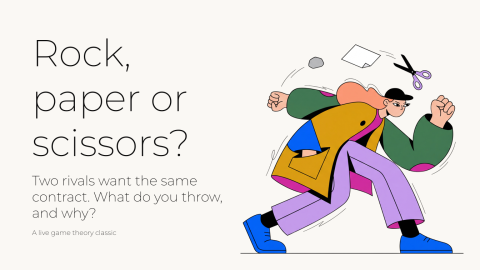
Rock, paper or scissors?
A ready-to-teach lesson deck: a hook, how it works, the live game and takeaways for the debrief.
6 slides · 1 activity
What it teaches
Rock, paper, scissors is the smallest symmetric game with no pure-strategy equilibrium: every throw loses to another, so whatever you would always throw, a rival can beat. The only plan nobody can exploit is to be unpredictable, throwing each a third of the time. The second throw puts that to the test: a pattern the whole room can see is a pattern anyone can beat.
- Zero-sum games
- Mixed strategies
- Nash equilibrium
Debrief, while the boards are still up
- 01
Which throw did the room favour the first time, and did the second throws chase it?
- 02
If you had a favourite throw, how could your rival have used it?
- 03
Whatever a pair threw, its weeks added up to twelve. What kind of game does that make it?
- 04
Is there a way to throw that you could announce in advance and still not lose on average?
How it works
- 01
Add it to your library
Sign up free and pull the activity from Decka's built-in classroom catalog — one click copies it into your own library, ready to run from Decka or inside PowerPoint.
- 02
Students join by QR
Everyone scans from the projector and plays in their phone's browser. No app, no account, nothing to install.
- 03
You run the room
You move the activity phase by phase: collection closes, the boards resolve on the big screen, and the debrief happens while the results are still up.
What does rock, paper, scissors teach about game theory?
Every student already knows the rules, which makes it the cleanest way into mixed strategies: no throw is best against everything, so there is no pure-strategy equilibrium, and the textbook answer is to throw each a third of the time.
Played live, every student throws blind before anyone is paired. Pairs are dealt only when the first throw closes, and the projector shows what the whole room threw and what each throw met. Then each pair throws again knowing what the room did. Exploiting a visible habit works only until your own throw becomes the pattern.
FAQ
Rock paper scissors questions, answered
Why teach mixed strategies with rock, paper, scissors?
Nobody needs the rules explained, and it is the smallest symmetric game with no pure-strategy equilibrium: any throw you always make can be beaten.
What happens between the two throws?
No rule or payoff changes. The same pairs throw again after the projector has shown what the whole room threw, so the second throw asks whether anyone can use that pattern, or hide from it.
Do students know who they are playing?
No. Pairs are dealt only when the first throw closes, and a phone is only ever told its table number, never who else is at the table. Each student sees their own result privately, and the projector shows the room's throws, never who threw what.
What is at stake?
By default, a contract of twelve weeks' work. A win takes all twelve weeks and a point, a draw splits the work six and six, and a loss gets nothing and costs a point, so what one side wins the other loses. Every payoff is a setting.
How long does it take?
Two throws; the saved default shows under the headline as "About N min", and every timer is a setting you control before you run it.
Do students need an app or an account?
No. Students scan a QR code from the projector (or open a link) and play in their phone's browser. Nothing to install and nothing to sign up for.
Does it work in PowerPoint or Google Slides?
In PowerPoint, yes: open the Decka add-in on a slide and choose the Classroom tile. Google Slides is not supported yet; there you present from Decka itself. Students play from their phones either way.
How many students can play at once?
Up to 50 participants per live activity on the free plan, 150 on Pro, and 300 on Badass.
More game theory games to run live
- Prisoner's dilemma — two suspects, separate rooms
- Twenty coins, take it or leave it
- Chicken — four seconds on a single-track lane
- The stag hunt — one day, two ways to spend it
- Battle of the sexes — one evening, two plans
- Ten rounds in the pot
- Matching pennies — the game where you want opposite things
- All game theory activities
Ready to make your
presentations interactive?
Start free. No credit card required.