Classroom · Biology
Hunt the moths. Watch the population shift.
A peppered moth simulation your class plays live. Every phone is a bird hunting its own patch of bark, and the moths the room misses live to breed. When the woods turn to soot, the drawer of specimens on the big screen fills with dark moths, and no moth changes colour.
- Up to 600 people
- 2 acts
A practice run with fictional students. No real classroom or join code is created.
Try an answer on the phone. Lead the lesson from the screen.
On their phone
You are presenting

Setting up the room…
Lesson deck
Teach it as a ready-made lesson
Hook, how it works, the live activity and takeaways. Edit anything.
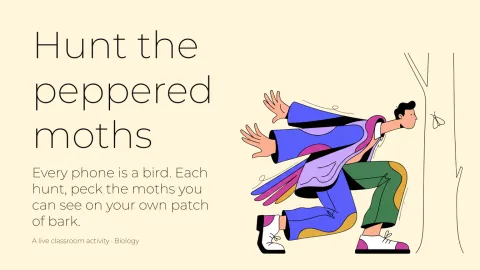
Hunt the peppered moths
A ready-to-teach lesson deck: a hook, how it works, the live activity and takeaways for the debrief.
6 slides · 1 activity
What it teaches
Students see natural selection with their own eyes as the predator: on lichen the room catches more of the dark moths, on soot more of the light ones, and the share of dark moths rises though no moth changes colour. They read each colour's survival on each woods as its fitness there, and explain why a population shifts while no single moth adapts.
- Natural selection
- Fitness
Debrief, while the boards are still up
- 01
Did any of you decide to eat more light moths on the soot? Then why did the share of light moths fall?
- 02
Did any moth change colour? What changed instead?
- 03
Which moths did your own eyes miss, and what does that have to do with fitness?
- 04
What would you predict if the soot cleared and the lichen came back?
- 05
Our birds are far hungrier than real ones, and real selection is much weaker. How would that change how many generations the shift takes?
How it works
- 01
Add it to your library
Sign up free and pull the activity from Decka's built-in classroom catalog — one click copies it into your own library, ready to run from Decka or inside PowerPoint.
- 02
Students join by QR
Everyone scans from the projector and plays in their phone's browser. No app, no account, nothing to install.
- 03
You run the room
You move the activity phase by phase: collection closes, the boards resolve on the big screen, and the debrief happens while the results are still up.
A peppered moth simulation, played by the room
Every phone is a bird. The big screen opens on a wood of lichen-covered bark and a museum drawer of a hundred pinned peppered moths, one in five of them dark. Each hunt, every phone shows its owner's own patch of bark with twenty moths resting on it, light and dark in the population's mix, and its owner gets twenty pecks to catch the moths they can see while the big screen times the hunt. A peck is a mark that can't be taken back, and a peck at bare bark is wasted.
When a hunt closes, the screen stamps what the room's birds took, light and dark, and the moths they missed live to breed. A model turns the room's catch into the next generation: each colour's chance of surviving a bird sets its share of the young. The drawer is re-pinned slot by slot, a new specimen of the other colour pressed into each slot that changes, and a line follows the share of dark moths from one generation to the next.
After one hunt on lichen the woods turn to soot, and the hunts go on. In a room of thirty practice birds following the lesson's simple rules, the share of dark moths fell from 20.0% to 5.8% after the hunt on lichen, where the dark moths stood out. On soot the light moths stood out, and after five hunts there 98.1% of the moths were dark. On lichen a light moth was 4.1× as likely to survive as a dark one; on soot a dark moth was 3.8× as likely to survive as a light one.
No moth changed colour. Each generation, more of the young were dark, because more of the dark moths lived to breed. And nobody chose to eat light moths: on the soot, the birds just couldn't see the dark ones. That is natural selection, with the room's own eyes as the predator.
Each phone shows its owner's own hunts: what they ate, the moths they looked past ringed on their own patch, and at the end a row for every hunt. The screen shows counts only: the room's catch, how many birds hunted, the drawer and the share. It never shows a name, a patch or a peck, and nobody sees anyone else's patch.
Try the screen-and-phone preview: you run the big screen's steps and hunt on the phone, while practice birds hunt their own patches through the same runtime as the lesson, by simple rules, never AI. To try the hunt alone, play the six hunts above on your own patch, beside practice birds that follow the same simple rules.
FAQ
Peppered moth simulation questions, answered
Does any moth change colour?
No, and that is the lesson. Every specimen in the drawer keeps its colour. When the share of dark moths rises, it is because more dark moths lived to breed, so the drawer is re-pinned with new specimens, never recoloured.
What is the smallest class it works with?
At least six birds. A pair hunting on one phone counts as one bird. With fewer, a hunt can catch every moth of one colour, and the model has no mutation: a colour that is gone stays gone.
What about a student who cannot judge the patch?
The hunt is a search by eye, so a student who cannot judge the patch can hunt in a pair, with a partner pecking, or follow the hunt by reading the drawer and the trend aloud for the room. Each cell of the patch is a button named by its row and column, never by what rests on it.
Is this how fast real moths changed?
No. Our birds are far hungrier than real ones, so the change takes generations, not decades. Every share on the screen is labelled as a model's, and the drawer rounds the share to whole moths.
Is this what really happened to the peppered moth?
The lesson follows a real story. The first dark peppered moth on record was found in Manchester in 1848, and by 1895 about 98% of Manchester's peppered moths were reported to be dark. After the Clean Air Act of 1956 and later laws cleaned the air, the dark form declined from the 1960s on. The lesson's start of one in five dark moths is a teacher's number, not a historical one.
Can I try the hunt on my own?
Yes. The hunt on this page is the lesson's own: your patch of bark, dealt and counted by the same rules as a student's phone, beside practice birds that follow simple rules, never AI. It is untimed, so stop a hunt whenever you can see no more moths.
Can I change the hunt?
Yes. Before you run it, you can set the pecks each bird gets (5 to 30), the share of dark moths at the start (5% to 50%), the hunt's clock (10 to 60 seconds) and whether the soot comes after one hunt on lichen or two. Every sentence the lesson prints that names one of them follows your setting.
How long does it take?
Six hunts, each followed by what the birds took, and the results; the saved default shows under the headline as "About N min", and every timer is a setting you control before you run it.
Do students need an app or an account?
No. Students scan a QR code from the projector (or open a link) and play in their phone's browser. Nothing to install and nothing to sign up for.
Does it work in PowerPoint or Google Slides?
In PowerPoint, yes: open the Decka add-in on a slide and choose the Classroom tile. Google Slides is not supported yet; there you present from Decka itself. Students play from their phones either way.
How many students can play at once?
Up to 50 participants per live activity on the free plan, 150 on Pro, and 300 on Badass.
Ready to make your
presentations interactive?
Start free. No credit card required.