Icebreaker games, filed by the size of the room
Thirty-seven games, each with the group size it holds and the way it goes wrong
Sort an icebreaker list by theme and you learn nothing about whether the game will fit the room. Sort it by whether the game runs in parallel or one person at a time, and you can predict which ones break when the room passes a dozen people.
Ingram and Morris measured what a room does when you leave it alone. They hosted an after-work mixer for almost 100 business executives, put an electronic name tag on every guest, and recorded who actually spoke to whom. Guests were much more likely to end up in conversation with the people they already knew. Only 5% had named strengthening their existing relationships as the most important goal for the night, and the seven more popular goals were all about meeting somebody new.
An unstructured room does not mix. A structured one that runs a queue does not mix either. It takes turns, which is a different thing and a slower one.
Thirty-seven games follow. The argument for why openers feel awkward in the first place has its own page, ice breakers that aren't cringe. This is the applied half of it.
Start from one of these
Each one opens in your dashboard, ready to run. You can change every word of it.
Rotating pairs
The mixer, run so it actually mixes. Everybody is paired with somebody new each round, walks over, talks about one prompt and rotates on the clock. Three rounds is three new people, which is three more than a round of the table produces in the same time.
4 slides · 1 activity
One word for the week
Ninety seconds to read a room of any size before you decide what to do with the hour. Everyone types one word at the same moment and it lands in a shared cloud, sized by how many people chose it. Ask for a weather word, not a feeling, or the cloud comes back busy, fine and tired.
4 slides · 1 activity
The silent reveal round
The chat waterfall, held on the server so nobody can send early. One question, everybody answers privately at the same moment, and nothing appears on screen until you turn the cards over one at a time. Say how many you will flip before you start, and stop at six.
4 slides · 1 activity
Nobody picked the teams
The two minutes in front of any team game. The software splits the room from whoever is actually in it, each team argues its way to a name, and then a wheel the room filled draws who brings next week's opener. Left to themselves, people group with people they already know.
5 slides · 2 activities
How to pick an icebreaker game in three questions
Ask how many people are in the room. Ask how many minutes you are willing to spend. Then ask whether every person in the room can actually play. Nothing else narrows the list as fast.
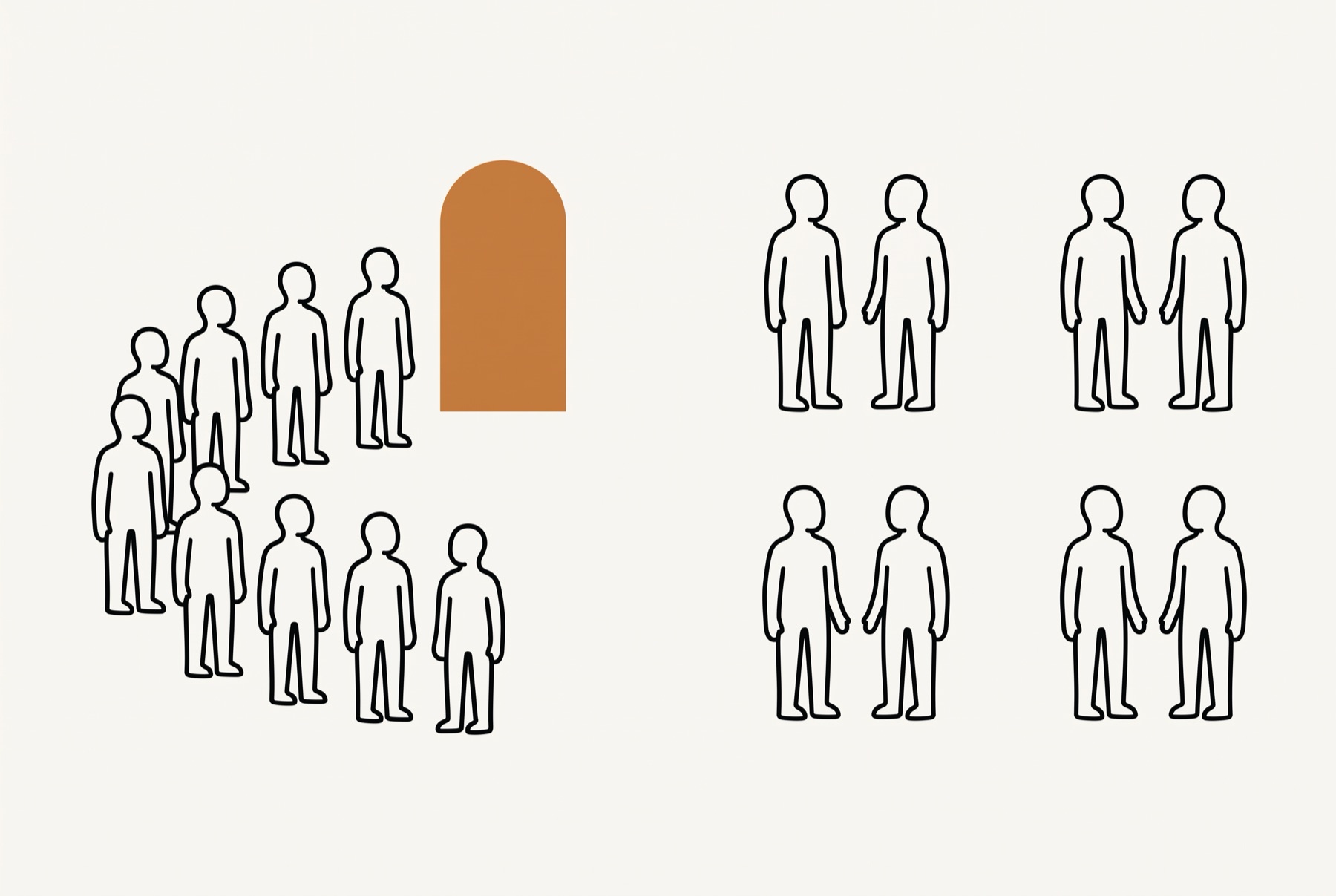
The first question is really a question about turn-taking. Dunbar censused 292 casual social groups in bars, parks, cafes and receptions, covering 1,201 adults. The mean conversation held 2.75 people, and no social group larger than six ever consisted of a single conversation. Twelve people in a meeting is not one conversation. It is one conversation with eight people watching it.
That is why a game running one voice at a time gets worse as the room grows, rather than merely slower. Stroebe, Nijstad and Rietzschel name the mechanism production blocking, which is having to take turns to express ideas, and they call it the major cause of productivity loss in interactive groups. The loss, they write, increases rapidly with group size.
Diehl and Stroebe recreated that blocking in a lab by wiring lights so that only one person could talk at a time. Participants under blocking produced only half as many ideas as participants without it. The remedy in that literature is not a better prompt. It is a format where everybody contributes in writing or on a device at the same moment, which deletes the queue.
The second question is arithmetic. Eighteen people at twenty-five seconds each is seven and a half minutes, and that is before anyone tells a story. The same eighteen people playing a parallel game finish in the sixty seconds it would take six.
| If the room is | What survives | What breaks |
|---|---|---|
| 3 to 6 people | Talking. Any question with a concrete answer | Teams, scoreboards, anything that needs a crowd |
| 6 to 12 people | One shared game, one prompt, one reveal | An untimed round of the table |
| 12 to 30 people | Everyone answering at once, then a capped reveal | Any round of the table past about fifteen people |
| 30 to 100 people | Pairs, small teams, or anything everybody answers at once | Any single conversation |
| Over 100 people | Anything the room does at once, then a capped reveal | Any queue the whole room is in |
The third question is the one that gets asked least and decides most. Can every person in this room actually play. A game that needs a circle, a clear floor or a standing round is one somebody in the room may not be able to play. Few people say so in front of colleagues. Where a game below needs one of those, its entry says so.
Icebreaker games for large groups
Past about twenty people, the room stops being a group and becomes an audience. A queue makes that official: one person speaks and the other nineteen wait. Splitting the room into pairs turns the same twenty people into ten conversations, and it takes no longer than the queue would have.
The reveal is where large-group games die. Collecting from a hundred people is instant. Showing them one at a time, at ten seconds each, is sixteen minutes, and ten seconds is optimistic. Cap the reveal before you start, say it out loud, and stop on time.
Turn to the person next to you
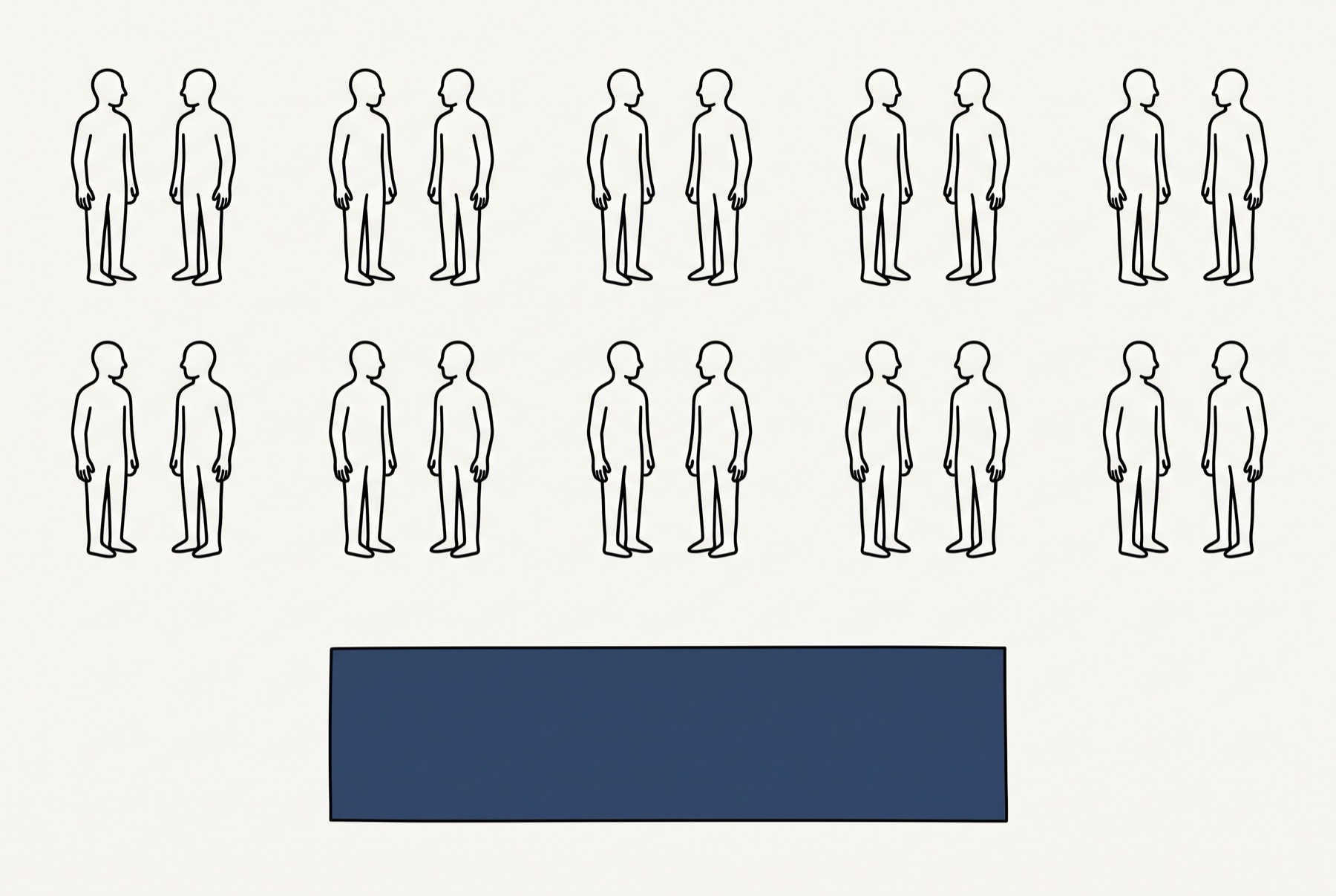
Any size. Three minutes. Everybody turns to whoever is beside them, one question goes up on the screen, and each person gets ninety seconds.
What it is for: a packed room or a fixed-seat lecture theatre. It needs no phones, no floor space and nobody has to stand up.
How it fails: an odd row leaves somebody sitting on their own, and few people put a hand up to say so. Walk the room once before you start the clock and take the spare seat yourself.
Draw and guess
8 to 200 people. Five minutes. Everybody draws the same prompt on their own phone at the same time, the drawings go up unsigned, and the room guesses who made each one. Show three drawings rather than all of them and the same game fits in three minutes.
What it is for: a cold room that has to loosen up without anybody having to speak. The drawing is private while it is being made and public afterwards, which is the opposite of a round of introductions. Prompts that are hard to draw badly are at drawing prompt generator.
How it fails: the reveal is serial even though the drawing is not, so the round length grows with the head count. In a two-hundred-person town hall, show a handful and end the activity. Guess the Doodler is the ready-made version, and the settings that decide how long a round takes are worked through on ice breakers that aren't cringe.
Rotating pairs
12 to 200 people. Ten to twenty minutes. Everybody is paired with somebody new each round, walks over, talks about one prompt, and rotates when the clock runs out.
What it is for: a room of strangers where the actual goal is that people meet people. Three rounds means three new people, which is three more than a queue produces.
How it fails: it needs floor space and it needs people who can cross it. Mingle Match puts the same large shape and colour badge on both phones in a pair, and names the person to go and find. Tap Found them and the badge is replaced by the prompt the pair shares. Rounds default to five minutes, three of them, and an odd room makes one group of three. Anyone dialling in from a car is out of the game, and you have to say so before you start.
Slips in a hat
8 to 60 people. Six minutes. Everybody writes one answer on a slip of paper, the slips go into a hat, and you read six of them out while the room guesses who wrote each.
What it is for: the paper version of almost everything else here, and the one to run when the room has no signal or you would rather not ask for phones.
How it fails: reading forty slips out is the same queue in a different costume, and the ones you skip are answers somebody wrote for nothing. Say the number before the hat goes round, and stop at six.
Everyone votes at once
Any size. Three minutes. Six either-or questions on the big screen, everybody answers from a phone, and the bar chart is the game. Three questions rather than six makes it a two-minute opener.
What it is for: the biggest room you have. A live poll takes the same three minutes at two hundred people as at twenty, and a two-hundred-person split reads better than a twenty-person one.
How it fails: it collects opinions rather than people, so it warms a room up and introduces nobody. Follow it with one question about the closest split. Our list of prompts that produce a real argument is at this or that questions.
One word for the week
Any size. Ninety seconds. Everybody types one word and the words land in a shared cloud, sized by how many people chose them.
What it is for: a large room you have to read before you can decide what to do with the hour. Six people typing rushed into a word cloud is a finding the room should see.
How it fails: ask for a feeling and you get busy, fine and tired. Ask for a weather word instead and you get something worth a follow-up. Words also land as they arrive, so the third person has already read the first two, and a Reveal round is the version that holds them back. And a cloud collects a mood and then stops, so pick one word off it and ask the room what is behind that one, without asking who typed it.
The silent reveal round
Any size. Four minutes. One question, everybody answers privately, nothing appears on screen until you turn the cards over.
What it is for: getting a true answer out of a large room, because nobody has read anybody else's before writing their own. Reveal holds answers on the server until you flip them, takes up to three per person, and flips them all at once or one at a time.
How it fails: forty cards turned over at once is a wall nobody reads. Flip them one at a time and stop at six, or flip them all and read three out loud.
Trivia about your own company
Any size. Eight minutes. Ten questions about the organisation, answered by everybody at once.
What it is for: shared history, and a competition about facts rather than about each other. Getting one wrong says nothing about you, which is what makes it survivable in a room that has just met.
How it fails: it rewards tenure, and a new joiner loses in public in their second week. Write half of them as questions nobody could know and anybody can estimate, like how many countries we ship to, so guessing well beats having been here. Live Quiz ranks individuals rather than teams, and it also has a mode that keeps no score at all, which is the one to pick when the room is new. Question sets are at trivia questions.
Human bingo
20 to 100 people. Ten minutes. A grid of statements like has lived in three countries, and you fill each square with a different person's name.
What it is for: a standing reception with drinks and floor space, where the point is circulation rather than depth.
How it fails: it is a scavenger hunt that rewards whoever is comfortable interrupting a stranger, and it leaves everybody else holding a sheet at the edge of the room. It also needs a floor everybody can cross. Cut the grid to five squares, give a hard stop, and never offer a prize, which only sharpens the advantage. Printable cards are at bingo card generator.
Stand up if
20 to 500 people. Three minutes. Read out statements and people stand when one is true of them.
What it is for: a fast, physical read of a big room with no equipment at all.
How it fails: it excludes anyone who cannot stand up, and you are unlikely to be told who that is. Ask for a show of hands instead, or run it as a vote from phones. A show of hands reads less well from the front of a big room, and that is the whole cost of not making somebody sit the round out in public.
The rock paper scissors ladder
20 to 200 people. Five minutes. Everybody plays one round against whoever is nearest. The loser gets in behind the winner and cheers for them from then on, and the winners keep playing until two people are left with half the room behind each.
What it is for: five minutes of noise with nothing personal in it. Nobody has to say anything about themselves, and the noise is cheering rather than talking.
How it fails: it needs hands, standing room and a room willing to shout, so it goes the same way as the circle games when any of the three is missing. It also ends the moment the last match does, so have the next thing ready.
Team dodgeball on the big screen
6 to 40 people. Eight minutes. The room splits into teams of three to five, and each team drives one character on the big screen with the controls divided across their phones.
What it is for: the graveyard slot at an offsite, or any meeting whose real problem is that everybody has been sitting down for two hours.
How it fails: it is loud, so it does not belong in front of hard news. Meeting Dodgeball needs two teams of at least three before it will start, which is why this one begins at six people.
The wheel the room filled
Any size. Three minutes. Everybody submits options from their phone, then the wheel picks one in front of the whole room.
What it is for: choosing a name, a topic or who goes first, in a way nobody can accuse of being rigged. Spin the Wheel decides on the server rather than in a browser, takes up to three entries per person, and can remove each result so nobody is drawn twice.
How it fails: on its own it is a picker rather than a game. Put it on top of something else, and give it a prompt worth arguing about.
Rank the unrankable
Any size. Five minutes. Ten items everyone has an opinion about, ranked into rows by every person at once, then shown as one board. Cut it to three items and the same board fits a two-minute warm-up.
What it is for: an argument that is enjoyable to have and impossible to lose. Tier List shows the spread of placements as well as the average, so the item half the room put top and half put bottom is visible rather than averaged away.
How it fails: pick items nobody has a stake in and you get a shrug. Rank the office biscuits rather than the corporate values. More on the format at tier list maker.
Name your team
6 to 40 people. Two minutes. The room is split into teams and each team argues its way to a name on their phones.
What it is for: the two minutes in front of any team game. The argument is the point, and Group 3 gives them nothing to argue about.
How it fails: on its own it is a warm-up with nothing after it. Team Naming makes between two and eight teams and settles each name by vote or by most recent proposal, and it exists to feed the game that follows.
Icebreaker games for a team meeting
Between about six and twenty people you have the hardest room, because it is small enough that a queue looks reasonable and large enough that a queue is expensive. This is where most of the damage gets done.
It is also the room where the same faces meet every week, so novelty runs out. Keep four of these in rotation and retire any one that gets a groan.
Two truths and a lie, played silently
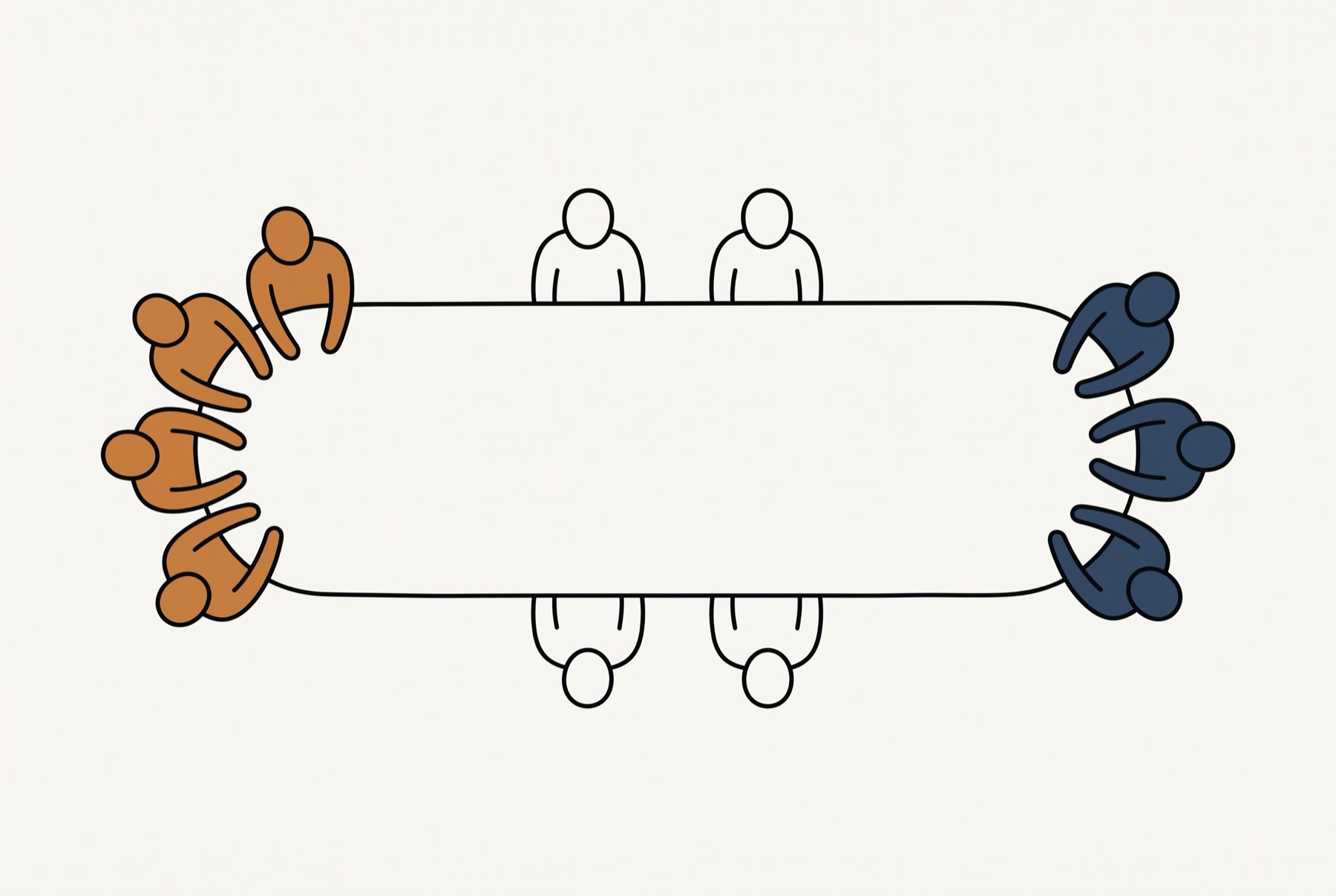
6 to 30 people. Six minutes. Three statements per person on the screen, everybody votes at once from their phone, and the answer comes out with the count. Six people is a round. Thirty is an afternoon.
What it is for: a team that already knows each other and wants an argument about who is bluffing. Voting at the same moment removes the queue that makes the spoken version so long.
How it fails: it costs you preparation, because quiz questions in the Live Quiz activity are presenter-authored and participants cannot type their own three statements in. You collect six sets beforehand and enter them yourself. And in a room that has just met, the content is a lie told with your name on it to people forming a first impression. The full case, including what makes a lie hold, is at two truths and a lie.
Most likely to
5 to 40 people. Four minutes. One prompt about the team, everybody names somebody privately, and the results come out together.
What it is for: a team with enough shared history to have opinions about each other, and enough goodwill to enjoy them. Reveal is the shape it needs, because the board fills with face-down cards while people type.
How it fails: it can turn into a vote on one person, which is where it stops being a game. Keep every prompt affectionate and skip anything about competence. Prompt lists are at most likely to questions.
Would you rather
Any size. Three minutes. Two bad options, everyone picks, the room argues about the split.
What it is for: warming up a meeting that has to make a decision, because it puts people in the habit of choosing and defending in ninety seconds.
How it fails: with soft options it produces a shrug, and the split has to be close to be interesting. There is a set built for work at would you rather questions for work.
Draw your area of responsibility
5 to 15 people. Five minutes. Everybody draws what they are responsible for, unsigned, and the team guesses whose is whose.
What it is for: a team that has worked together for years and has stopped being able to say what anybody else does. The wrong guesses are the finding.
How it fails: it needs a team with a real map to test, so it does nothing for a room of strangers. Fifteen drawings will not fit in five minutes either, so pick five to show and say the number first. The full version of the prompt, and what to say when the misattribution is embarrassing, is on ice breakers that aren't cringe.
Charades
6 to 30 people. Ten minutes. One person acts a word only they can see, and everybody else guesses.
What it is for: physical energy and a great deal of laughing, in a room that is comfortable enough for one person to be watched on purpose.
How it fails: it is a spotlight, and one person being watched is what the simultaneous formats on this page exist to remove. Never assign a performer, always ask for volunteers, and let the round end while people still want another. Charades puts the word on the performer's phone, the clock on the big screen, and takes guesses from every phone at once, and word lists are at charades ideas.
Draw against decoy answers
8 to 40 people. Ten minutes. One person draws a word their own team has not seen. Every other team writes a fake that could pass for it, and the artist's team has to pick the real word out of the list.
What it is for: a team game with two skills in it, drawing and lying, so people who are bad at one are useful at the other.
How it fails: it has the longest rules on this page, and ten minutes buys you the explanation and two rounds. Doodler Decoy runs with between two and four teams, and it is worth the explanation at an offsite and not worth it before a Tuesday standup.
Fist of five
3 to 25 people. Ninety seconds. One claim, and every hand goes up at the same instant: a fist for no, five fingers for yes, and every number in between.
What it is for: finding disagreement fast. A room split between fives and twos is the conversation you actually needed to have.
How it fails: hands go up at different speeds and the slow ones copy the fast ones, especially the ones going up after the boss's. Count down from three, or take it from phones where nobody can see anybody.
Guess the number
Any size. Two minutes. One true number about the team, and everyone guesses before you show it.
What it is for: putting a real number in front of a team that has stopped reading them. Everybody commits to a guess first, so the figure arrives as an answer rather than as a slide. Tickets closed last quarter, customers spoken to, days since the last incident.
How it fails: pick a number that flatters management and the room can tell. Pick one nobody has any basis for and it is a lottery.
Your phone — draw here
Waiting for host to start...
On the big screen
Guess the Doodler
Draw your area of responsibility
You get 30 seconds on the phone. Four teammates are drawing the same prompt.
See it in action
On a desktop you can play this round yourself — drawing included.
On the big screen
Guess the Doodler
Draw your hidden talent
Quick icebreaker games under five minutes
Short is not a compromise. An opener that overruns is one reason people brace for the next one, and every game below finishes before anybody has had time to resent it.
Several of the games above also run short, and where they do the entry says so. The shortest thing here is ninety seconds, and if you have less than that, skip the opener rather than rushing eleven people through a round.
The last photo
3 to 8 people. Four minutes. Describe the last photo on your phone. Do not show it.
What it is for: a genuinely specific answer with a safety valve built in, because describing is voluntary in a way showing is not.
How it fails: somebody will show it anyway, and then the next person has to match that or look like they are hiding something. Say the rule twice.
Countdown categories
Any size. Two minutes. Name five things in a category in thirty seconds, everybody writing at once.
What it is for: energy without exposure. It is a race against a clock rather than against each other.
How it fails: with an obscure category it becomes a knowledge test. Keep the category so easy it is almost insulting.
Two lines about a stranger
8 to 60 people. Four minutes. Pair people up, give them ninety seconds, then each person writes two lines about the other into a shared board.
What it is for: the smallest possible version of a mixer, when you have four minutes rather than twenty.
How it fails: ninety seconds is not enough with a difficult prompt. Give a prompt with a concrete answer, and there is a bank of those at icebreaker questions. Read three lines off the board at the end, because a board nobody reads out is a form.
The nine-second answer
3 to 15 people. Three minutes. One question, nine seconds each, timed out loud. Anybody can pass.
What it is for: a round of the table a room this size can survive, because nine seconds is too short to perform in and the constraint is the joke.
How it fails: past fifteen people the arithmetic beats you, since nine seconds each is over two minutes at fifteen and nearly four at twenty-five. Past that, ask the same question of five volunteers.
Icebreaker games for three to eight people
Small rooms need less than the internet thinks. With five people there is no queue to remove and no back row to include, so most of the machinery on this page is solving a problem you do not have. The one thing that does not shrink with the room is the person who talks most, and asking everybody to answer at the same moment is still the cheapest way round them.
The honest advice for a group this size is to ask one good question and answer it yourself first. Games are for when that has stopped working, or when the group is about to do something harder than talking.
Just talk
3 to 6 people. Two minutes. No format. One question with a concrete answer, asked while people settle.
What it is for: almost every meeting of this size. No phones, no rules to explain, and the question does all of the work.
How it fails: with a question that has no answer. What are you passionate about is an interview. What did you spend too much on and not regret is a story, and there are more of that shape at get to know you questions.
The rotating question
3 to 8 people. Three minutes. One person brings a question each week and asks it first.
What it is for: spreading ownership of the opener so it stops being a management ritual. The person who asks also answers first, which sets the depth.
How it fails: the same person keeps volunteering. Put the rota somewhere visible.
Count to twenty-one
5 to 8 people. Three minutes. The group counts to twenty-one out loud with nobody assigned an order, and any collision restarts it.
What it is for: a group about to do something that needs real coordination. The collision is the feedback, because you can hear the moment two people stopped listening to each other.
How it fails: it is unplayable on a call with any audio delay, and once a group has got it twice there is nothing left in it.
One word at a time
3 to 8 people. Four minutes. The group tells one story, contributing a single word each in turn.
What it is for: making a group build one thing together in a way that is almost impossible to take seriously.
How it fails: somebody tries to steer the story and it stops being collective. If that happens, name it lightly and keep going.
The question you would ask a new joiner
3 to 8 people. Four minutes. Everybody writes the question they would want asked on their first day, and the group answers the best one.
What it is for: a small team about to grow, because what people want asked on their first day tells you what this team thinks a first day is for.
How it fails: it needs a team that has thought about itself. In a brand new group it produces polite blanks.
Start from one of these
Each one opens in your dashboard, ready to run. You can change every word of it.
Rotating pairs
The mixer, run so it actually mixes. Everybody is paired with somebody new each round, walks over, talks about one prompt and rotates on the clock. Three rounds is three new people, which is three more than a round of the table produces in the same time.
4 slides · 1 activity
One word for the week
Ninety seconds to read a room of any size before you decide what to do with the hour. Everyone types one word at the same moment and it lands in a shared cloud, sized by how many people chose it. Ask for a weather word, not a feeling, or the cloud comes back busy, fine and tired.
4 slides · 1 activity
The silent reveal round
The chat waterfall, held on the server so nobody can send early. One question, everybody answers privately at the same moment, and nothing appears on screen until you turn the cards over one at a time. Say how many you will flip before you start, and stop at six.
4 slides · 1 activity
Nobody picked the teams
The two minutes in front of any team game. The software splits the room from whoever is actually in it, each team argues its way to a name, and then a wheel the room filled draws who brings next week's opener. Left to themselves, people group with people they already know.
5 slides · 2 activities
Virtual and hybrid icebreaker games
A call is the room where serial formats are worst, because there is no side conversation, no hallway and no way to tell whether the silence means agreement. Anything that queues on a call queues at full cost.
Fatigue makes it worse in a way that is easy to miss. Masjutin and colleagues ran two preregistered studies, one describing real meetings and one an experiment, and found a clear link between fatigue and conformity. In their experimental task, 78% of participants changed an answer to match the majority at least once. Camera use, they report, was not related to either conformity or fatigue. Shockley and colleagues found the reverse in a four-week field experiment, where 1,408 daily observations from 103 employees supported a model running from camera-on to daily fatigue. Two careful studies disagree, so a cameras-on rule is not something the evidence hands you.
So the design for a call is the same as the design for a large hall. The hybrid room has one rule of its own, which is that the people sitting together play from their own phones like everybody else. The drawing round is where that case is worked through, on ice breakers that aren't cringe.
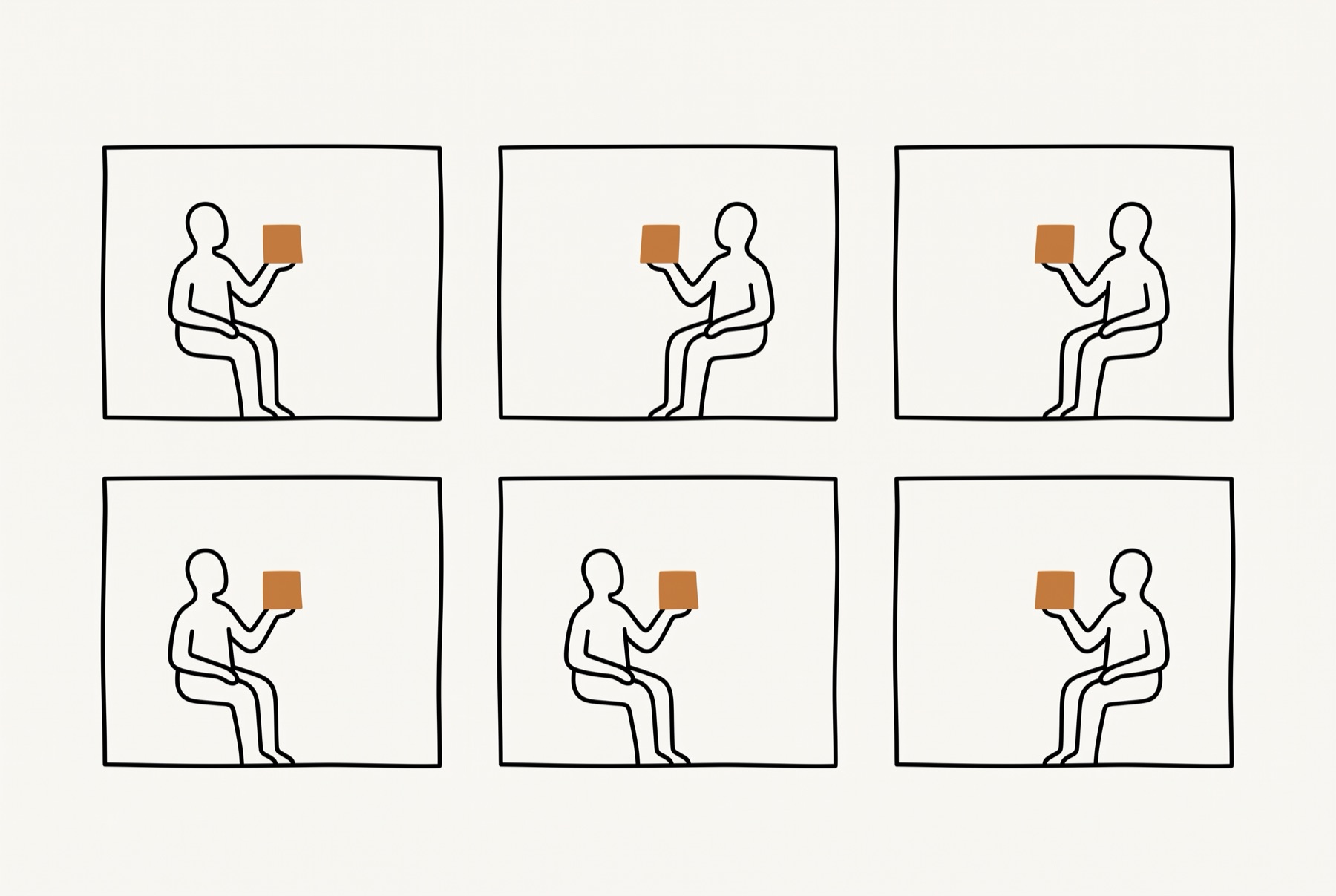
The chat waterfall
Any size. Two minutes. Everybody types an answer in the chat and nobody presses send until you count down from three.
What it is for: the cheapest simultaneous format a call has, working on any software with a chat box. Nobody can read an answer that has not been sent yet.
How it fails: somebody will send early and the rest will read it. Say the rule, count out loud, and expect to lose the first one.
One object within arm's reach
3 to 25 people. Three minutes. Everybody holds up something within reach of where they are sitting.
What it is for: the one advantage a call has over a room, which is that everybody is somewhere personal and the objects are already there.
How it fails: it can read as an invitation to inspect people's homes. Make it explicitly optional and go first with something dull.
Breakout pairs, one prompt
8 to 200 people. Six minutes. Two people per room, one question they take in with them, four minutes, then everybody comes back.
What it is for: the closest a call gets to a mixer. Pairs, not threes, because in a pair nobody can sit it out and in a three somebody can.
How it fails: with no prompt, or with a prompt too vague to start on. Put the question in the room name if your software allows it, because a pair that cannot remember the question has nothing to start on.
Guess whose desk
5 to 15 people. Four minutes. Everybody sends one photo of their desk beforehand, and the room guesses whose is whose.
What it is for: the same mechanic as the drawing game with none of the drawing. Wrong guesses are the fun part and cost nothing.
How it fails: it excludes anybody who does not want their home on screen, and they are unlikely to say so. Offer a second option, such as a photo of the view, and take the photos in advance so nobody is caught out live. Ask six people rather than the whole room, because fifteen photos will not fit in four minutes.
The silent vote before the discussion
Any size. Ninety seconds. Before anybody speaks, everybody registers a position privately, and you show the distribution.
What it is for: any call that has to decide something. It barely counts as a game, and it stops the discussion starting from whatever the first person to speak happened to say.
How it fails: run after the discussion, it measures the discussion. Vote first or do not vote.
Icebreaker games that do not work, and why
Each game below has a cost that is known before you start it. That is the reason to drop them rather than to run them carefully.
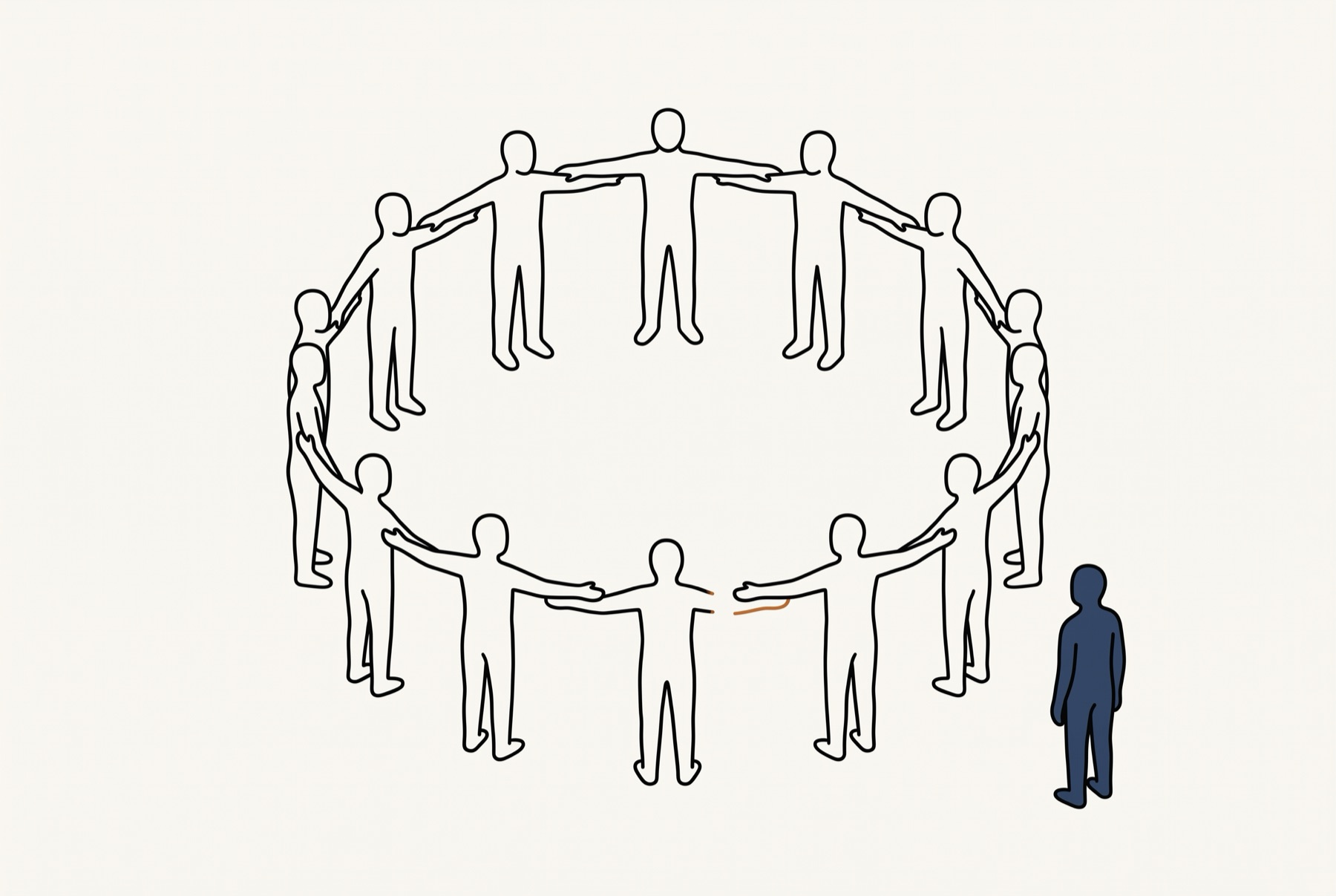
Anything that requires standing in a circle. In the UK Family Resources Survey for 2022 to 2023, 23% of working-age adults were classified as disabled. Among disabled working-age adults, 41% reported a mobility impairment. The human knot, the trust fall and every relay race have the same defect. Almost nobody announces a reason to sit out in front of colleagues, so they play along badly and resent it quietly.
Anything that puts one named person on the spot. Hot seat, the interview round, and every format where the group questions one person in turn. Eddy and colleagues asked 323 students about their small-group discussions, and 29.4% agreed that somebody in their group dominated. Of the students who said groupmates had prevented them contributing, 54.4% named one dominating person as the worst part of group work. A format that hands one person the floor before they have put their hand up is that failure by design.
Anything that fishes for a confession. Your biggest failure, your worst boss, an embarrassing story. These prompts do get an honest answer. They also get an answer somebody cannot take back, in front of people who decide their next promotion.
Anything that takes longer to explain than to play. If the rules need a diagram, the room has already decided how this is going. In a meeting, two sentences of instruction is the budget, and a game that needs more than that has to be worth an offsite.
Superlatives that stick to a person. Anything that awards most annoying, least organised or worst timekeeper. The joke lands for the room and stays with the person. A most likely to round is the same shape and survives only on prompts about habits nobody is appraised on.
Prizes. A losing round ends when the round does. A prize makes the loss into something somebody carries out of the room, which is more than a warm-up is worth.
Any game at all in front of bad news. A room that already knows what the meeting is about will read the opener as an instruction to be cheerful about it. Open with the news.
The same game, unchanged, every week. An opener run by reflex is a ritual, and a ritual gets the compliance a ritual deserves. Rotate who picks it before you rotate the game.
There is also a broader honesty problem worth stating. Lacerenza, Marlow, Tannenbaum and Salas reviewed team development interventions for American Psychologist. Naming a ropes course and an icebreaker as their examples, they write that there is limited evidence that team-building activities lacking scientifically based components are effective. What the pooled evidence does support, they report, is goal setting and role clarification. Reporting Klein and colleagues' meta-analysis of 60 effect sizes, they record gains in trust and coordination and no significant direct effect on team performance.
Staged fun has a measured cost as well as an unproven benefit. Georganta and Montgomery surveyed 433 employees in Greece. Fun the organisation stages, meaning special events and sanctioned fun freedoms, did not predict lower turnover intentions or less need for recovery from work. Fun that arose on its own predicted lower turnover intentions, fewer chronic social stressors and less need for recovery. Of those three, staged events moved one, and in the wrong direction: they showed up alongside more chronic social stressors rather than fewer.
One classroom study is worth knowing before you conclude an opener does nothing. Sawyer, Braz and Babcock compared a photo roster kept up all term against a traditional get-to-know-you exercise across 140 students. The roster group reported higher classmate liking, instructor liking and name recall. Note what it did not find. There was no difference in anxiety, empowerment or group immediacy between the two exercises, and no group that did nothing at all to compare against.
None of that means run nothing. It means the game is not the intervention. Five minutes is cheap enough to spend on a maybe, and the thing to judge it on is who speaks in the next fifty minutes rather than how the five felt. What to do with an actual team-building budget is a different conversation, at team building activities for work.
How to run one so it lands
The game matters less than six decisions that usually get made by accident.
Never say the word icebreaker. Describe the thing instead. Everybody gets sixty seconds to draw, then we guess whose drawing is whose. A description of the actual thing is harder to dread than the label on it.
Put it before the agenda. An opener works by changing what follows it, so a game in the middle is a break rather than an opener. If the meeting has already started badly, a game will not rescue it.
Collect at the same moment. Reveal on your terms. Freeman, Blayney and Ginns held a large lecture constant except for how students answered. They concluded that anonymity is a critical factor in willingness to participate, with engagement rising with the degree of anonymity provided. Of the 135 students surveyed, more valued being anonymous to the instructor than to their peers, and 63% said anonymity mattered when they were unsure of the answer.
Collecting at the same moment does the other half, because nobody can shape an answer around one that is already on the screen. Below about a dozen people there is no queue to remove, which is why the small-room games above ignore this one.
Decide the reveal count before you start. Collection scales and reveals do not. Say the number out loud, so ending on time reads as the plan rather than as running out of interest.
Split teams before the room can self-select. Left to themselves people group with people they already know, which is the mixer result again. Random team generator does the split from a list of names, and Team Naming does it live from whoever is actually in the room.
Play, and go first badly. A facilitator who sits out has rebuilt the audience the format exists to remove. Going first with a visibly poor answer is the cheapest way to set the bar low enough for everybody else.
When a round lands flat there are three moves, and none of them is an apology.
If nobody guesses at a reveal, make one specific wrong guess yourself. A specific guess is cheap to contradict, contradicting is participation, and a facilitator being wrong is proof that being wrong here costs nothing.
If one person is answering everything, ask for a second guess before you show the answer. A wrong guess from somebody else turns it back into a game.
If submissions stall, end the round early. A game that finishes while people still want one more beats a long one you had to rescue.
And never apologise for the activity. Ninety flat seconds feels enormous from the front of the room and reads as Tuesday from the seats. An apology confirms there was something to apologise for.
FAQ
Common questions
What is a good icebreaker game for a large group?
A drawing and guessing round, a simultaneous vote, or a paired mixer. All three work by having everybody act in the same moment rather than in turn, which is the property that decides whether a game survives past about twenty people. Cap the reveal before you start, because collecting from a hundred people is instant and showing them one at a time, at ten seconds each, is sixteen minutes.
How long should an icebreaker game take?
Ninety seconds to six minutes for a meeting opener, and ten to twenty for a mixer where the point is that people meet people. Past ten minutes in a regular meeting the opener has become the meeting. If you have less than ninety seconds, skip it rather than rushing everybody through a round of the table.
What is the best icebreaker for a small team of five?
Ask one question with a concrete answer and answer it yourself first. With five people there is no queue to remove and no back row to include, so most of the machinery in a games list is solving a problem you do not have. Save the games for when the group is about to do something harder than talking.
What icebreaker games should you avoid at work?
Anything requiring a physical circle, because you are unlikely to be told who cannot join it. Anything that puts one named person on the spot. Anything fishing for a confession rather than a fact. Anything with a prize, because a prize makes the loss outlast the game. And any game at all in front of bad news.
What are good virtual icebreaker games?
The chat waterfall, where everybody types an answer and nobody sends until you count down from three. A drawing round played from phones, which gives the people dialling in the identical game rather than a degraded feed. Paired breakouts with one concrete question. Avoid anything serial, because a call has no side conversation to absorb the waiting.
Run this with your own team
Start free, no credit card. Your audience joins from their phones with a code — nothing to install.