Would you rather questions for work
The work dilemmas that split a team down the middle
· Updated
Mas and Pallais ran a real hiring process as an experiment. Applicants to a national call centre were offered the standard weekday office job or an alternative, with the wage gap between the two randomised. Workers were willing to give up 8% of wages for the option to work from home. For flexible scheduling, the great majority would give up nothing at all.
Flexibility is the thing everybody says they want. Attach a price and most of them walk away. That gap is the whole case for asking your team a dilemma instead of a favourite.
Work would-you-rather lists are full of favourites wearing a dilemma's clothes. Coffee or tea. Beach or mountains. Those are this or that questions, and they are good at what they do, but nothing is given up so nothing is found out. The questions below are grouped by subject. Two more sets sit at the end: one where both answers are bad, and one for a room that has just met.
Start from one of these
Each one opens in your dashboard, ready to run. You can change every word of it.
Would you rather, for work
Two work dilemmas that split a room, answered on phones and counted live. A preference is free; these cost something, which is why they start an argument worth having.
5 slides · 2 activities
Would you rather, meetings
The article's meeting dilemma answered in one tap, then the reason typed privately and held back until the presenter turns the cards over. Neither option is a meeting anybody wants, so the split says which failure the room would sooner carry.
5 slides · 2 activities
Would you rather, with a price on it
One trade asked two ways at once. Half the room gets the money question with no number in it and half gets the article's repaired version, both answering from the same pair of options. Both wordings go up, then one grouped chart draws the gap between them, and the gap is the wording doing the deciding.
4 slides · 1 activity
Would you rather, hard mode
Five dilemmas where both answers are bad, twenty seconds each, with the option-by-option split held back until the round ends. The room is not picking a favourite, it is picking which cost it would sooner carry. Save it for a team that already argues comfortably.
4 slides · 1 activity
Why a dilemma tells you more than a favourite
The shape of what Mas and Pallais did has a name. Phillips, Maddala and Johnson describe conjoint analysis as comparing hypothetical scenarios by ranking, rating or choosing one, and write that those choices indicate the relative importance of the attributes. Mas and Pallais made the scenarios real, which is why their numbers bite. You do not ask somebody what they value. You make them give one thing up, and what they hand over is the answer.
The average worker in that experiment would surrender 20% of wages to avoid a schedule set by an employer at a week's notice. Most would surrender nothing for the freedom to pick their own hours. Two things everyone files under flexibility, and only one of them is load-bearing.
Barrero, Bloom and Davis got the same answer from the other direction. They surveyed 22,500 Americans over seven waves. Asked what size of pay rise would feel equal to working from home two or three days a week, the average employee answered 7.7%. That is close to the figure the hiring experiment produced by watching people choose.
You are not running a wage study in a Tuesday standup. You are borrowing the shape. A question that costs the answerer nothing produces an answer worth nothing.
So the test for any question on this page is short. What does the person picking give up? If the answer is nothing, cut it.
What makes a work question worth asking
A good question splits the room near the middle. Exam writers measure a near relative of it: whether an item separates one student from another. The University of Illinois teaching centre states the principle plainly in its item analysis guide. An item everyone gets right does not discriminate at all between students, and contributes nothing statistically to the effectiveness of the examination. The guide says such an item may stay on the paper if the goal is checking that everybody grasped a basic idea.
Run the prediction test before you run the question. Guess the winning side and the margin. If you are right, the question told you nothing you did not already know, and you have spent twenty seconds of a meeting confirming it.
Most dead questions can be repaired instead of dropped. Take the money question: would you rather be paid more, or enjoy the work? Neither side names a number, so picking one costs nothing. Put a number on the money and it wakes up. A job you like at your current salary, or one you tolerate for half as much again. Now the answer depends on what somebody's salary is already covering, which is the thing you wanted to know.
Two options, never three. Tversky and Shafir put 224 people through paired choices, some of them close and some clearly ranked. People searched for a further option more when the two were close. Their paper opens: the experience of conflict is the price one pays for the freedom to choose. Add an "it depends" and the hardest question on your list is the one that collects it. If the real question has five options rather than two, that is a ranking and not a dilemma, and the tier list maker here does that job.
There is a class of question to keep off the list entirely. Baron and Spranca call them protected values, the ones people resist trading against anything else, economic values especially. Across their five studies, trade-off resistance travelled with anger at the thought of the trade, and with denial that the trade was needed. The values they put to people were moral and environmental ones, not workplace ones. The workplace equivalents are easy to name: a real person's job, a real person's pay, who gets made redundant. Those questions make a person hate the meeting and remember why.
Would you rather questions about the office
Most people in the room had no say in the office they are sitting in, which is what makes it good material. Bernstein and Turban measured two head offices before and after a move to open plan, using wearable sensors instead of surveys. Face-to-face interaction fell by roughly 70% while email and instant messaging rose. So open plan with good headphones against your own room with a closed door is a trade and not a preference. The open side costs the conversations it was sold on.

Every line below is one round. Read the stem "would you rather", then the two options, and no third door.
- Work in total silence, or in constant background chatter?
- A desk by the window with no monitor, or a windowless desk with two?
- An office that runs too cold, or one that runs too hot?
- Hot desk every day, or keep one desk you cannot move?
- Open plan with good headphones, or your own room with a closed door?
- A twenty minute walk to work, or a fifty minute train with a seat?
- Free lunch every day, or leave an hour early on Fridays?
- Free coffee that is bad, or good coffee you pay for?
- Share an office with your manager, or with the loudest person on the floor?
- Start at seven and finish at three, or start at eleven and finish at seven?
- A four day week with longer days, or five normal days?
- Never wear anything but a suit, or never wear anything but the same fleece?
- Sit next to the kitchen, or next to the printer?
- No air conditioning in summer, or no heating in winter?
- A one hour lunch alone, or a twenty minute lunch with the team?
- Your calendar visible to everyone, or nobody able to see it at all?
- A standing desk you have to use, or a chair that is slightly too low?
- Work in a building with no windows, or one with no lift?
- Work somewhere everyone brings their dog, or somewhere nobody can?
- A kitchen that is always clean but has no snacks, or the reverse?
- Take every call at your desk, or book a room for every call?
- No notifications at all, or no ability to turn them off?
- Everyone answers email within an hour, or nobody answers before tomorrow?
- Work somewhere beautiful and slow, or somewhere ugly and fast?
- Share a fridge with forty people, or bring a cool bag every day?
- Have a fixed lunch hour, or eat whenever you can?
Some of those answers give nothing away. Temperature, the kitchen or the printer, the coffee, the shared fridge: nobody is judged on picking a side. Others do. Open plan against a closed door, a calendar everyone can see, notifications you cannot turn off: those answers say something about how a person works. In a room where that is being noticed, expect a more careful answer. Both kinds are worth asking. Ask the first kind before the second.
Would you rather questions about money, time and career
Money and time questions find the tail. Mas and Pallais found it at the edge of their own distribution. Even where the average worker would pay nothing for an arrangement, a tail of workers with high willingness to pay is enough to support a sizable wage differential. The point of asking the room is to find the people in that tail, not to compute an average.
The UK four-day week pilot put a hard edge on it. Across 61 companies and around 2,900 workers in 2022, 56 kept the policy after the trial. And 15% of employees said that no amount of money would get them back to five days. That is the tail, on a question a room can actually answer.
- A 20 percent pay rise, or a four day week on the same pay?
- Ten extra days of holiday, or leave at four every day?
- A promotion with no pay rise, or a pay rise with no promotion?
- Be paid well to do work nobody sees, or paid badly to do work everyone sees?
- Know everyone's salary, or have nobody know yours?
- A manager who is brilliant and absent, or average and present?
- Be the least experienced person on a strong team, or the most experienced on a weak one?
- Do one job perfectly, or three jobs adequately?
- Keep your title and lose your team, or keep your team and lose your title?
- Guaranteed work you find dull, or uncertain work you find interesting?
- Feedback once a year that is honest, or weekly feedback that is vague?
- Never be promoted again, or be promoted into a job you would not choose?
- Work for a company you admire on a boring product, or the reverse?
- Take a sabbatical now with no pay, or in five years fully paid?
- Learn a skill that doubles your rate, or one you would do for free?
- Be known as reliable, or known as brilliant?
- A shorter commute, or a bigger budget?
- Have your work credited to the team, or credited only to you?
- Be underpaid and left alone, or paid well and watched?
- Retire five years early on less, or five years late on more?
- Choose your projects but not your team, or your team but not your projects?
- Have a mentor you rarely see, or a peer group you see daily?
- Never write another document, or never attend another workshop?
- Be told the truth about your performance today, or in a year?
- Be excellent at one thing forever, or good at something new every year?
In Decka the door for a run of these is a preset called This or That, in the dashboard's activity picker. It is the live quiz engine with the answer key switched off: the Scoring toggle offers Right answers or No right answer, and the preset seeds the second. It does not touch the pace, so set the Mode toggle to Group-paced yourself, or apply one of the preset's packs, which set it for you. Two of those packs are a would-you-rather office set and an impossible set, five questions each, twenty seconds per question, answered from everyone's own phone. One of the five in the office pack is work from home forever against the office forever. Neither side of that one costs anything, so it is the one to replace.
The stage below is an illustration of a scored round rather than the presenter screen. It shows a leaderboard and paints the split as the votes arrive, and a This or That round does neither.
On the big screen

Question 1 of 1
A supplier emails an unexpected invoice attachment. What do you do?
0 / 31 answered
On their phone
Question 1
A supplier emails an unexpected invoice attachment. What do you do?
Answer on your phone. Everyone sees the same question.
Would you rather questions about meetings
Meeting questions do a second job. Stasser and Titus showed why a group needs help saying the unsaid. Their biased sampling model says discussion tends to be dominated by what members already hold in common. In their political caucus simulation, groups picked the candidate initially preferred by a plurality rather than the best one. Members' recall showed discussion perpetuating that distortion rather than correcting it. A forced choice puts the private opinion on the board before the majority has formed.
Disagreement then pays for itself. Schulz-Hardt and colleagues found groups with no disagreement before discussion hardly ever solved a hidden profile, while solution rates rose in groups that started out split, mainly because those groups discussed more.
- A meeting with no agenda, or one that follows a bad agenda exactly?
- Two hours of meetings in one block, or four half hour meetings spread out?
- A meeting that runs over, or one that ends before the decision?
- Everyone on camera, or nobody?
- A daily standup you mostly do not need, or no standup and finding out late?
- Be asked to present with no warning, or write a document nobody reads?
- Decisions made in the meeting, or made after it by two people?
- A meeting where one person talks, or where nobody does?
- Cancel every recurring meeting, or cancel every one-off?
- Take the notes every time, or never see the notes?
- Attend a meeting you are not needed in, or miss one you were?
- Start every meeting five minutes late, or end every one five minutes over?
- A silent five minutes of reading at the start, or ten minutes of small talk?
- Be the person who says the awkward thing, or the person who thinks it?
- A meeting with your whole department, or a one to one with the head of it?
- No meetings on Mondays, or none on Fridays?
- Reply to every message within the hour, or attend two more meetings a week?
- A recorded meeting you can skip, or a live one you must attend?
- Have every meeting run by an outsider, or by the most senior person present?
- A thirty minute meeting with no break after, or an hour with one?
- Give the update, or receive it?
- Meetings that always start with bad news, or always end with it?
- Be interrupted mid-sentence, or never interrupted and never agreed with?
- Have a decision made quickly and wrongly, or slowly and rightly?
Run the agenda question in a team that has meeting problems and watch where the split lands. Neither option is a meeting anybody wants, so an even split tells you the room is divided on which failure it would sooner carry.
Would you rather questions for remote and hybrid teams
The obvious remote question is the weak one, which is why it is not in the list below. Work from home forever or the office forever puts no cost on either side, so it collects an identity rather than a trade. The first question below is the same subject with a price on both answers.
Pew surveyed 2,315 US adults with remote-capable jobs in October 2024. Three quarters of them were already working from home at least some of the time. Among those, 46% said they would be unlikely to stay if their employer withdrew it. Ask the version with a cost in it.
- Four days in the office and a short commute, or one day and a long one?
- Camera on for every call, or never see a colleague's face again?
- A team all in one room, or a team spread across five time zones?
- Work from home with bad internet, or the office with a bad chair?
- Be the only remote person in a room of eight, or the only person in the office?
- Written updates nobody reads, or calls nobody wants?
- Async by default and slower, or synchronous by default and interrupted?
- Choose your days in the office, or have them chosen and never change?
- Work from anywhere on a lower salary, or one city on a higher one?
- Two offsites a year, or a weekly video call with the whole company?
- Live an hour from a great office, or ten minutes from a poor one?
- A quiet home with no colleagues, or a loud office with all of them?
- Onboard a new starter remotely, or fly them in for a week?
- Have core hours everyone keeps, or no rules and constant negotiation?
- Be in the office on the days your team is not, or at home on the days they are?
- Be trusted and unsupported, or supported and monitored?
- A company that pays for your desk at home, or one that pays your commute?
- Respond to messages at night, or start an hour earlier?
- Have every meeting recorded, or have none of them written down?
- Meet your team in person once a year, or never but talk daily?
- Work with people you like remotely, or people you tolerate in person?
- A hybrid policy that is strict, or one that nobody follows?
- A separate room to work in at home, or an extra day in the office?
- Lose the commute and the boundary, or keep both?
The first and the last of those both come down to what somebody's evening looks like, and who else is in the house. That is not something you can guess from an org chart.
Start from one of these
Each one opens in your dashboard, ready to run. You can change every word of it.
Would you rather, for work
Two work dilemmas that split a room, answered on phones and counted live. A preference is free; these cost something, which is why they start an argument worth having.
5 slides · 2 activities
Would you rather, meetings
The article's meeting dilemma answered in one tap, then the reason typed privately and held back until the presenter turns the cards over. Neither option is a meeting anybody wants, so the split says which failure the room would sooner carry.
5 slides · 2 activities
Would you rather, with a price on it
One trade asked two ways at once. Half the room gets the money question with no number in it and half gets the article's repaired version, both answering from the same pair of options. Both wordings go up, then one grouped chart draws the gap between them, and the gap is the wording doing the deciding.
4 slides · 1 activity
Would you rather, hard mode
Five dilemmas where both answers are bad, twenty seconds each, with the option-by-option split held back until the round ends. The room is not picking a favourite, it is picking which cost it would sooner carry. Save it for a team that already argues comfortably.
4 slides · 1 activity
Hard mode: both answers are bad
Hard mode is a different instrument. Neither option is attractive, so the answer is not a preference. The room is choosing which cost it would sooner carry, and that is a much sharper thing to learn. Save these for a team that already argues comfortably.
Wording moves these, so write both sides with the same care. Tversky and Kahneman gave two groups the identical choice described two ways, and support for the safe option went from 72 percent to 22 percent when lives saved became lives lost. If one of your two options is written warmly and the other coldly, you have not asked a question.
- Ship late and right, or on time and broken?
- Tell your manager about a mistake before you understand it, or wait a day and bring the fix?
- Inherit a codebase nobody understands, or rewrite it with no time?
- Give feedback that will hurt, or withhold it and watch the repeat?
- Work for someone competent and cold, or warm and hopeless?
- A deadline you cannot meet, or a scope you cannot defend?
- Be blamed for a decision you argued against, or watch a colleague blamed for yours?
- Do the boring work yourself again, or hand it to someone who will learn nothing from it?
- Be the only person who thinks the plan is wrong, or one of many who says nothing?
- Cut the feature, or cut the quality?
- Report a peer's mistake, or carry it?
- Present unfinished work, or ask for a week you do not have?
- Take on the project nobody wants, or watch it fail from a distance?
- Lose a week to process, or lose a month to chaos?
- Work with a brilliant person who is difficult, or a pleasant person who is slow?
- Say no to your manager, or say yes and miss?
- Be the bottleneck, or hand over work you know is not ready?
- Have your best idea rejected, or your worst idea shipped?
- Be micromanaged on work that matters, or ignored on work that does not?
- Choose the safe plan you disagree with, or the risky one you own?
- Deliver bad news early with no plan, or late with one?
- Explain a decision you did not make, or make one you cannot explain?
- Work weekends for a month, or hire someone you are not sure about?
- Keep a process everyone hates, or change it and break something?
- Admit you do not understand in front of the room, or find out afterwards and lose the day?
- Be right and ignored, or wrong and followed?
Do not open with these. They land when the room already knows that disagreeing is survivable, and they land badly when it does not.
Safe would you rather questions for a room that has just met
A room that has just met needs a split with little riding on the answer. These still cost something small, and the answers say more about how somebody works than about who they are.
- Always be twenty minutes early, or always ten minutes late?
- Fix your own problems slowly, or have someone fix them fast?
- Read the instructions first, or start and find out?
- Plan the whole holiday, or turn up and see?
- Be very good at writing, or very good at speaking?
- Have one long holiday a year, or six long weekends?
- Learn every shortcut, or never use one?
- Run your week off the calendar, or off a list?
- Talk it through, or write it down?
- Do the hardest task first, or clear the small ones?
- Get an answer today that is rough, or next week and right?
- Keep every email, or delete everything after a month?
- Be interrupted with the answer, or left alone to find it?
- Have a tidy desk and a messy inbox, or the reverse?
- Say what you think immediately, or think first and say it later?
- Be the one who asks the obvious question, or the one who is glad somebody did?
Open with the early or late one. The two camps genuinely do not understand each other, which is what makes the argument start on its own. Watch for the landslide, though: lateness at work is a thing people apologise for, so an answer with a name attached to it drifts towards early.
How to run a round without wrecking the split
The question does half the work. The rest is a handful of decisions that get made by accident if you do not make them.
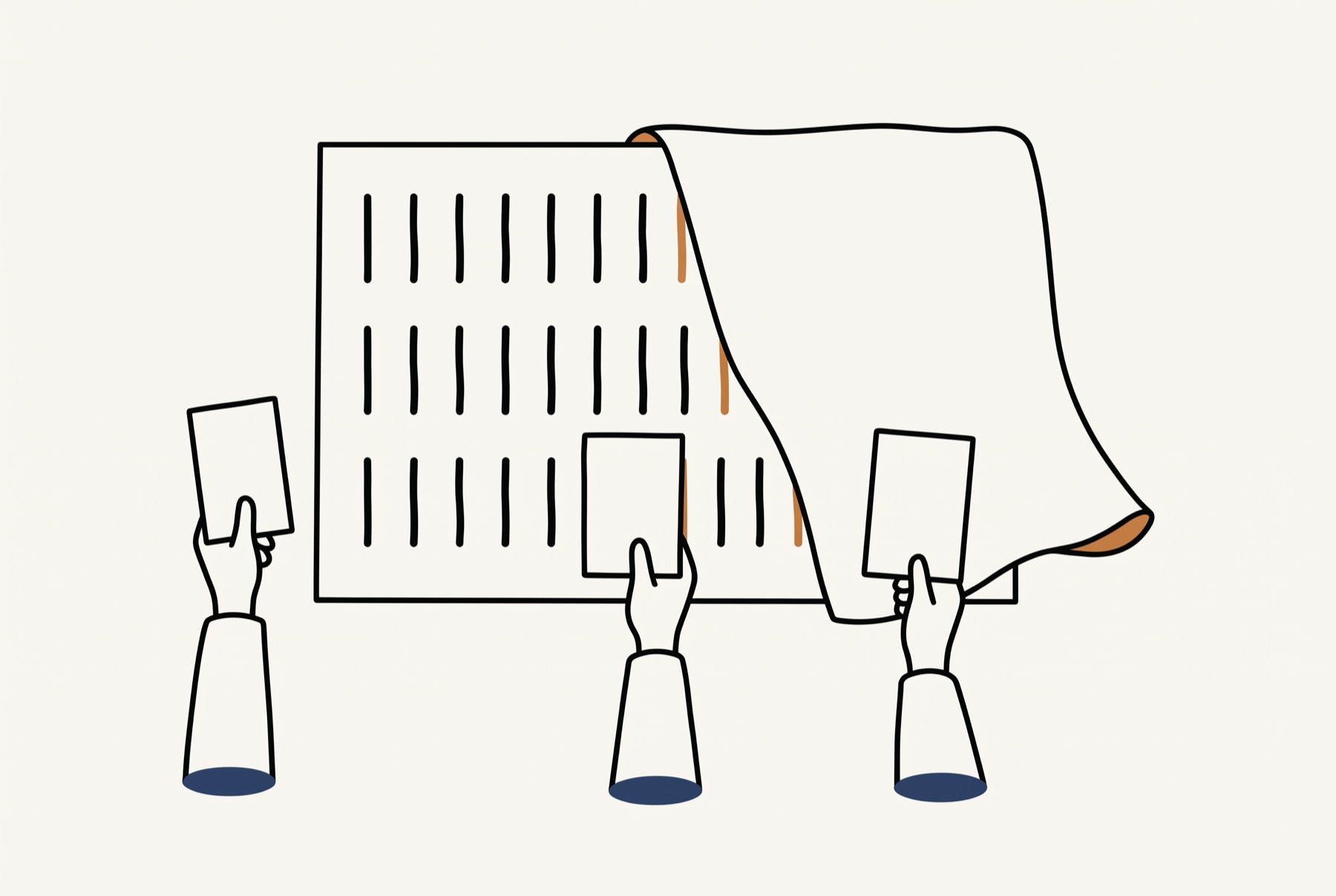
Hide the running tally. Muchnik, Aral and Taylor gave a single arbitrary up-vote to randomly chosen comments as they were posted on a news site. The experiment covered 101,281 comments over five months. That raised the chance that the first person to see one up-voted it by 32%, and the final mean ratings by 25%. Salganik, Dodds and Watts found the same shape with 14,341 participants in a music market: showing people what others had chosen made outcomes both more unequal and less predictable. A visible tally builds the room it claims to measure.
Watch the order. Krosnick and Alwin tested a theory of response-order effects on the 1984 General Social Survey and confirmed a primacy effect, strongest among respondents low in cognitive sophistication. Nothing in the published abstract says how those options were presented, so do not assume the effect survives a projector. Alternate which side goes first across a set of five and stop guessing.
Watch the wording, and test it if it matters. The framing result above is not a curiosity. If you suspect the split came from the words rather than the view, that is a different activity: split the room and give each half a different wording of the same choice. Decka calls that an A/B test, and the two halves get genuinely different wordings on their phones while the big screen shows neither.
Ask the smaller side first. Invite the minority to speak rather than naming somebody. Being outvoted and then called on by name is how you get a shrug. The Schulz-Hardt result says the value of a split is the discussion it causes, and the majority will speak whether you invite it or not.
Keep it to five. Five questions at twenty seconds each is under two minutes of voting, and both would-you-rather packs are five questions long. Reading the split out and taking one comment on each is what fills the rest, so budget ten minutes. A sixth question buys you more voting rather than more discussion, and the discussion is what the round is for.
Know where the split appears. In a group-paced This or That round, the presenter screen shows the question and then how many people answered. The end screen lists who took part. The option-by-option split is in the activity report afterwards, not on the wall during the round. If you want the bars filling live in front of the room, run the question as a live poll instead. They fill as the votes land, which is the herding in the first bullet. If you want everyone locked in before anybody sees anything, the This or That round already does that, for exactly the reason above. Reveal does the same job one step further out, holding every answer back until you turn the cards over. It takes typed answers rather than two options, so it is the instrument for the open question rather than for this one. If you want the number in the room without the herding, ask for hands once everybody has answered on their phone.
Do not interview people with them. Indeed's hiring guide recommends them because there are no right or wrong answers. So a candidate cannot answer the way they think you want. That holds in a room where nothing is riding on it. In an interview the candidate is guessing at what you want all the way through, and an invented dilemma is one more thing to guess about. Ask instead about a trade-off they made in a job they actually had.
When the split lands 90/10. Do not manufacture a debate that is not there. Name the number, ask the smaller side one question, and move on. A lopsided answer is still information. It means the room agrees about something you had assumed was contested.
Know when not to run it. Not in the week of a restructure. Not with anything that touches a real decision about somebody's pay, job or performance, for the reason Baron and Spranca describe. And not at the end of a meeting that went badly, where you risk collecting a comment on the meeting rather than an answer to the question.
When a question lands 60/40, say the number out loud and stop talking for a moment. The pause is what tells the person who thought they were the only one that four in ten of the room agree with them.
FAQ
Common questions
What are good would you rather questions for work?
The ones where both answers are defensible and the room splits near the middle. A four day week or a pay rise worth the same. Silence or background noise. Ship late and right or on time and broken. If you can predict the winning side before you ask, the question is not worth the twenty seconds.
Are would you rather questions appropriate for work?
Yes, with one boundary. Anything that touches a real decision about somebody's pay, job, performance or health is not a game. Baron and Spranca found anger at the thought of the trade, and denial that the trade was needed, travelling with resistance to trading the value at all. Keep the cost inside the question hypothetical.
How many would you rather questions should you ask in a meeting?
Five, at about twenty seconds each. That is under two minutes of voting, and closer to ten minutes once you have read the split out and taken one comment on each. Past five you are buying more voting rather than more discussion, and the discussion is the part worth the time.
What would you rather questions should you avoid at work?
Avoid anything with an obvious right answer, anything a person could be judged on later, and anything about a real decision that has already been made. Also avoid the version with a third option. Tversky and Shafir found people go looking for a further alternative exactly when the choice is hard, which is when you most want an answer.
How do you run would you rather with a hybrid team?
Everyone answers on their own phone at the same moment, including the people in the room. That way the remote half is not watching a show. Keep the running tally hidden until everyone has locked in, because Muchnik and colleagues showed that a visible score changes the votes that come after it.
What is a good would you rather question of the day for work?
A question of the day is answered without a facilitator, usually in a message thread, so it has to work with nobody holding the room. That rules out the hard-mode ones, which are worth nothing without the discussion afterwards. Always twenty minutes early or always ten minutes late is the one that keeps going, because the two camps do not understand each other. Every answer in a thread has a name on it, so expect the result to lean early.
What is the difference between would you rather and this or that?
Would you rather is the hypothetical version of a forced pair, and it usually puts a cost on both sides. This or that covers any forced pair at all, including plain preferences with nothing at stake. Coffee or tea is a this or that and not a would you rather. Most likely to is a different shape again: you nominate a person rather than pick an option.
Run this with your own team
Start free, no credit card. Your audience joins from their phones with a code — nothing to install.