Team building activities for work, for the room you already have
Forty activities grouped by the time you have, and four that come out weaker than they are sold
Forty people are in a room with one screen and an hour to fill. Nobody booked a ropes course, the minibus is not coming, and the budget for this is the room you are already standing in.
The number worth staring at is the quiet one. YouGov reported in January 2022 that among Britons who had been through a workplace team building exercise, 44% agreed their team could work together more effectively as a result. More of them, 50%, disagreed. The 60% who called the experience embarrassing or cringe-worthy came from the same survey.
Start from one of these
Each one opens in your dashboard, ready to run. You can change every word of it.
Split the room
The room splits itself from a single QR code: everybody is dealt onto eight teams, each team argues out its own name in private for ninety seconds, and the next forty minutes is a team game instead of one conversation with an audience of thirty-nine.
4 slides · 1 activity
Everyone draws at once
One prompt, sixty seconds, forty people drawing in the same moment — the one shape that still works at that size. The reveals do not scale the way the drawing does, so this deck tells you to stop after five rather than sit the room through forty.
4 slides · 1 activity
Debrief in silence
The twenty minutes after the activity, which is the part with the strongest evidence behind it and the first part everybody cuts. Two answers each, written before anyone speaks, nothing on screen until the presenter opens it, and a question about Tuesday rather than about whether it was fun.
4 slides · 1 activity
The first five minutes
The five minutes before anything starts, which decide how the rest lands. One word each on how the last month felt, so the plan is not built over the top of it, then two named options the room picks between. Describe the thing rather than announcing its genre.
5 slides · 2 activities
Does team building actually work
Team building has been measured, more than once, and the answer is narrower than either its sellers or its cynics want.
Salas, Rozell, Mullen and Driskell pooled the experiments in 1999 and reported no significant effect of team building on performance overall. On objective measures of performance the tendency ran slightly the wrong way, and it was not significant either. On subjective measures, where people rate their own team, there was a small positive effect. One component beat the others: interventions emphasising role clarification were more likely to raise performance than ones emphasising goal setting, problem solving or interpersonal relations.
Their last finding is the one this page is built on. The effects of team building decreased as the size of the team went up.
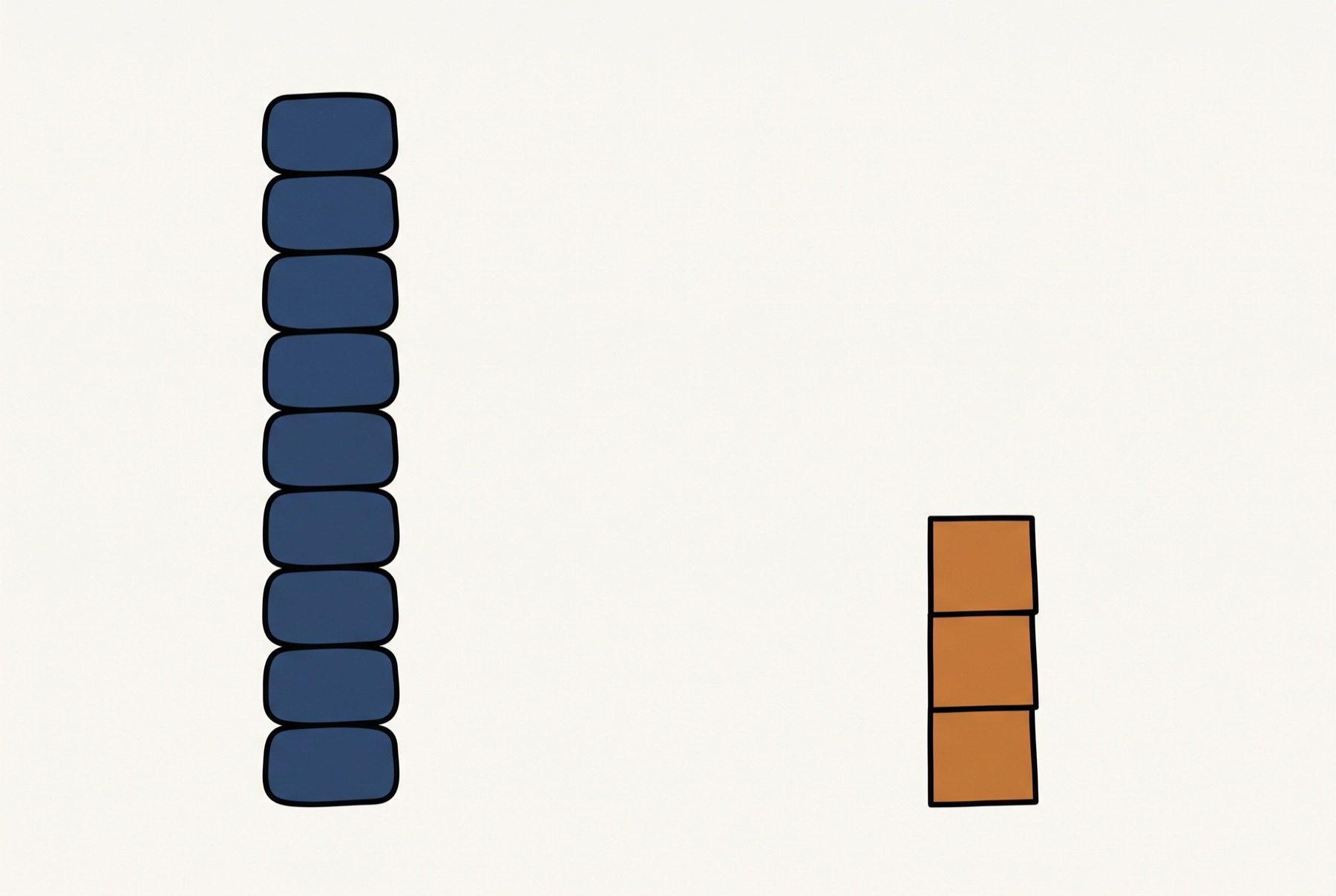
Klein and colleagues redid that analysis a decade later against a larger database, and their answer is friendlier. On 60 correlations, team building had a positive moderate effect across all team outcomes. Read which outcomes moved, though. Team building was most strongly related to affective and process outcomes, which is how people feel about the team and how the team goes about its work.
Then there is the training literature, which is a different animal and a more encouraging one. McEwan and colleagues meta-analysed 51 articles covering 72 interventions and 8,439 participants. Workshops moved teamwork at d = 0.50, simulation-based training at 0.78 and team reviews at 0.64. Sitting people down and lecturing them managed 0.19, which was not significant.
The condition attached to those numbers matters more than the numbers. Effects on teamwork showed up when two or more dimensions of teamwork were targeted, and fell to d = 0.05 when only one dimension was.
Put the three together and the summary is short. These sessions move how a team feels and how it works together. They move output least. And what works best looks like practice at the actual job, done in a group, with somebody reviewing it afterwards.
That is not a reason to cancel the hour. It is a reason to spend it differently.
What forty people in one room changes
Group size decides which of these activities are even possible.
Fay, Garrod and Carletta ran the same discussion task at two sizes and watched who influenced whom. In five-person groups the communication behaved like a dialogue, and people were influenced most by those they had actually talked to. In ten-person groups it behaved like a monologue, and people were influenced most by the dominant speaker. That is ten people. Not forty.
Mueller studied 212 knowledge workers in 26 teams ranging from 3 to 19 members and found that relational loss explained why individuals in bigger teams performed worse. Relational loss is the sense that support is less available to you as the team grows. That study is about standing work teams rather than about an afternoon, so do not stretch it into a law about parties.
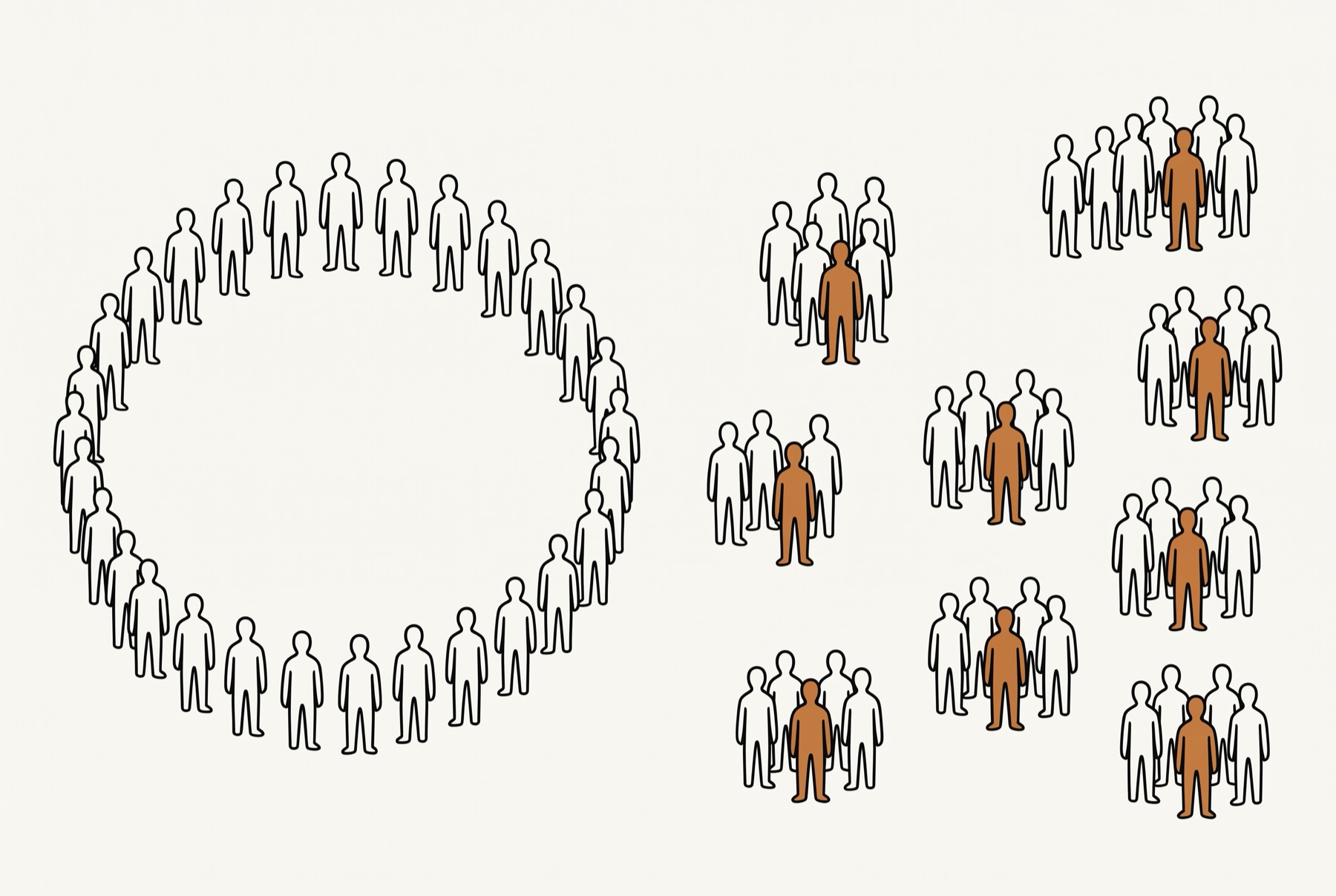
Google's own team research went the other way on size. Across 180 teams, 115 in engineering and 65 in sales, team size sat on the list of variables that were not significantly connected with team effectiveness, alongside sitting together, seniority and extroversion. Google's write-up adds the caveat that plenty of work elsewhere does find that size matters.
For one hour with forty people, the practical rule survives all of it. A single forty-person conversation is a performance with an audience of thirty-nine, and the dominant speaker is the one the rest end up following. One shape holds at that size, and it is everybody acting at once. Either the whole room does the same thing at the same moment, or it breaks into pairs, threes or teams of four to six that all act at the same moment.
Splitting the room is therefore step one of about half the activities below. The random team generator does it from a list of names. Team Naming does it from a QR code, for when the people are in front of you and the list is not.
How to spend the hour
The activity is the part everybody plans and the part that matters least. Here is where the sixty minutes should go.
Five minutes: say what is happening, and offer a choice. Describe the thing rather than announcing its genre. Then give the room two options and let it pick. Patall, Cooper and Robinson pooled 41 studies of what choice does, across child and adult samples, and found it raised intrinsic motivation, effort and task performance. Forty people can choose between two named things in the time it takes to count the hands, and the hour stops being something done to them. If you would rather not put it to a vote, the decision wheel picks one in a single spin, in front of everybody.
Twenty minutes: the activity. One activity, not three. Pick it from the lists below by the time you have and the number of people in the room.
Twenty minutes: the debrief, aimed at the real work. This is the part with the strongest evidence behind it and the part that gets cut first. Across 83 studies of the after-action review, Keiser and Arthur put its overall effect at d = 0.92, on 955 teams and 4,684 individuals. An hour of talking rarely buys a number that size.
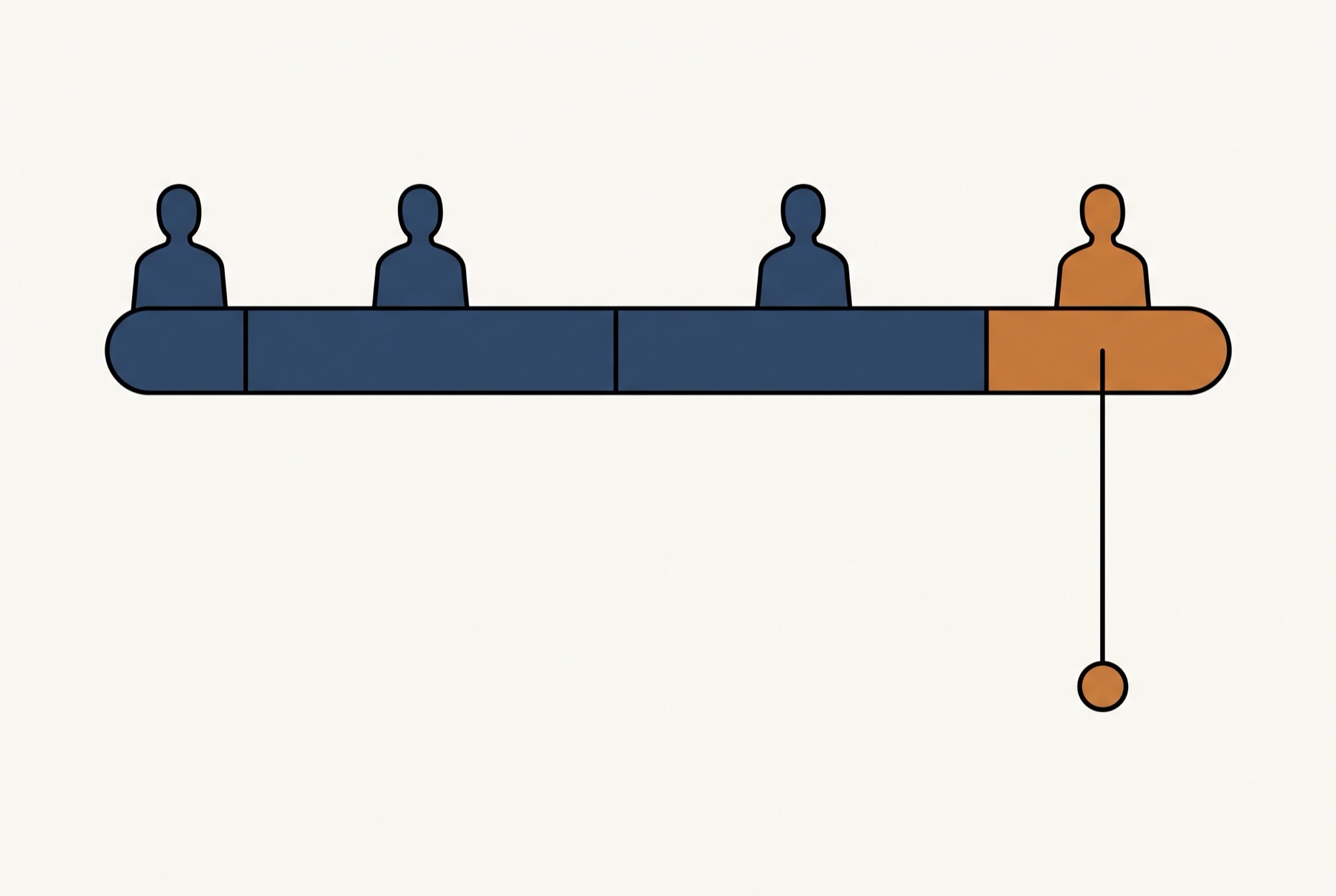
That number is narrower than it looks. An after-action review is a structured look back at one performance the team has just given, held against a record of what happened in it. So the debrief question is never "did everybody have fun". It is "what did we just do that we also do on Tuesdays, and what happened when we did it".
Fifteen minutes: one decision. Give it a name and a date. Kleingeld, van Mierlo and Arends put the effect of group goals on group performance at d = 0.56, and specific difficult goals at 0.80. A session that ends without a decision is a session nobody can point at in a month.
If your team is twelve people rather than forty, spend the hour on a charter instead. It is the least entertaining option on this page. Mathieu and Rapp followed 32 teams of MBA students through a business strategy simulation. The highest sustained performance came from the teams that were high on both charter quality and performance strategies. Students in a simulation are a limited sample, and this is still the closest thing to direct evidence that an hour of agreeing how you will work together pays for itself.
On the big screen
On their phone
Get ready!
Shooter
You throw, catch & pick up the ball
Each teammate controls a different part of the same player. Coordinate to move, throw, and catch.
Twelve team building activities that take five minutes
These are openers rather than sessions, and not one of them asks forty people to take a turn each, because a round-robin of forty people is not an activity. If what you want is the first two minutes of an ordinary meeting rather than a whole hour, icebreaker games and get to know you questions are the pages for that.
1. One word for the last month. Two minutes, any number of people, cards or a screen past about ten. Everyone gives one word for how the last month felt. Called out in any order round a table of eight, written on cards for twenty, typed into a word cloud for a hundred. What it is for: finding out what the room brought in with it before you spend an hour on a plan that ignores it. The same word coming back from several people is the finding, and it should change your plan.
2. Rock paper scissors evolution. Five minutes, fifteen to a hundred people, nothing but the room. Everyone pairs off and plays one round. The loser becomes the winner's supporter, follows them and cheers for them, and the winner finds a new opponent. Crowds build behind the survivors until two people play a final in front of a room split in half. What it is for: noise, movement and a clean finish, and it works better at sixty people than at fifteen.
3. Count to twenty. Five minutes, six to twenty people per group, nothing but the room. The group counts to twenty out loud, one voice at a time, with nobody assigned an order and nobody allowed to say two numbers in a row. Two voices at once and you go back to one. In a big room every table does it at the same time. What it is for: a coordination task where failure is audible and always takes two people, so no one person carries it.
4. The silent line-up. Four minutes, eight to forty people, nothing but the room. Line up in order of how long you have worked here, or how far you travelled this morning, without speaking. Then check the order without a queue: everybody compares with the person on each side of them at the same moment. Past twenty people, run two lines at once and check them separately, because one line of forty does not order itself in four minutes. What it is for: getting people out of their chairs and mixing the tables, which is worth doing before you split the room into teams.
5. Common ground in threes. Five minutes, any number, nothing but the room. In threes, find three things all three of you share, excluding work, clothing and the room you are sitting in. What it is for: giving the people who will not speak to forty a two-person audience instead. The rule that makes it work is the exclusions, because without them the three things are the office, the weather and the meeting they are sitting in.
6. Fist of five. One minute, any number, nothing but the room. Ask a question with a scale on it, such as how ready this project is to ship, and everyone answers on a count of three. A fist is zero and five fingers is full agreement, which is where the name comes from. Simultaneous is the whole design: nobody gets to see the manager's hand first. What it is for: finding the disagreement in a room too big to ask one voice at a time. Forty hands going up at once shows you the split before anybody has to defend a position.
7. Two truths and a lie, voted silently. Five minutes, four or five volunteers in front of any size of room, easier with a screen. Their statements go up and everybody votes at once instead of guessing out loud. That fixes the queue and leaves the flaw in place, because you are still the person who told the lie. Ask for volunteers the day before, because being asked to invent a lie on the spot is the part people dislike. It is better where people already know each other, because a room of strangers is guessing at random. The full case for and against is in two truths and a lie.
8. Would you rather, three rounds. Five minutes, any number, nothing but the room. Two options, everyone commits at the same moment by hand or by phone, then ask one person on each side for their reason. What it is for: an opinion with no wrong answer, which is the safest thing you can ask of a room that has not spoken yet. Question banks: would you rather questions for work.
9. This or that, rapid fire. Three minutes, any number, nothing but the room. Ten binary choices in three minutes, hands up for each, no discussion until the end. Shallower and faster than the round above, and the right pick when you have three minutes rather than five. Prompts: this or that questions.
10. A draw-and-guess round. Five minutes, eight people upwards, phones and a screen. Everyone draws the same prompt inside the same sixty seconds. Then the drawings come up one at a time with no name on them, and the room picks the artist from a short list. Guess the Doodler is this shape, and the drawing scales because it all happens in the same sixty seconds. The reveals do not, because they come one at a time, so the five minutes runs out long before forty drawings do. Prompts: the drawing prompt generator.
11. Stand up if. Three minutes, any number, nothing but the room. Read out statements and people stand if the answer is yes, with a raised hand doing the same job for anybody who would rather not stand. Open with one the whole room will answer yes to. End on one you expect two or three people to answer. What it is for: a poll the whole room can see, with no devices and no queue. Six statements is about three minutes once you count the standing and the sitting, and it shows a big group how much of itself it has in common.
12. Name the teams. Three minutes, any number, easier with a screen. Split the room, give each team ninety seconds to agree a name, then read them out. Team Naming deals people onto two to eight teams from a single QR code, and lets each team argue in private. Arguing in private is why the name comes from the team rather than from whoever shouted first. What it is for: making the next forty minutes a team game rather than a room of individuals.
Fourteen team building activities for half an hour
This is the block for a slot somebody has actually given you, rather than for the first five minutes of a meeting. Each entry gives its own running time, because half of them are longer than the twenty-minute slot in the middle of the hour, and two run to forty-five minutes.
13. A trivia round. Thirty minutes, teams of four to six, a screen. Six questions a round, three or four rounds, answers written down and swapped for marking. What it is for: an easy win with a low floor, and a format nobody has to be taught. Keep the questions off specialist ground, or one person answers for each team and everybody else watches. Questions: trivia questions. Live Quiz does the marking, with one limit worth knowing first: it scores individuals rather than teams. Give each team one phone and join under the team's name, or keep the marking on paper.
14. Charades. Twenty minutes, six to thirty people, nothing but the room. One person acts, their team guesses against a clock, and the clock is what stops it sagging. It is also the entry in this block most likely to expose somebody who hates performing, so ask for volunteers rather than picking people. Word lists: charades ideas and the charades generator, or run it as a Charades activity.
15. The marshmallow challenge. Twenty-five minutes, teams of four, materials needed. Twenty sticks of dry spaghetti, a metre of tape, a metre of string and one marshmallow. Tallest freestanding structure with the marshmallow on top after eighteen minutes wins. What it is for: watching a team plan confidently and then be wrong, which is a debrief you could not script. Somebody has to buy the spaghetti the day before.
16. Blind drawing pairs. Twenty minutes, even numbers, paper and pens. One person gets an abstract shape and describes it while their partner draws it, unseen, with no questions allowed. Then run it again with a second shape and questions allowed, because running the same shape twice measures memory rather than questions. What it is for: the gap between the two drawings. Each round is four minutes of work, and the two drawings side by side are the argument for asking questions in a handover.
17. Lost at sea. Thirty minutes, teams of five, printed sheets. Rank fifteen salvaged items alone, rank them again as a team, then compare both to the published expert ranking. What it is for: finding out whether the team's ranking beats the best individual ranking inside it, which is the question behind any meeting that turns several answers into one. Do not promise the room that it will. When the team loses to one of its own members, the question worth asking is which voice won the ranking.
18. Human bingo. Fifteen minutes, twenty to sixty people, printing needed. A grid of statements, and you need a different person's name in each square. It moves the whole room, and it dies instantly if the squares are generic, so write them about this company and this year. Cards: the bingo card generator.
19. Meeting Dodgeball. Fifteen to twenty minutes, from eight people to a packed all-hands, phones and a screen. Each team drives one character on a 2.5D court and the controls are split across that team's phones. One phone moves it left and right, another moves it up and down, a third throws, catches and picks the ball up, and a fourth jumps and ducks. Meeting Dodgeball is the entry on this page that most literally answers forty people and one screen, because the coordination is the control scheme rather than a metaphor for one. It is also loud, so check what is happening in the room next door.
20. Doodler Decoy. Twenty to thirty minutes, two to four teams, phones and a screen. One team's artist draws a word their own teammates have never seen. Every other team supplies a plausible decoy, and the artist's team has to pick the real word out of the list. Doodler Decoy gives the teams who are not drawing the better job, where a drawing game usually makes them the audience instead.
21. Speed meeting rounds. Twenty minutes, twelve to sixty people, a timer everybody can hear. Timed pairs, a new partner every round, one question per round, three minutes each. Twenty minutes is six partners once you count the handovers, so it makes a start rather than introducing the whole room. What it is for: the room where everybody knows four faces and needs to know more. Mingle Match pairs each person with somebody new each round and gives the pair a question, which removes the part where a facilitator counts heads and re-pairs the stragglers. Questions: icebreaker questions.
22. A tier list of something you all use. Twenty minutes, any number, a screen. Everyone ranks the same items into rows privately and at the same time, then the board goes up. Rank your own meetings, tools or rituals rather than films, and the argument afterwards is a real one. Tier List gives you the spread of placements alongside the average, so a divided room shows up as divided instead of as a middle row. More: tier list maker.
23. The team charter. Forty-five minutes if you are honest, any team up to about twelve, paper or a screen. Eight questions the whole team answers together, once: how we decide, how we disagree, what done means. The team charter template is the question set. This is the entry with the most direct evidence behind it and the least fun in it, and both of those facts are worth knowing before you pick it.
24. A pre-mortem. Thirty minutes, four to twenty people, paper or phones. Tell the room the project has already failed, twelve months from now, and have everyone write down why in silence before anyone speaks. Reveal all of it at once. What it is for: getting the objection out of the person who would otherwise have taken it home.
25. The silent stop-doing round. Twenty minutes, any number, phones or paper. Everyone writes two answers to one question, what should we stop doing, and nothing appears until the presenter turns the cards over. Reveal is built for that shape and takes up to three answers a person. Retrospective games carries the argument for the silence, and more formats built on it.
26. An escape room in a box. Forty-five minutes, teams of four, buy the kit. A boxed puzzle set that runs on a table with none of the travel, for the price of a takeaway. What it does not buy is the interdependence, because a box on a table is a thing two people can do while four watch. Hand the components out rather than letting one person hold the box, and expect the puzzles to be the weakest part of it.
Start from one of these
Each one opens in your dashboard, ready to run. You can change every word of it.
Split the room
The room splits itself from a single QR code: everybody is dealt onto eight teams, each team argues out its own name in private for ninety seconds, and the next forty minutes is a team game instead of one conversation with an audience of thirty-nine.
4 slides · 1 activity
Everyone draws at once
One prompt, sixty seconds, forty people drawing in the same moment — the one shape that still works at that size. The reveals do not scale the way the drawing does, so this deck tells you to stop after five rather than sit the room through forty.
4 slides · 1 activity
Debrief in silence
The twenty minutes after the activity, which is the part with the strongest evidence behind it and the first part everybody cuts. Two answers each, written before anyone speaks, nothing on screen until the presenter opens it, and a question about Tuesday rather than about whether it was fun.
4 slides · 1 activity
The first five minutes
The five minutes before anything starts, which decide how the rest lands. One word each on how the last month felt, so the plan is not built over the top of it, then two named options the room picks between. Describe the thing rather than announcing its genre.
5 slides · 2 activities
Seven team building activities for a whole afternoon
Half a day costs forty people half a day, which is the most expensive line in this article once you count the hours. Two of the seven have a reason beyond the day out. The hack day is practice at the real task with a review at the end, and the volunteering afternoon puts the team on work that is real. The rest are a nice afternoon, and a nice afternoon is allowed to be the reason as long as nobody pretends otherwise.
27. A real escape room. Two to three hours with travel, teams of four to six. A booked room, a locked door, a chain of puzzles and a clock you can watch running down. What it is for: work that has to be divided up, under a deadline the team did not set and cannot move. Two or three people will still end up driving it, and in a group that size it is visible to everybody. Read the section below before you book one, because the evidence is thinner than the marketing.
28. A cooking session. Three hours. Teams cook courses and then everybody eats what they made. What it is for: the eating, which is the only part that reliably works. Ask about dietary requirements in advance, and expect one person who hates being watched while they cook.
29. A volunteering afternoon. Half a day. Real work for an outside beneficiary, in teams, with an actual finish line. What it is for: the only afternoon here whose output belongs to somebody outside the company. Check the charity genuinely wants forty untrained people for four hours, because not every charity has work for that many, and the ones that do not may not say so.
30. A hack day. Four hours at the least, a full day if you can get it. Teams pick a real problem, build something by the deadline and demo it to the room. What it is for: practice at the actual task, in a group, with a review at the end. That is the shape McEwan's simulation and team-review numbers favour. Only the volunteering afternoon comes close, and it has no review at the end.
31. A sports afternoon. Three hours. Rounders, five-a-side, an obstacle course. Physical, exclusive, and worth being honest about: some people cannot take part, and they will not always tell you why. Invent a refereeing or scoring job that is a real job rather than a consolation.
32. A city scavenger hunt. Two to three hours, teams of four to six, phones. A list of photographs to take inside a fixed area, with a hard deadline and a meeting point. Cheap, scales past a hundred people, and entirely at the mercy of the weather.
33. An improv workshop. Two hours, twelve to thirty people, a paid facilitator. Structured games about listening and accepting what you are given. Much better than its reputation when a professional runs it, and miserable for anybody who hates performing when a manager runs it off a blog post.
Seven team building activities for remote teams
Remote changes three things. Everybody is already on their own device, so parallel input costs nothing and nobody has to hand anything out. The camera itself has a cost. Shockley and colleagues ran a four-week field experiment, 1,408 daily observations from 103 employees. Camera use raised daily fatigue, and fatigue in turn related negatively to voice and engagement in the meeting. The effects were larger for women and for newer employees. So "cameras on for team building" is a cost, not a rule.
The third is trust, which does more work at a distance. Breuer, Hüffmeier and Hertel meta-analysed 52 studies covering 12,615 individuals in 1,850 teams. The link between team trust and team performance was stronger in virtual teams than in face-to-face ones. In the same analysis, documenting team interactions weakened that dependence. Writing things down is a substitute for trust you have not built yet, which is the least romantic team building advice on this page and possibly the best.
34. A quiz on the call. Twenty minutes, a screen and breakout rooms. Read every question first, then send the teams out once to answer all of them, because bouncing in and out of breakouts each round eats the twenty minutes. The teams are what make it work. Run individually, a remote quiz is a spreadsheet with a host.
35. The five-minute object hunt. Five minutes. Name a category, everyone has ninety seconds to fetch something from wherever they are, and then all of them go up at once. What it is for: the only entry in this list that gets everybody out of their chair. The reveal is one gallery of small pictures rather than forty turns. It does need cameras on, which the study above says is not free.
36. Random coffee pairings. Fifteen minutes a fortnight, running quietly in the background. A rota that pairs two people who do not work together for a call with no agenda. What it is for: exactly the thing an offsite is trying to buy, delivered in instalments and at almost no cost.
37. Show us the thing. Ten minutes a week. Two people bring one object, one photograph or one thing they made, and get four minutes each. What it is for: the rotation. Two named people a week means the slot has an owner, which is the part that usually goes missing by week four.
38. An online escape room. Ninety minutes, teams of four to six. The same caveats as the physical version, plus one genuine gain. Everybody is remote, so nobody is playing a downgraded copy of a game the office is enjoying in person.
39. A map-guessing round. Fifteen minutes. Drop the group into a street view somewhere and collect guesses on the country, then the city. What it is for: a game where being wrong out loud is the fun, which is rarer than it sounds and useful for a team that is careful with each other.
40. The team playlist. Twenty minutes for a team of about eight, plus five minutes of homework. Everyone sends you three songs privately, then you play thirty seconds of each and the room guesses who sent it. Collect them yourself rather than opening a shared playlist, because a shared playlist shows who added each track. What it is for: a guessing game about colleagues that nobody has to perform in. It is the same mechanism as the drawing round.
What to think twice about, and what to stop saying
Four of the things below come out weaker when you check them than when somebody sells them to you. The last two are a story to stop repeating and a format that is probably already in your calendar.
Escape rooms are less proven than they are sold as. The one review we could find of escape rooms as teamwork training covers acute care professionals rather than offices. Of the fourteen studies it found, twelve measured an effect on teamwork, and nine of those twelve measured reaction, which means whether the participants liked it. Two measured learning, and one measured both. The reviewers concluded there is insufficient evidence about which design features change the outcome at all. Escape rooms are a good afternoon. Sold as a teamwork intervention, they are ahead of their evidence.
Trust falls sit in the branch with nothing under it. In the 1999 meta-analysis, interpersonal relations was one of three components no more likely to raise or lower performance. The other two were goal setting and problem solving. Role clarification was the branch that worked. The branch with the evidence is the one about who decides what, and the branch without it is the one that is fun to sell.
Fun that reads as managed does nothing for turnover. Tews, Jolly and Stafford looked at turnover among 491 hourly associates across 141 stores of a US retailer. Where employees saw the fun as less managed, the activities went with lower staff turnover. Where they saw it as managed, the same activities had no effect on turnover at all, and socialising with colleagues went with higher turnover. The tax is on the framing rather than on the activity.
A leaderboard is not the mechanism you think it is. Murayama and Elliot's first meta-analysis found no noteworthy relation between competition and performance. The direct effect cancels out through two opposing routes, one that raises performance and one that undermines it. And Kleingeld and colleagues found that individual goals aimed at maximising individual performance had a strongly negative effect on group performance in interdependent groups, at d = -1.75 across six effect sizes. Keep scores at the team level. An individual leaderboard inside a team exercise is pointed at the wrong unit.
One more, without a citation because there is not one. The marshmallow challenge is almost always sold with a line about kindergarten children beating business school graduates. We went looking for that comparison in a peer-reviewed source and did not find it, so treat it as a good story from a conference talk rather than a result. The exercise is still worth twenty-five minutes.
One format is missing from all four lists, because it is the default rather than a choice: going round the table, one person at a time, with everyone's name attached. That is a queue, and ice breakers that aren't cringe is the long argument about why it costs so much.
How to run it, and what to do when it lands flat
The decisions below are the ones a room notices. The last three are what to do when the hour has already gone wrong.
Never say the words team building. Acas polled 1,052 British employees in January 2025 and found 31% disliking work team-building activities, against 20% for after-hours drinks. The phrase files the next hour under a genre before anybody has heard what is in it. Say what is going to happen instead: we are going to spend twenty minutes on this thing, then twenty on what it tells us about the way we work.
Everyone plays, including you. Exempting the senior people rebuilds the audience of thirty-nine the whole design exists to remove. It also tells forty people which half of the room this hour is for.
Ignore the ten-minute attention rule. You will be told to keep every block under ten minutes because attention collapses after that. Wilson and Korn reviewed the studies behind that estimate and found little support for the belief that attention declines after ten to fifteen minutes. Most of the studies had not accounted for individual differences. Run a twenty-minute block if the activity needs twenty minutes.
One device per person, including the people sitting in the same room. That is the hybrid rule and it is the one people get wrong. Six people around a laptop in a meeting room and four people at home is two different sessions. Everybody on their own phone is one session, and the remote half stops being an audience.
Aim at psychological safety, not at fun. Edmondson studied 51 work teams. A team's belief that it was safe for interpersonal risk taking reached performance through what the team then did: ask questions, admit mistakes, raise a problem early. In the same Google study, psychological safety came first in order of importance of the five dynamics it identified. An hour cannot make forty people like each other. It can move whether the next difficult sentence in this team feels sayable.
When not to run one at all. A live incident outranks the hour, so run the incident. In the week of redundancies, do not: forty people working out who is still going to be here will spend your twenty minutes doing exactly that. And when what the team needs is a decision nobody in the room is allowed to make, no activity reaches it. Name the decision and who owns it. That is a better hour than any game on this page.
When it lands flat. Forty people who have stopped playing are watching to see what you do about it, so do the next thing rather than explaining the last one. Cut the activity where it is and go to the debrief question early, because a round that went badly is still a performance the team can review.
When one team dominates. Say so out loud, then change the unit. Score the round at the table rather than the room, or reshuffle the teams for the second round. A game that one team has already won is a game the other seven have stopped playing.
When somebody refuses. Give them a real job rather than an exemption: timekeeper, scorer, the person who reads the questions out. A role is participation, and it includes the person who cannot take part without making them the subject of the room's attention for thirty seconds.
FAQ
Common questions
What are good team building activities for work?
The best one for a room that is already assembled is a short task everybody does at the same moment, followed by a debrief about the real work. A drawing-and-guessing round, a team dodgeball match, a trivia round in teams of four, or a silent round on what the team should stop doing. Avoid anything that goes round the table one person at a time.
Do team building activities actually work?
Partly, and less than they are sold as. Salas and colleagues pooled the experiments in 1999 and found no significant effect of team building on performance overall, with role clarification the one component more likely to raise it. Klein and colleagues later found a moderate positive effect that was strongest on how people feel about the team and how the team works together. What moves output is closer to practice at the job than to a party.
How long should a team building activity take?
Twenty minutes of activity inside a sixty-minute session. Five minutes to explain it and offer a choice, twenty on the activity, and twenty on what it says about the way the team works. Then fifteen minutes to agree one change with a name and a date on it. The debrief is the part with the strongest evidence behind it and the part most people cut.
What team building activities work for large groups?
Anything where everyone acts at the same moment, whether that is the whole room together or in pairs, threes and teams of four to six. Rock paper scissors evolution, a drawing round on phones, human bingo, and team quizzes all hold at forty people or more. A single forty-person conversation does not, because Fay and colleagues found that ten-person groups already follow whoever talks most.
What are good team building activities for remote teams?
A quiz with breakout rooms for the answers, a five-minute object hunt, or a silent round where nothing appears until the host turns the cards over. Guessing who sent which song works too, if you collect the songs yourself rather than sharing a playlist. Recurring random coffee pairings do the same job in instalments, and they keep working between sessions. Make cameras optional: Shockley and colleagues found camera use raised daily fatigue, which related negatively to speaking up.
What team building activities should you avoid at work?
Anything that puts one person in front of the room without asking them first, anything physical that quietly excludes people, and anything sold as mandatory fun. Tews and colleagues found workplace fun activities went with lower turnover where employees saw the fun as less managed, and no effect at all where they saw it as managed. Individual leaderboards inside a team exercise are pointed at the wrong unit.
What is a quick team building activity for a meeting?
Fist of five on a real question, one word each for how the month felt, or common ground in threes. All three take five minutes or less, need nothing but the room, and have everybody answering at once rather than in turn. If you have less time than that, skip the activity and start the meeting.
Run this with your own team
Start free, no credit card. Your audience joins from their phones with a code — nothing to install.