Exit tickets that change what you teach next
Three minutes at the door, and a question worth reading
· Updated
An exit ticket is a short question a class answers in the last few minutes of a lesson, on the way out. It costs three minutes. It is worth those three minutes only if tomorrow changes, and tomorrow was usually planned last week.
Start from one of these
Each one opens in your dashboard, ready to run. You can change every word of it.
The muddiest point, live
One open question in the last three minutes: which part of today was least clear? Answers arrive as a list the teacher reads from the front while the class packs up.
4 slides · 1 activity
Confidence beside evidence
The class answers in one sentence, then rates how sure they are on a one-to-five scale. The pair separates right-and-unsure from wrong-and-certain before anyone leaves.
5 slides · 2 activities
The one-word check
Each student types the one word from today they could not explain to a friend. The repeated words grow into a cloud the whole room watches build.
4 slides · 1 activity
Tomorrow's opening question
Collects one named question per student for the start of the next lesson, as cards that stay face down until the teacher turns them. Tomorrow opens on whatever the class asked.
4 slides · 1 activity
What an exit ticket actually is
A slip of paper, a sticky note, a form, a poll. The medium is the least interesting part of it. What fixes the format is the position: one question, the last three minutes, and an answer nobody has to mark.
Black and Wiliam's 2009 paper names the format outright. It lists students' own summaries made at the end of a lesson and calls them exit passes. They are an asynchronous moment of contingency: evidence gathered now, used to plan a lesson later.
The same paper sets the condition every exit ticket lives under. Practice is formative to the extent that evidence about student achievement is elicited, interpreted, and used to make decisions about the next steps in instruction. The other thirty-one checks that meet that test, and the long argument about whether any of it moves results, sit on the formative assessment examples page.
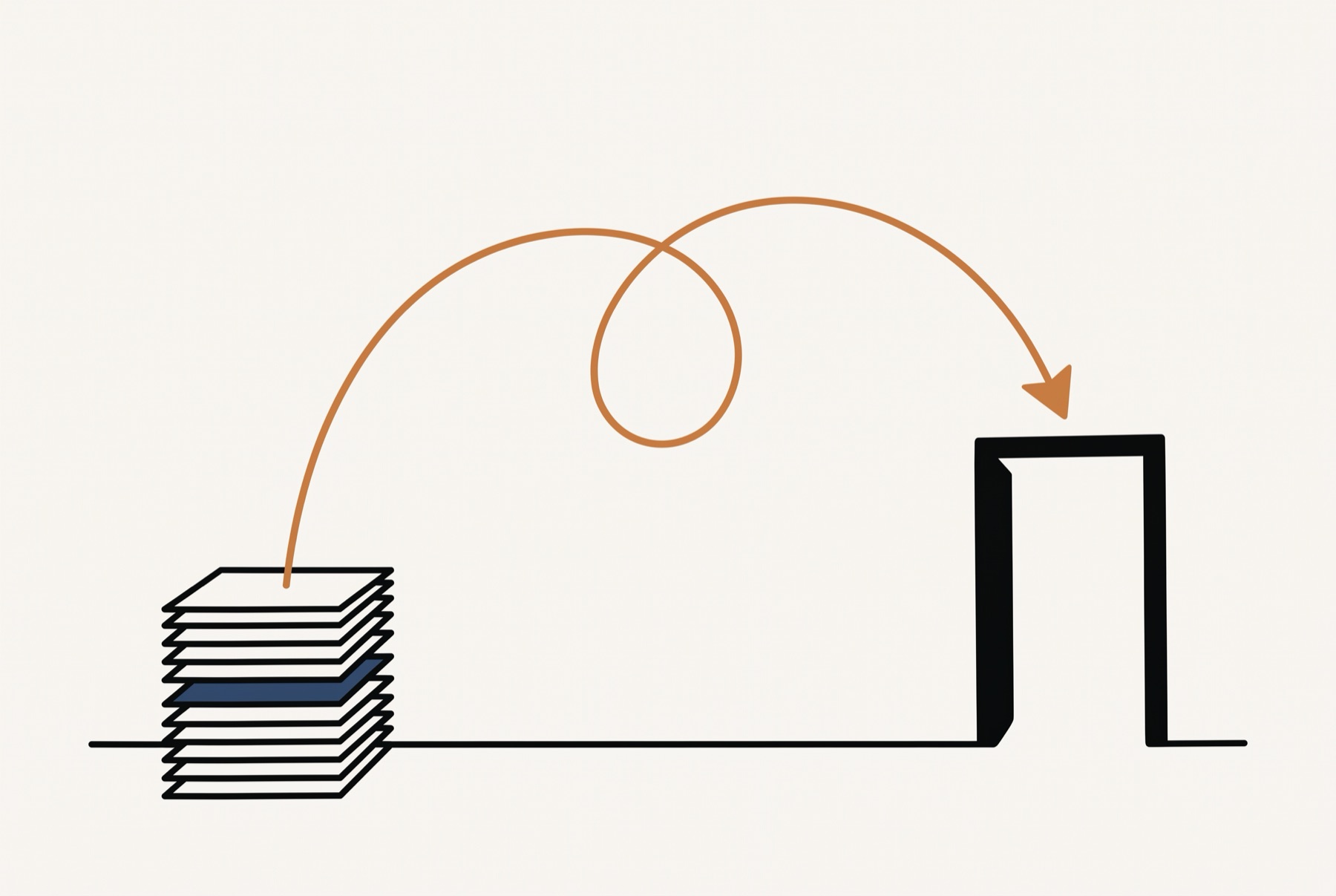
So the test of an exit ticket is not whether the class filled it in. The test is whether anything about Tuesday differed because of Monday. If nothing did, you collected thirty pieces of paper and taught the lesson you were always going to teach.
Why a question beats a recap at the end of a lesson
The instinct at the end of a lesson is to say the three main points again, slowly, so they sink in. Rereading is among the most common study strategies and one of the weakest.
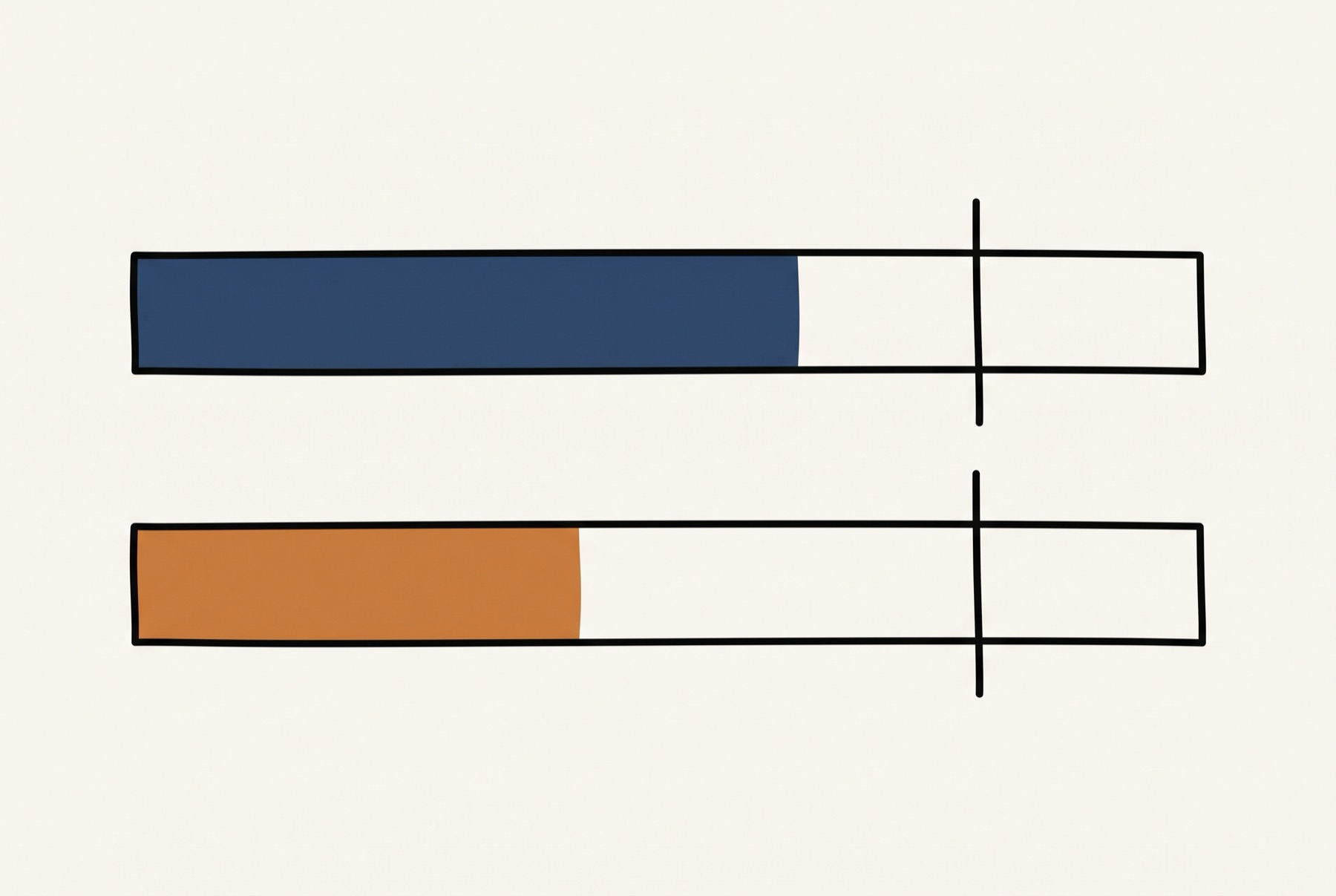
Roediger and Karpicke had students read a prose passage, then either study it three more times or take three recall tests on it with no feedback at all. Five minutes later the re-readers were ahead. A week later the tested group recalled 61% of the passage against 40% for the group who had only studied. The students who reread were also the ones most confident they would remember it.
Karpicke and Blunt ran the same contest against a more respectable rival, concept mapping. Retrieval practice beat it by one and a half standard deviations on a short-answer test a week later. Students predicted the opposite result.
That result survives outside the lab. Yang and colleagues pooled 222 classroom studies covering 48,478 students and put the effect of regular quizzing on achievement at g = 0.499. Dunlosky and colleagues reviewed ten common study techniques for Psychological Science in the Public Interest. Practice testing and spacing study out over time were rated high utility. Rereading was rated surprisingly low.
None of this is an argument for testing more. It is an argument for ending on a question instead of a summary, which costs the same minutes and leaves you holding an answer.
Stop asking the class whether they understood
Hands up if you got it. Thumbs up, thumbs down. A row of faces at the bottom of the slip to circle. Each of these asks a student to rate their own understanding, and a self-rating is a poor guide to what somebody knows.
Stowell and Nelson gave four groups of undergraduates the same 30-minute psychology lecture in a simulated class. Review answers came by hand-raising, by paper response cards, by clicker, or not at all. Participation ran at 76% for hands, 97% for cards and 100% for clickers. The accuracy is the interesting part. The hand-raisers got 98% of the in-class review questions right and then scored 60% on the quiz afterwards. The clicker group got 82% right in the room and scored the same 60%. Quiz scores did not separate the four groups at all, so what moved was the room's account of itself rather than what it had learned.
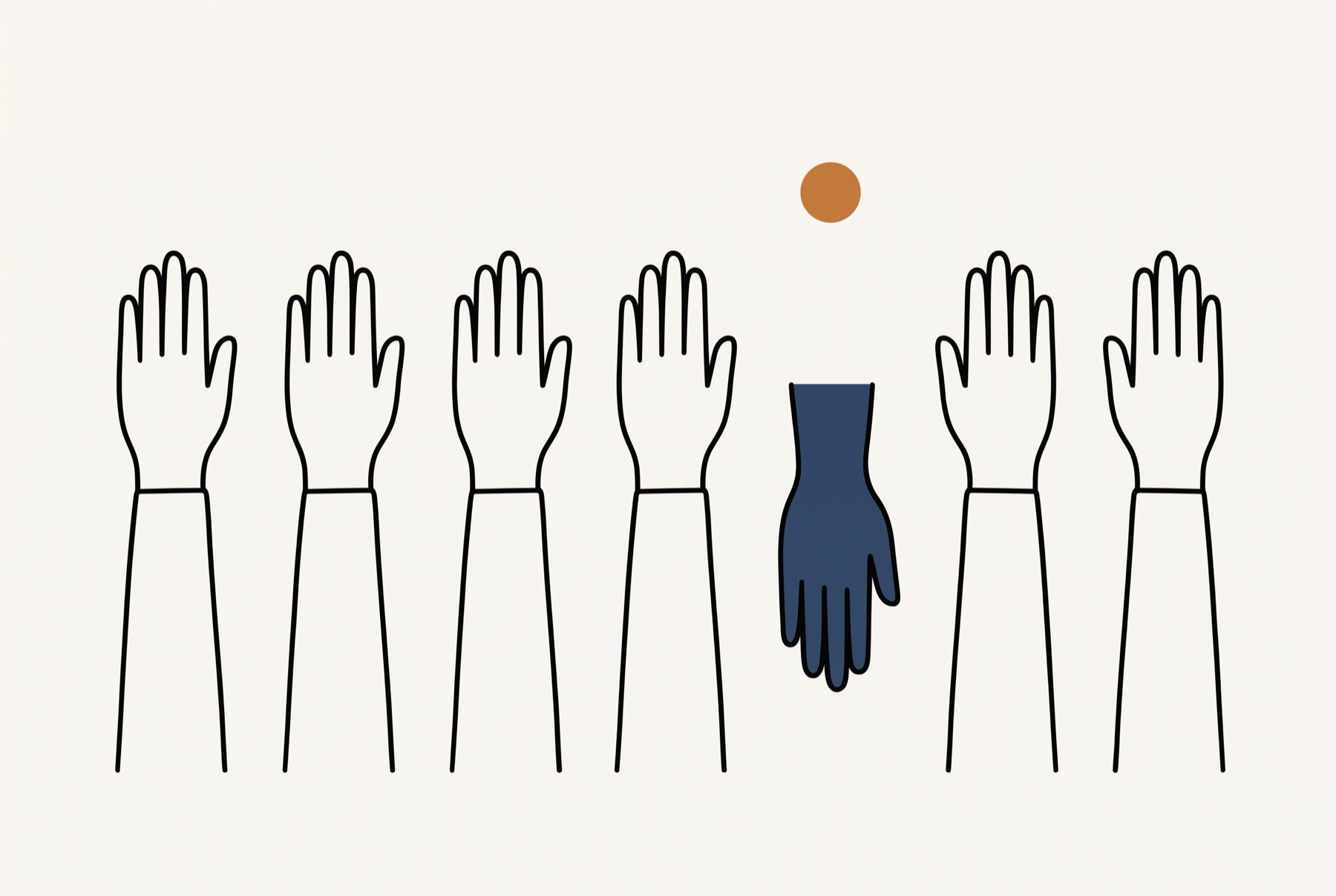
Putting a hand up in front of a room is a performance, and rooms perform competence. An anonymous answer is the version of the question that reports what is actually there, which is the thing you need in order to plan.
The same warning covers the student's own estimate of how they did. In Roediger and Karpicke's experiment, the group that learned least was the group most sure it would remember. In Karpicke and Blunt's, students ranked the winning strategy last. Confidence is worth collecting and it is not a measure of understanding.
So ask something with an answer. One question, tied to the one thing the lesson existed for, with a response you can count from the front of the room.
Never put a mark on an exit ticket
Butler and Nisan gave 261 sixth-graders a similar pair of tasks at each of three sessions over two days. After the first two rounds, one group got written comments on their work, one got a numerical grade, and one got nothing back. On the creative task the comments group's score rose from 24.9 to 32.6. The graded group's fell from 25.0 to 17.1, no better than the group given nothing back at all.
A grade is information about you. A comment is information about the work. Kluger and DeNisi's meta-analysis pooled 607 effect sizes across 23,663 observations of feedback on everything from memory tasks to attendance behaviour, not on classroom marking. Feedback helped on average, at d = 0.41, and over 38% of the effects were negative. Their account of why is that a feedback intervention loses power as attention moves up towards the self and away from the task. The example they give of feedback that points at the self is a classroom grade.
An exit ticket has no business in the mark book. Take it in complete or not at all. A class that knows the ticket is graded has a reason to hide what it does not know. You will have paid three minutes for a worse measurement than the free one.
Low-stakes practice is also easier on the room. Agarwal and colleagues surveyed 1,408 middle and high school students who had been through a programme of classroom retrieval practice. 72% said it made them less nervous for unit tests and exams, and 6% said it made them more nervous.
One caution belongs beside that. A ticket nobody ever refers to teaches its own lesson, and a class works out quickly that it does not matter. Ungraded is not the same as unread.
Five exit ticket formats, and what each one is for
Marzano sorts exit slip prompts into four kinds in Educational Leadership. One kind obtains information about students' current levels of understanding. The others ask students to weigh their own effort and strategies, ask about the teaching, or invite an open message to the teacher. Mixing all four into one slip costs you the answer, because the pile that comes back cannot be sorted.
Pick one job per ticket.
One question with a right answer. The best default. Take the single thing the lesson existed to teach, write a question only somebody who learned it can answer, and count the responses. Two minutes, no marking, and a number that points at a decision.
Three, two, one. Three things you learned, two questions you still have, one thing you would tell a friend. It is the best-known format here and the weakest daily diagnostic. Asking for three things invites the last three things said. Asking for two questions asks a class to name what it does not know, which is the job you were trying to do for them. Keep it for the end of a unit, where breadth is the point.
The muddiest point. One line, asking which part of today was least clear. Angelo and Cross put it in their handbook as an adaptation of the one-minute paper, which asks two questions where this asks one. Stead's review of the one-minute paper found that lecturers and students both like it, and that response rates decline quickly when it runs lecture after lecture.
Confidence beside evidence. Ask the question, then ask how sure they are about their answer. That is still one job, because the rating attaches to the answer rather than standing on its own. The pair is worth more than either half alone, because a class that is right and unsure needs a different Tuesday from a class that is wrong and certain.
The one that sets tomorrow's opening. Ask for one question they want answered at the start of the next lesson. What comes back is not a measurement. It is the first item on tomorrow's agenda, written by the class.
On the big screen
SLD.FUN/OFFSITE
Where should we host the Q3 offsite?
Exit ticket questions by purpose and subject
Pick one. Two questions is a survey, and a survey is harder to read than a check. A confidence rating is the exception, because it rides on an answer rather than asking for a second one. Every question below fits the three minutes at the door, and none of them needs marking.
Check the one thing
- Write the sentence you would use to explain today's idea to someone who missed the lesson.
- Here is a statement about today's idea. Say whether it is true, and how you know.
- In one line, what was this lesson actually about?
- Give one example of today's idea that we did not use in class.
- Name the step you would take first if you met this problem tomorrow.
Find the confusion
- Which part of today was least clear?
- Where did you get stuck, and what were you trying to do at that moment?
- Which word from today could you not explain to a friend?
- What would you ask if nobody could see who was asking?
- Which part of today feels like it should make sense and does not yet?
Make them use it
- Solve the problem on the board and show your first line only.
- Here is a wrong answer. Find the mistake and say what the person was thinking.
- Write a question on today's topic that you think would be hard.
- Predict what happens if we change one condition in today's example.
- Where outside this room would today's idea show up?
Ask about the teaching
- What is one thing I could do to make tomorrow easier to follow?
- Which helped most today: the explanation, the example, or the practice?
- Which part of today did I go through too fast?
- What should I go over again first thing tomorrow?
- If you could rerun ten minutes of today, which ten?
Maths
- Estimate the answer to this one, and say how you got the estimate.
- Here is an answer with a mistake in the second line. What was the student thinking?
- Explain in words why today's method works.
- Which of these four problems would you not know how to start?
- Write a problem whose answer is twelve, using today's method.
- When would today's method be the wrong one to reach for?
- What is the difference between the two methods we compared?
English and reading
- Quote the line that carries the most weight, and say why it does.
- What does the narrator want, and how do you know?
- Rewrite today's opening sentence so it does the opposite job.
- Which word in today's text did you have to guess from context?
- What is the strongest objection to the argument we read?
- Summarise the chapter in one sentence, using no adjectives.
Science
- State today's idea as a prediction somebody could test.
- What would you expect to see if the opposite were true?
- Name one variable we held steady today and say why that mattered.
- What is the difference between the everyday meaning and the scientific meaning of today's key word?
- Which part of the experiment would you change if you ran it again?
- Write today's process as three steps in the right order.
History and social studies
- Give one piece of evidence for today's claim and one against it.
- Whose account is missing from the sources we read?
- Which of today's causes would you rank first, and why?
- What changed for an ordinary person as a result?
- Write the headline for what we studied today.
- What would you need to know before you could be sure?
Languages
- Write one sentence about your own weekend using today's structure.
- Which of today's new words can you not yet use in a sentence?
- Translate this sentence and underline the part you guessed.
- Which sound from today does your mouth still refuse to make?
- Which habit from your first language made today's sentence come out wrong?
Computing
- Explain in one line what this loop does.
- Here is a program that runs and gives the wrong answer. Where would you look first?
- Write the smallest input that would show today's bug.
- What does the computer do between the third line and the fourth?
- Which part of today's code could you not write again from memory?
Art, music and PE
- What did you change between your first attempt and your last?
- Which part of the technique still feels wrong when you do it?
- Name a decision you made today that you could defend.
- What would you practise for ten minutes before the next lesson?
- Describe today's piece to somebody who cannot hear it.
Primary and early years
- Draw the thing we learned about and label one part of your drawing.
- Answer this one, then show me with your fingers how sure you are.
- What can you do now that you could not do yesterday?
- Tell me one new word you heard today.
- Which bit was tricky?
Training rooms and lectures
- What will you do differently on Monday because of this session?
- Which claim from today would your team argue with?
- What did you already know, and what was new?
- Write the question you would have asked if there had been time.
- What is the first thing you will forget without a note?
Start from one of these
Each one opens in your dashboard, ready to run. You can change every word of it.
The muddiest point, live
One open question in the last three minutes: which part of today was least clear? Answers arrive as a list the teacher reads from the front while the class packs up.
4 slides · 1 activity
Confidence beside evidence
The class answers in one sentence, then rates how sure they are on a one-to-five scale. The pair separates right-and-unsure from wrong-and-certain before anyone leaves.
5 slides · 2 activities
The one-word check
Each student types the one word from today they could not explain to a friend. The repeated words grow into a cloud the whole room watches build.
4 slides · 1 activity
Tomorrow's opening question
Collects one named question per student for the start of the next lesson, as cards that stay face down until the teacher turns them. Tomorrow opens on whatever the class asked.
4 slides · 1 activity
What to do with the answers in ten minutes
Sort into three piles and stop. Got it. Half got it. Did not get it. You are counting rather than marking, and the count is the plan.
If nearly everything lands in the first pile, say so out loud tomorrow and move on. If the middle pile is the biggest, reteach the single step they tripped on, in five minutes, at the start of the lesson. If the third pile is the biggest, the lesson did not work, and individual feedback will not repair a whole-class miss.
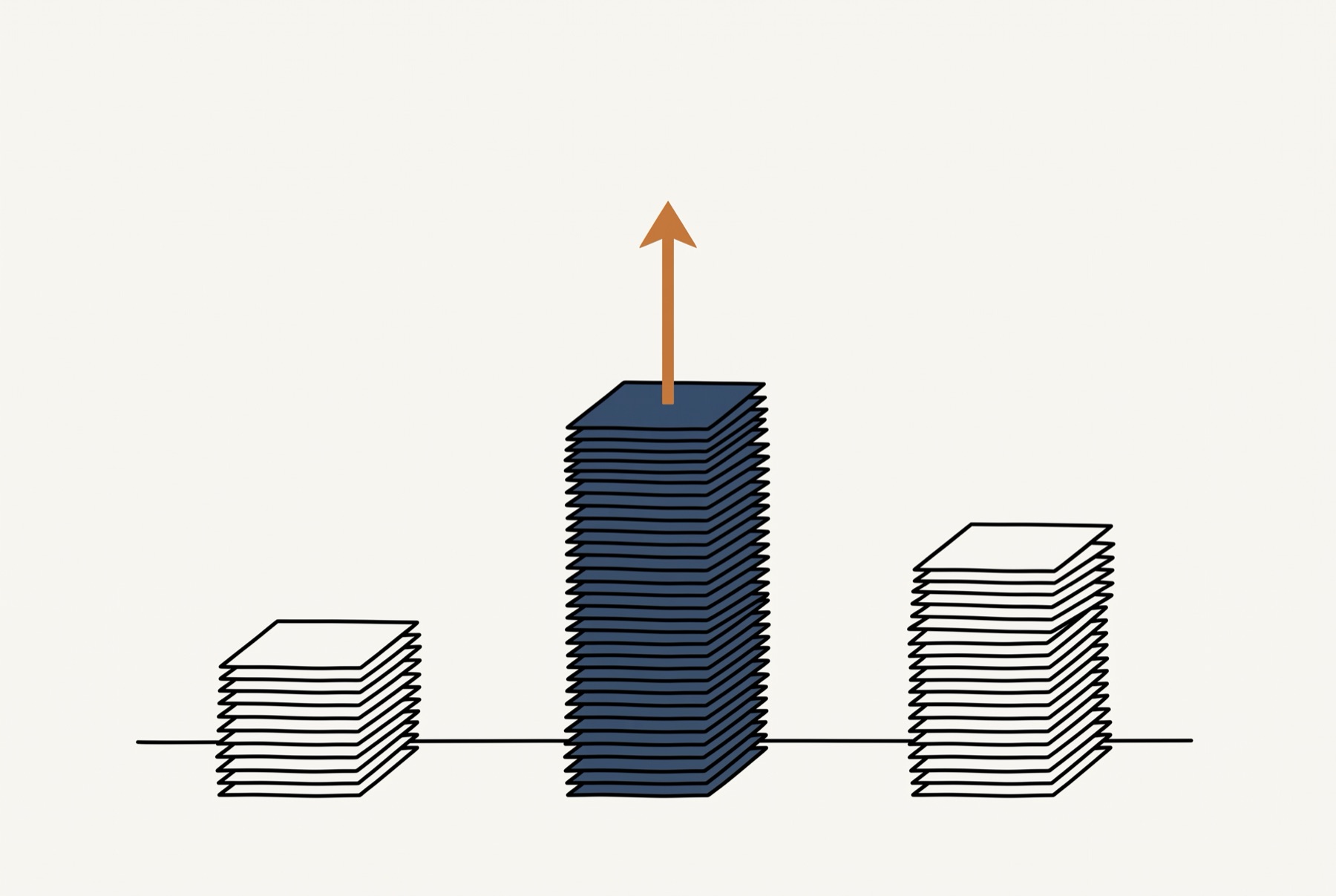
Naming the pattern to the class costs nothing, and it is how they learn the ticket was read.
There is a workload argument here and it points the same way. Full-time teachers in England reported working 51.2 hours in a term-time week in the Department for Education's 2024 survey, on a base of 6,472 full-time teachers. A routine that adds an evening of marking has to come out of that week, and there is nothing in it to give. Three piles and ten minutes fits.
Running one without collecting paper
Paper has two advantages that matter: you know whose is whose, and it needs nothing switched on. The rest is friction. It has to be printed, handed out, collected, carried home and read, and then it lives in a bag.
A live version takes the pile out of your bag. The answers arrive as counts you can read from the front of the room while the class packs up. Live Polls is the closest match to a one-question ticket: single choice for the check with a right answer, open text for the thing they would still ask. The formative assessment examples page runs through the other activities and which check each one suits.
Word Clouds suit the one-word check. Live Reactions asks how sure they are, as thumbs or faces or a one-to-five scale, with a free-text box you can turn on beside it. Both come back unattributed, so neither can hand you the child you were about to go and find.
An open-text poll is almost the same, with one exception you do not control. The answer box carries a "Share my name" checkbox, so some answers come back named and the rest do not. A named Reveal is the one activity here that keeps every name, on the projector as each card turns and in your own report afterwards, including answers you never turned over. If the room must not see who wrote what, that leaves a written slip with a name on it, or a named Reveal you collect and never reveal.
Running a whole-class ticket live every school day is a paid use rather than a free one, and the current meters are on the pricing page.
If the paper version is what you want, Exit Ticket Template prints one, with ruled space under each question.
When not to run one
Skip it when you need the answer today. An exit ticket reports at the door, so the earliest it can change anything is the next lesson. If the choice is which of two explanations to use in the next twenty minutes, the check has to run mid-lesson. A hinge question answered on mini whiteboards takes about a minute, and think-pair-share takes about five.
The same closing question, lesson after lesson, stops getting answered. Stead's review of the one-minute paper found response rates falling quickly across two lecture series, and an exit ticket is the same ritual in a shorter form. Run it on the lessons where the next step genuinely depends on the answer, and leave the others alone.
Skip it when the last few minutes are not yours. A lesson that ends on a bell, a room with the next class already outside it, an afternoon that finishes in assembly. The ticket gets answered by whoever is slowest to pack up, and what you read is the sample that stayed.
FAQ
Common questions
What is an exit ticket?
An exit ticket is a short question a class answers in the last few minutes of a lesson, before they leave. It usually takes two or three minutes and is not graded. Black and Wiliam's 2009 paper calls the same thing an exit pass, and treats it as evidence gathered at the end of one lesson in order to plan the next.
What are some good exit ticket questions?
The strongest default is one question with a right answer, tied to the single thing the lesson existed to teach. After that, ask which part of today was least clear, or ask students to explain the idea in one sentence to somebody who missed the lesson. This page carries seventy of them, grouped by purpose and by subject.
How long should an exit ticket take?
Two or three minutes, including the time it takes to settle the room. If it takes longer, it has become a piece of work rather than a check, and it will start eating the lesson it was meant to measure.
Should exit tickets be graded?
No. Butler and Nisan gave pupils written comments on their work, a numerical grade, or nothing back at all. On the creative half, the graded group did worse afterwards than the comments group, and no better than pupils given nothing at all. Kluger and DeNisi's meta-analysis of feedback on everything from memory tasks to attendance behaviour found it helped on average, and that a substantial minority of interventions made performance worse. The example they give of feedback that points at the self rather than the work is a classroom grade. Take exit tickets in complete or not at all.
What is a 3-2-1 exit ticket?
Three things you learned, two questions you still have, one thing you would tell a friend about it. It is the best-known of the formats on this page and a weak daily diagnostic. Asking for three things invites the last three things said, and asking for two questions asks a class to name what it does not know. It works better at the end of a unit than at the end of a lesson.
Are exit tickets formative assessment?
Only when you use them. Black and Wiliam's definition turns on the use rather than on the instrument, so the slip itself does not settle it. A ticket that is collected, skimmed and filed has gathered evidence and changed nothing. It becomes formative on Tuesday morning, at the front of the room, or it does not become formative at all.
How do you run exit tickets digitally?
Ask one question on the screen and let the class answer from their phones, so the responses arrive as counts you can read before anyone leaves. Anonymity is the advantage: Stowell and Nelson's undergraduates answered review questions far less flatteringly on clickers than the group answering with their hands. The cost is that a tally cannot tell you which student is stuck.
Run this with your own team
Start free, no credit card. Your audience joins from their phones with a code — nothing to install.