Classroom · Economics
Two factories, one market, and a price nobody chose.
You and one rival make the identical crate and sell into the same demand. The price is not yours to set — it is whatever the two of you produce between you. Your class plays the market instead of shifting its curves.
- In pairs
- About 20 min
- 2 acts
A practice run with fictional students. No real classroom or join code is created.
Try an answer on the phone. Lead the lesson from the screen.
On their phone
You are presenting

Setting up the room…
Lesson deck
Teach it as a ready-made lesson
Hook, how it works, the live game and takeaways. Edit anything.
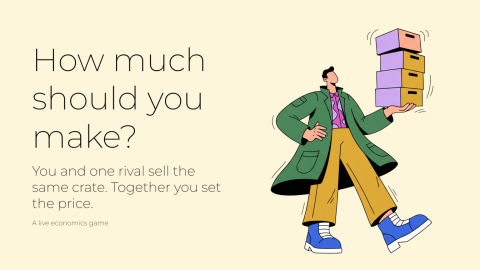
How much should you make?
A ready-to-teach lesson deck: a hook, how it works, the live game and takeaways for the debrief.
6 slides · 1 activity
What it teaches
Cournot competition is where students first meet a price as an outcome rather than a decision: each firm chooses a quantity, and the market prices the total. The equilibrium sits strictly between monopoly and perfect competition — which is the model's whole claim — and a room that has just overproduced its way below the monopoly profit understands why in a way no diagram delivers. Concepts: imperfect competition, Nash equilibrium, best response.
- Imperfect competition
- Nash equilibrium
Debrief, while the boards are still up
- 01
Nobody set the price. So who is responsible for where it ended up?
- 02
You and your rival together would have earned more producing less. Why couldn't you?
- 03
What would change with three firms in this market? With ten? What is the limit of that process?
How it works
- 01
Add it to your library
Sign up free and pull the activity from Decka's built-in classroom catalog — one click copies it into your own library, ready to run from Decka or inside PowerPoint.
- 02
Students join by QR
Everyone scans from the projector and plays in their phone's browser. No app, no account, nothing to install.
- 03
You run the room
You move the activity phase by phase: collection closes, the boards resolve on the big screen, and the debrief happens while the results are still up.
What is the Cournot game?
Cournot's duopoly model, from 1838, is the oldest formal game in economics: two firms choose production quantities simultaneously, the market price falls out of their combined output, and each firm's best quantity depends on what it believes the other will make. Its equilibrium is the canonical example of imperfect competition — more output and a lower price than a monopolist would choose, less output and a higher price than a competitive market would force.
In this activity, every pair of students is a market. Both firms sell the identical crate into the same demand — the first crate sells for a hundred, the price falls a pound a crate, and a crate costs twenty to make — so the numbers are simple enough to reason about and sharp enough to punish a guess. Each firm commits its production on its own phone; the projector then shows where every market in the room landed between the monopoly outcome and the price war, and what each firm earned for it. Two rounds against the same rival lets a pair try to find its way toward restraint — and discover why restraint keeps slipping.
It pairs naturally with the Bertrand and Stackelberg games in this library: the same market under three rules, so a course can run them back to back and put three different prices from one demand curve on the board.
FAQ
Cournot game questions, answered
Do students need to know the maths first?
No — the activity is a good way IN to the maths. The demand and cost numbers are simple and stated up front; students reason their way to a quantity, see the price their market produced, and the best-response logic of the formal model lands afterwards as an explanation of what they just watched themselves do.
Why two rounds against the same rival?
Because the interesting question after round one is whether a pair can tacitly cooperate its way toward the monopoly outcome — and round two lets them try. Watching restraint emerge, or collapse, is the best introduction to collusion and its instability a classroom can stage.
How does this relate to the Bertrand game?
Same market, different strategic variable. In Cournot, firms choose quantities and the price falls out; in Bertrand they name prices and the cheapest takes the whole market. That one change moves the equilibrium from comfortably above cost to exactly at it — running both is the cleanest way to show that market structure is about rules, not just firm counts.
Do students need an app or an account?
No. Students scan a QR code from the projector (or open a link) and play in their phone's browser. Nothing to install and nothing to sign up for.
Does it work in PowerPoint or Google Slides?
In PowerPoint, yes: open the Decka add-in on a slide and choose the Classroom tile. Google Slides is not supported yet; there you present from Decka itself. Students play from their phones either way.
How many students can play at once?
Up to 50 participants per live activity on the free plan, 150 on Pro, and 300 on Badass.
More economics games to run live
- Closing time at the market
- You are the market
- Who really pays a tax?
- Two sellers, identical crates, and whoever is cheapest takes the lot
- One of you builds the factory first
- Send it and see what comes back
- Ten coins and nobody can stop you
- One lot, and the best loser sets the price
- Spend the neighbourhood fund
- Four boats and a bay that belongs to nobody
- What is a flat worth to you?
- Three cars on one forecourt
- Tenants and landlords
- All economics activities
Ready to make your
presentations interactive?
Start free. No credit card required.