Classroom · Economics
Cheaper rent. Fewer flats?
Half the room holds flats with a private letting cost; half needs one, with a private value. Everyone makes one sealed offer, and the projector builds the housing market from them. Then rent is capped, everyone offers again, and each phone says privately whether its owner found a tenancy.
- Up to 600 people
- About 13 min
A practice run with fictional students. No real classroom or join code is created.
Try an answer on the phone. Lead the lesson from the screen.
On their phone
You are presenting

Setting up the room…
Lesson deck
Teach it as a ready-made lesson
Hook, how it works, the live market game and takeaways. Edit anything.
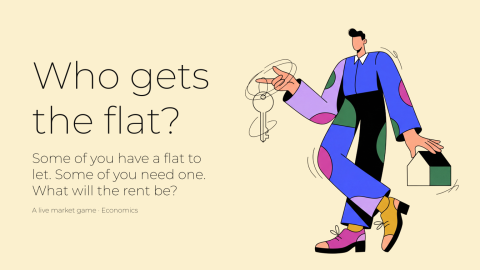
Who gets the flat?
A ready-to-teach lesson deck: a hook, how it works, the live market game and takeaways for the debrief.
6 slides · 1 activity
What it teaches
Students see why a binding ceiling makes housing cheaper for those who find it and scarcer overall. At a cap below the market's rent, fewer landlords will let and more tenants want to rent, and the tenants turned away were willing to pay the cap. Students also separate what the cap did from what their fresh offers did.
- Supply and demand
- Price controls
Debrief, while the boards are still up
- 01
Did the cap bind? Where does it sit against the open-market rent?
- 02
Which landlords stopped letting, and why?
- 03
The flats went to the highest bids. What would a waiting list or a lottery have done?
- 04
Which differences came from the cap, and which from people offering differently?
How it works
- 01
Add it to your library
Sign up free and pull the activity from Decka's built-in classroom catalog — one click copies it into your own library, ready to run from Decka or inside PowerPoint.
- 02
Students join by QR
Everyone scans from the projector and plays in their phone's browser. No app, no account, nothing to install.
- 03
You run the room
You move the activity phase by phase: collection closes, the boards resolve on the big screen, and the debrief happens while the results are still up.
A rent control game: a price ceiling in a housing market
Half the room are tenants with a private value for a flat; half are landlords with a private cost of letting one. Everyone makes one sealed offer, and the projector draws the room's bids and asks as two curves with no names attached.
The highest bids are matched with the lowest asks, and one rent is set for every tenancy: the middle of the range of rents that would clear the market. Each person sees their own card, offer and outcome privately.
Then a legal maximum rent is set, and the same cards make fresh offers. When the cap binds, only landlords whose asks it covers let, and if more tenants will pay the cap than there are flats, the lowest bids are turned away first, each told privately. It is two sealed markets, not one market re-cleared: for the same orders held fixed, see the price floor game.
FAQ
Rent control game questions, answered
Who gets the flats when there aren't enough?
The highest bids, with ties going to whoever offered first. That shows a cap at its best; a lottery or a queue would add misallocation.
Is the capped market the same offers?
No: fresh offers, same cards. For same-orders re-clearing, see the price floor game.
Can I change the cap?
Yes. By default it is 45 tokens a week, against tenant cards from 60 to 90 and landlord cards from 30 to 75, and the rule on screen reads the same number the market uses. A cap above the open-market rent does not bind.
Do students see each other's cards?
No. The curves carry no names; each person privately sees their own card, offer and outcome.
Which classes is it for?
Introductory price controls. Advanced classes can go on to rationing rules and long-run supply.
How long does it take?
Two sealed markets; the saved default shows under the headline as "About N min", and every timer is a setting you control before you run it.
Do students need an app or an account?
No. Students scan a QR code from the projector (or open a link) and play in their phone's browser. Nothing to install and nothing to sign up for.
Does it work in PowerPoint or Google Slides?
In PowerPoint, yes: open the Decka add-in on a slide and choose the Classroom tile. Google Slides is not supported yet; there you present from Decka itself. Students play from their phones either way.
How many students can play at once?
Up to 50 participants per live activity on the free plan, 150 on Pro, and 300 on Badass.
More economics games to run live
- Closing time at the market
- You are the market
- Who really pays a tax?
- Two factories, one market, and the price you both set
- Two sellers, identical crates, and whoever is cheapest takes the lot
- One of you builds the factory first
- Send it and see what comes back
- Ten coins and nobody can stop you
- One lot, and the best loser sets the price
- Spend the neighbourhood fund
- Four boats and a bay that belongs to nobody
- What is a flat worth to you?
- Three cars on one forecourt
- All economics activities
Ready to make your
presentations interactive?
Start free. No credit card required.