Classroom · Economics
The bank run game: will your class wait, or run?
Everyone has £100 in one small bank that keeps cash for 3 in every 10 depositors. Each student chooses: withdraw £100 today, or wait for £110 next year. If more ask than the vault holds, the bank fails. Then deposit insurance arrives, and your class chooses again.
- Up to 600 people
- About 30 min
- 2 acts
A practice run with fictional students. No real classroom or join code is created.
Try an answer on the phone. Lead the lesson from the screen.
On their phone
You are presenting

Setting up the room…
Lesson deck
Teach it as a ready-made lesson
Hook, how it works, the live game and takeaways. Edit anything.
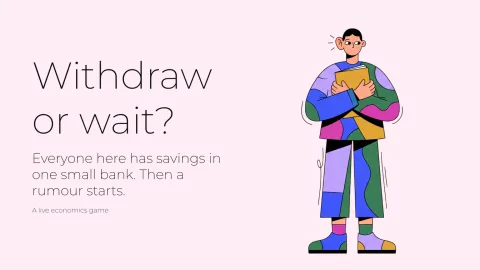
Withdraw or wait?
A ready-to-teach lesson deck: a hook, how it works, the live game and takeaways for the debrief.
6 slides · 1 activity
What it teaches
Students meet the Diamond–Dybvig model as a room rather than a diagram. A bank that lends out most of its deposits is sound while its depositors wait, and fails once enough of them expect the others to withdraw: then asking for your money first is the right answer, even for someone who trusted the bank. Deposit insurance changes one rule, what a failed bank pays, and with it the reason to run. The class tests both on its own room.
- Bank runs
- Deposit insurance
- Coordination problems
Debrief, while the boards are still up
- 01
If the bank failed in round 1 while most of the room waited: did it fail because people were greedy, or because each asker feared the others would ask first?
- 02
If the bank held in round 1, the rumour did not break it. With the vault's number on the board, how many askers would it have taken?
- 03
If the bank failed in round 1 with most of the room asking: once a run starts, is asking wrong? What does a waiter get from a failed bank?
- 04
If nobody asked in round 1: what would one person who asked have got, and what would it take for a second to follow?
- 05
If the insured bank held: insurance changed one rule. Why did that change your answer, when the bank's vault did not change at all? Who are the ribbons from Withdraw to Wait?
- 06
If the bank failed even insured: who lost? (Nobody lost their £100; the waiters lost only the £10 interest.) Why might people ask even so?
- 07
Diamond and Dybvig (1983) showed that a bank like this has two outcomes, and which one happens depends on what depositors believe. Real banks keep only a fraction of deposits as cash: why is that a good thing, until it is not?
How it works
- 01
Add it to your library
Sign up free and pull the activity from Decka's built-in classroom catalog — one click copies it into your own library, ready to run from Decka or inside PowerPoint.
- 02
Students join by QR
Everyone scans from the projector and plays in their phone's browser. No app, no account, nothing to install.
- 03
You run the room
You move the activity phase by phase: collection closes, the boards resolve on the big screen, and the debrief happens while the results are still up.
What is a bank run, and what does the Diamond–Dybvig model say?
A bank run is a rush of depositors asking for their money at once, because each fears the bank cannot pay everyone. Every bank keeps only part of its deposits as cash and lends the rest out, so even a sound bank cannot repay every depositor on the same day. The classic model is Douglas W. Diamond and Philip H. Dybvig, “Bank Runs, Deposit Insurance, and Liquidity”, Journal of Political Economy 91 (1983). The Diamond–Dybvig model shows that such a bank has two outcomes: if those who can wait do, its loans pay off and everyone is paid; if enough of them expect a run, withdrawing first is each one's best answer, and the run happens. Deposit insurance, which promises every depositor their money, removes the reason to run.
In this lesson your class is the bank's depositors. Everyone has £100 in one small bank, which sets aside cash in its vault for 3 in every 10 of them and lends the rest out for a year. Each student chooses: withdraw £100 today, or wait for £110 next year. If no more ask than the vault has cash for, the bank holds, and both are paid as promised. If more ask, the bank shuts and sells its loans early for what they fetch: £50 to each person who asked, and nothing to whoever waited. Waiting pays more only if few others ask, so each choice is a forecast of the room.
Your class plays it as “One small bank”. The phones open on a rumour that the bank has lent too much, and everyone chooses while the screen shows the rule and how many have answered, never how many chose either way. Then the big screen deals the answers onto a tally of who asked for their money, and a pen ticks the vault's cash across the Withdraw lane. Its tag says whether the bank held, and if it failed, by how many askers.
A note for the teacher: the vault is worked out from the room. It holds cash for 3 in every 10 depositors who answered, rounded down and never fewer than 1, and the bank fails when more ask than that. In a room of 30 the vault holds cash for 9, so 9 askers leave the bank standing and the 10th breaks it. The £50 is the lesson's rule whatever the number of askers: at 30 depositors it is at most £1,500, the vault's £900 and £600 from loans that cost £2,100 to make, sold early at under a third of their worth.
Then deposit insurance: same bank, same vault, same rumour, and one rule changed. If the bank fails, an insurer pays every depositor their £100, so waiting never pays less than asking, and the run has no reason to start. The room chooses again, and the last step compares the rounds: round 1 whole on the left, the insured round on the right, a ribbon for the people who kept or changed their answer, each as thick as its people, and a headline that says whether the insured bank held.
Counts only: the screen never names a student or a seat. Each phone shows the same counts and the bank's line, and each student reads their own payout from the answer they gave. Try the screen-and-phone preview: the phone is yours, and fictional classmates choose through the same runtime as the lesson; they are illustrative, not observations of a real class.
FAQ
Bank run questions, answered
What is a bank run?
A rush of depositors asking for their money at the same time, because they fear the bank cannot pay everyone. A bank lends out most of what is deposited, so even a sound one cannot repay every depositor at once. That is why the fear of a run can cause one: whoever asks first is paid, and whoever waits may be left with nothing.
What is the Diamond–Dybvig model?
The model of bank runs that Douglas W. Diamond and Philip H. Dybvig published in 1983. A bank turns deposits that can be withdrawn any day into loans that pay off only later. That makes it useful, and it also leaves it open to a run: the same bank can end with depositors waiting and paid in full, or with a run that fails it, depending only on what depositors expect of each other. They showed that deposit insurance removes the reason to run. Diamond and Dybvig shared the 2022 Nobel Memorial Prize in Economic Sciences with Ben Bernanke, for research on banks and financial crises.
Why can the bank fail when most of the class waits?
Because the vault holds cash for only 3 in every 10 depositors, and the bank fails as soon as more ask than that, however many wait. So a minority who ask can break it, and the ones who waited are the ones left with nothing. Nobody has to panic for the bank to fail; enough people only have to expect that others will ask.
What changes in the second round?
Deposit insurance. Same bank, same vault, same rumour; the one rule that changes is what a failed bank pays: an insurer pays every depositor their £100. So waiting never pays less than asking. The last step compares both rounds, so the class sees whether insurance stopped the run.
Does anyone see who chose what?
No. The big screen shows counts only: how many asked for their money and how many waited, never a name or a seat. While the room is choosing, it shows only how many have answered. Each phone shows the same counts and the bank's line, and each student reads their own payout from the answer they gave.
Can I change the vault or the payouts?
The payouts, yes; the vault, no. The payouts are only words: the two choices, the question, the rule and both framings say them, and you can change any of those, the currency too, before you run it. The lines that give the verdict name no amount, so they stay true. Whether the bank held is worked out from the vault, cash for 3 in every 10 depositors who answered, so that share is fixed; the first framing states it, so keep it if you edit that framing. You can change every clock too.
How long does it take?
Two rounds of choosing, each on its own clock, then the comparison at your pace; the saved default shows under the headline as "About N min", and every timer is a setting you control before you run it.
Do students need an app or an account?
No. Students scan a QR code from the projector (or open a link) and play in their phone's browser. Nothing to install and nothing to sign up for.
Does it work in PowerPoint or Google Slides?
In PowerPoint, yes: open the Decka add-in on a slide and choose the Classroom tile. Google Slides is not supported yet; there you present from Decka itself. Students play from their phones either way.
How many students can play at once?
Up to 50 participants per live activity on the free plan, 150 on Pro, and 300 on Badass.
More economics games to run live
- Closing time at the market

- You are the market

- Who really pays a tax?

- Two factories, one market, and the price you both set
- Two sellers, identical crates, and whoever is cheapest takes the lot

- One of you builds the factory first

- Send it and see what comes back

- Ten coins and nobody can stop you

- One lot, and the best loser sets the price

- Spend the neighbourhood fund

- Four boats and a bay that belongs to nobody

- What is a flat worth to you?

- Three cars on one forecourt

- Tenants and landlords

- Ten days at the lemonade stand

- Steer the economy