Classroom · Economics
Four boats, one bay, and a catch that belongs to nobody.
Students skipper boats in bays of four and choose, privately, how much gear to shoot: two strings, the way the bay has always been worked, or five, landing what they can. The projector shows how the fleet worked the bay. Then comes the year the bay does not come back.
- Groups of 4
- About 19 min
- 2 acts
A practice run with fictional students. No real classroom or join code is created.
Try an answer on the phone. Lead the lesson from the screen.
On their phone
You are presenting

Setting up the room…
Lesson deck
Teach it as a ready-made lesson
Hook, how it works, the live game and takeaways. Edit anything.
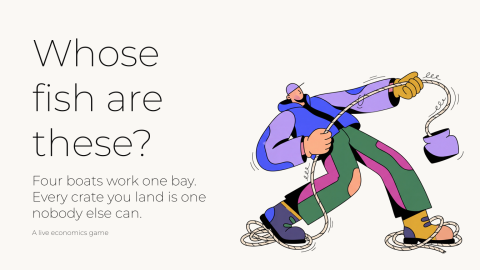
Whose fish are these?
A ready-to-teach lesson deck: a hook, how it works, the live game and takeaways for the debrief.
6 slides · 1 activity
What it teaches
Students meet a common-pool resource from inside a boat. Hauling harder pays each skipper more whatever the other three do, in both seasons, yet in the good year a bay where all four haul lands every boat half what a steady bay does. The harm is a threshold, not a straight line: in a good year one extra hauler costs the others nothing and the second costs every other boat. In the thin year there is no slack, so the first hauler already costs the boats that worked steady.
- Common-pool resources
- Externalities
- Dominant strategies
Debrief, while the boards are still up
- 01
Whatever the other three boats did, would five strings have landed you more than two? Why did that not make the bay better off?
- 02
In the good year one boat hauling cost the others nothing. When did the bay start taking it off everybody, and did anyone decide that?
- 03
In the thin year, what did the first boat to haul cost the boats that worked steady?
- 04
A quota, a licence, a closed season or ownership of the bay: which protects it without relying on restraint, and what does each cost the skippers?
How it works
- 01
Add it to your library
Sign up free and pull the activity from Decka's built-in classroom catalog — one click copies it into your own library, ready to run from Decka or inside PowerPoint.
- 02
Students join by QR
Everyone scans from the projector and plays in their phone's browser. No app, no account, nothing to install.
- 03
You run the room
You move the activity phase by phase: collection closes, the boards resolve on the big screen, and the debrief happens while the results are still up.
What is the tragedy of the commons game?
A commons is shared, rivalrous and open to everyone who uses it. Each user gains in full from taking more and bears only a share of the damage. Here the commons is a bay that stands about twelve strings of pots a season. Four steady boats work eight strings. One hauler takes it to eleven, still inside. The second takes it to fourteen, past what the bay will stand.
Each skipper chooses on their own phone without seeing the other boats. When the season closes, the projector shows how many boats worked steady and how many hauled. Each phone shows what its boat landed and how many strings its bay can still stand. Nobody is told who decided what.
Then the bay does not come back. The survey puts it at about nine strings, and the same four boats choose again. With no slack left, the first boat to haul already costs the boats that did not.
FAQ
Tragedy of the commons questions, answered
Do students see the catch table before they choose?
No. The phones state the rule in words: a steady catch or a harder haul, a bay that stands about twelve strings, and everyone's catch suffering past that. Each boat's crates appear on its own phone after the season closes. If you want the room to reason from the table first, show it yourself.
Does the first season cause the thin year?
No. The thin year is written into the lesson and arrives whatever the room did. The figure on each phone for what the bay can still stand is for discussion; it is not carried into season two.
What if a student doesn't choose?
Their bay's season does not resolve for anyone in it, because every catch depends on all four boats, and the lesson never invents a choice.
What if the class doesn't divide into fours?
Anyone in an incomplete bay, or who joins after the bays are dealt, is not asked to choose: their phone says they weren't placed in a full group, and they land no catch of their own.
How is this different from the public goods game?
There, contributions create the pot, and every token kept costs the rest of the room the same, however many were kept before it. Here the bay is finite and has slack: the harm is a threshold the room can cross without anyone deciding to.
What can I customize?
Every catch, what the bay has left, the timers and all the wording. “About twelve strings” is wording, so change it along with the numbers.
How long does it take?
Two seasons; the saved default shows under the headline as "About N min", and every timer is a setting you control before you run it.
Do students need an app or an account?
No. Students scan a QR code from the projector (or open a link) and play in their phone's browser. Nothing to install and nothing to sign up for.
Does it work in PowerPoint or Google Slides?
In PowerPoint, yes: open the Decka add-in on a slide and choose the Classroom tile. Google Slides is not supported yet; there you present from Decka itself. Students play from their phones either way.
How many students can play at once?
Up to 50 participants per live activity on the free plan, 150 on Pro, and 300 on Badass.
More economics games to run live
- Closing time at the market
- You are the market
- Who really pays a tax?
- Two factories, one market, and the price you both set
- Two sellers, identical crates, and whoever is cheapest takes the lot
- One of you builds the factory first
- Send it and see what comes back
- Ten coins and nobody can stop you
- One lot, and the best loser sets the price
- Spend the neighbourhood fund
- What is a flat worth to you?
- Three cars on one forecourt
- Tenants and landlords
- All economics activities
Ready to make your
presentations interactive?
Start free. No credit card required.