Classroom · Economics
Three cars, one forecourt, and a buyer who cannot tell them apart.
Every student is a seller with a good car, a fair one and a banger, and room on the forecourt for one. The buyer pays one pooled price for the average car on offer. Then the cars are inspected, and the price follows each car's own quality.
- Groups of 3
- About 19 min
- 2 acts
A practice run with fictional students. No real classroom or join code is created.
Try an answer on the phone. Lead the lesson from the screen.
On their phone
You are presenting

Setting up the room…
Lesson deck
Teach it as a ready-made lesson
Hook, how it works, the live game and takeaways. Edit anything.
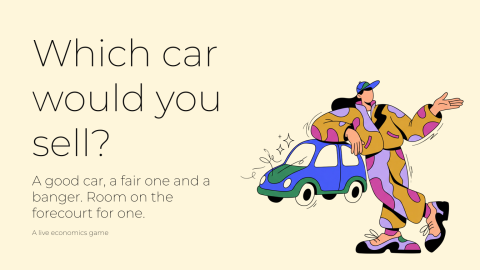
Which car would you sell?
A ready-to-teach lesson deck: a hook, how it works, the live game and takeaways for the debrief.
6 slides · 1 activity
What it teaches
Students meet adverse selection by selling into it. When the buyer cannot see quality and pays for the average, putting out your worst car beats putting out your best, whatever the other sellers do. Good cars stay on the drive even though the buyer values every car above its owner. Inspection reverses the incentive. The projector shows which cars reached the forecourts, and each phone shows the good cars its seller kept on the drive: the trades hidden quality cost.
- Adverse selection
- Asymmetric information
- Dominant strategies
Debrief, while the boards are still up
- 01
In week one, what did the banger earn you over the good car, whatever the other two did?
- 02
The buyer valued every car above its owner. Why did good cars stay home?
- 03
What did inspection change: the cars, the buyer, or the price rule?
- 04
Warranties, history reports, dealer reputations: which of these is an inspection, and who pays for it?
- 05
Where else does one side know the quality while the other pays the average?
How it works
- 01
Add it to your library
Sign up free and pull the activity from Decka's built-in classroom catalog — one click copies it into your own library, ready to run from Decka or inside PowerPoint.
- 02
Students join by QR
Everyone scans from the projector and plays in their phone's browser. No app, no account, nothing to install.
- 03
You run the room
You move the activity phase by phase: collection closes, the boards resolve on the big screen, and the debrief happens while the results are still up.
What is the market for lemons game?
George Akerlof's 1970 paper on the market for lemons asked what happens when a buyer cannot tell good goods from bad and so pays for the average: a good car is under-paid, a bad one over-paid, and good cars start to stay home.
Here every student is a seller with a good car, a fair one and a banger, worth £6,000, £4,000 and £2,000 to them by default, and room on a forecourt of three for one of them. The buyer is a price rule, not a student: it pays one and a half times the average value of the cars on its forecourt. Each phone shows its own sale; the projector shows which cars went out, never whose.
In week one, each step down in quality earns the seller the same £1,000 more, whatever the other two do. In week two the cars are inspected and the buyer pays one and a half times each car's own value, so the good car becomes the best one to sell.
FAQ
Market for lemons questions, answered
Who is the buyer?
A price rule, not a student. A version where students also play the buyers would be a different lesson.
Can a seller lose money?
Yes: a good car beside two bangers sells below its owner's value.
What if the class doesn't divide into threes, or a seller doesn't choose?
Anyone in an incomplete forecourt, or who joins after the forecourts are dealt, is not asked to choose: their phone says they weren't placed in a full group, and they make no sale. A forecourt where a seller does not choose does not resolve, and the lesson never invents a choice.
Can I change the car values?
The payoffs and all the wording are settings. The car values and the one-and-a-half rule in the brief are wording, not formulas, so rewrite them to match any change.
Which classes is it for?
Introductory microeconomics on information. Advanced classes can go on to signalling, screening and insurance.
How long does it take?
Two weeks on the forecourt; the saved default shows under the headline as "About N min", and every timer is a setting you control before you run it.
Do students need an app or an account?
No. Students scan a QR code from the projector (or open a link) and play in their phone's browser. Nothing to install and nothing to sign up for.
Does it work in PowerPoint or Google Slides?
In PowerPoint, yes: open the Decka add-in on a slide and choose the Classroom tile. Google Slides is not supported yet; there you present from Decka itself. Students play from their phones either way.
How many students can play at once?
Up to 50 participants per live activity on the free plan, 150 on Pro, and 300 on Badass.
More economics games to run live
- Closing time at the market
- You are the market
- Who really pays a tax?
- Two factories, one market, and the price you both set
- Two sellers, identical crates, and whoever is cheapest takes the lot
- One of you builds the factory first
- Send it and see what comes back
- Ten coins and nobody can stop you
- One lot, and the best loser sets the price
- Spend the neighbourhood fund
- Four boats and a bay that belongs to nobody
- What is a flat worth to you?
- Tenants and landlords
- All economics activities
Ready to make your
presentations interactive?
Start free. No credit card required.