Classroom · Economics
Send it, watch it grow, and see what comes back.
Whatever you send your partner is multiplied on the way over — and then it is entirely theirs. Nothing makes them return a coin. Played twice with the same person, tripled and then doubled, with the room's returns on the projector.
- In pairs
- About 30 min
- 2 acts
A practice run with fictional students. No real classroom or join code is created.
Try an answer on the phone. Lead the lesson from the screen.
On their phone
You are presenting

Setting up the room…
Lesson deck
Teach it as a ready-made lesson
Hook, how it works, the live game and takeaways. Edit anything.
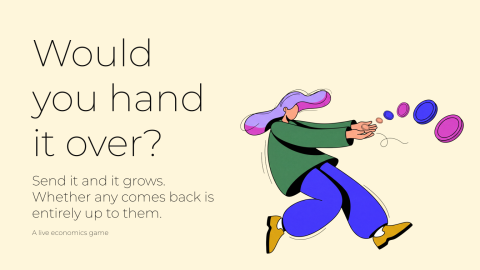
Would you hand it over?
A ready-to-teach lesson deck: a hook, how it works, the live game and takeaways for the debrief.
6 slides · 1 activity
What it teaches
The trust game puts a number on trust and on trustworthiness separately: the sender's transfer measures one, the returned share measures the other, and the multiplier makes trust efficient — the pair is richest when everything is sent — while backward induction says none of it should happen. Students watch the room beat that prediction, partially, and then argue about which part: reciprocity, reputation, or the second round with the same partner.
- Trust and reciprocity
- Repeated games
Debrief, while the boards are still up
- 01
The theory says send nothing, because nothing obliges a return. What did the room actually do, and what does that break in the argument?
- 02
Senders: what were you buying with a large transfer? Returners: what did you feel you owed, and why owe anything?
- 03
Round two was doubled instead of tripled. Did thinner growth make the room more careful with its trust, or less?
How it works
- 01
Add it to your library
Sign up free and pull the activity from Decka's built-in classroom catalog — one click copies it into your own library, ready to run from Decka or inside PowerPoint.
- 02
Students join by QR
Everyone scans from the projector and plays in their phone's browser. No app, no account, nothing to install.
- 03
You run the room
You move the activity phase by phase: collection closes, the boards resolve on the big screen, and the debrief happens while the results are still up.
What is the trust game?
The trust game — Berg, Dickhaut and McCabe's investment game — is how experimental economics measures trust without asking anyone about it. A sender passes some amount to a partner; it is multiplied in transit; the partner returns whatever share they choose, including none. Every step is voluntary and the last mover has no material reason to return a coin — so a strictly self-interested chain reasons backwards to zero: nothing returned, therefore nothing sent, therefore the multiplier's free value is left on the table.
Decades of experiments say people send, and people return, and this activity lets your room join the data. Each pair plays twice with the same partner — the transfer tripled the first time, doubled the second — and the projector shows what went out against what came back, which is what trust was worth in this room, in coins. The same-partner design sharpens the debrief: how much of the first round's generosity was reciprocity, and how much was an investment in the second?
FAQ
Trust game questions, answered
Is the partner really free to return nothing?
Completely. The return is an open choice, not a rule — that absence of enforcement is the point, because whatever comes back was given, not owed. A version where returns were compelled would measure compliance, not trust.
Why the same partner twice, when the ultimatum game uses strangers?
Opposite designs for opposite questions. The ultimatum game isolates fairness by removing any future between players; this pairing keeps the future in, so the room can argue about how much round-one generosity was reciprocity and how much was reputation-building — with its own round-two data as evidence.
Why does the multiplier drop from three to two?
It moves the efficiency of trust without touching its logic. Nothing about the strategic problem changes — the last mover still owes nothing — but the value created by trusting shrinks, and the room gets to see whether its trust was principled or price-sensitive.
Do students need an app or an account?
No. Students scan a QR code from the projector (or open a link) and play in their phone's browser. Nothing to install and nothing to sign up for.
Does it work in PowerPoint or Google Slides?
In PowerPoint, yes: open the Decka add-in on a slide and choose the Classroom tile. Google Slides is not supported yet; there you present from Decka itself. Students play from their phones either way.
How many students can play at once?
Up to 50 participants per live activity on the free plan, 150 on Pro, and 300 on Badass.
More economics games to run live
- Closing time at the market
- You are the market
- Who really pays a tax?
- Two factories, one market, and the price you both set
- Two sellers, identical crates, and whoever is cheapest takes the lot
- One of you builds the factory first
- Ten coins and nobody can stop you
- One lot, and the best loser sets the price
- Spend the neighbourhood fund
- Four boats and a bay that belongs to nobody
- What is a flat worth to you?
- Three cars on one forecourt
- Tenants and landlords
- All economics activities
Ready to make your
presentations interactive?
Start free. No credit card required.