Classroom · Physics
Half the Moon is always lit. So why does it change shape?
The big screen draws a tellurion: a lamp for the Sun, a globe for the Earth and a ball on an arm for the Moon. Three times your class picks the shape a person on the globe would see, then the camera comes down to the globe and the light shows it.
- Up to 600 people
- 4 acts
A practice run with fictional students. No real classroom or join code is created.
Try an answer on the phone. Lead the lesson from the screen.
On their phone
You are presenting

Setting up the room…
Lesson deck
Teach it as a ready-made lesson
Hook, how it works, the live activity and takeaways. Edit anything.
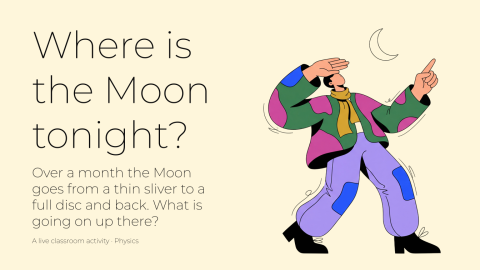
Where is the Moon tonight?
A ready-to-teach lesson deck: a hook, how it works, the live activity and takeaways for the debrief.
6 slides · 1 activity
What it teaches
Students explain the Moon's phases from where its lit half faces: half the Moon is always lit by the Sun, and the phase is how much of that lit half can be seen from Earth. They also see why a full Moon rises as the Sun sets, why the phase is not Earth's shadow, and what a model like the tellurion can and cannot show.
- Moon phases
- Scientific models
Debrief, while the boards are still up
- 01
From above, how much of the Moon was lit each time? So what changes over a month?
- 02
If you first chose Earth's shadow: where would Earth's shadow have to be for that to work, and where was the Moon when it was a crescent?
- 03
Why is a first-quarter Moon half lit, when it is only a quarter of the way round its orbit?
- 04
If some of the second vote still chose Earth's shadow, what did the view from the globe show that the shadow idea cannot explain?
- 05
If the Moon goes round behind Earth every month, why isn't every full Moon an eclipse?
- 06
Tonight's Moon is on the screen. When and where will you look for it, and what will you tell the class tomorrow?
How it works
- 01
Add it to your library
Sign up free and pull the activity from Decka's built-in classroom catalog — one click copies it into your own library, ready to run from Decka or inside PowerPoint.
- 02
Students join by QR
Everyone scans from the projector and plays in their phone's browser. No app, no account, nothing to install.
- 03
You run the room
You move the activity phase by phase: collection closes, the boards resolve on the big screen, and the debrief happens while the results are still up.
A moon phases game where the room's picks meet the light
The big screen draws a tellurion, the classroom apparatus with a lamp for the Sun, a globe for the Earth and a small ball on an arm for the Moon. The class first votes, on their phones, on why the Moon changes shape over a month: Earth's shadow, how much of its sunlit half we see, clouds and dust, or its distance from the Sun. The room's first vote is shown unmarked: the answer waits until the room has seen three Moons.
Three times the arm moves the Moon round its orbit, and the screen shows it from above, lit on the half that faces the lamp. Every student picks, from eight drawn shapes, the one a person standing on the globe would see. The room's picks land on the board first. Then the camera lifts the ball and comes down to the person on the globe, and the same half-lit ball becomes the shape the light shows. Only then is the right shape marked, so a mirror-image pick is the room's own to find.
Next the Moon is full, and the room predicts when it rises. The globe turns through one model afternoon, a model hour a second, and the full Moon clears the person's horizon as the Sun sets. The class then votes on why once more, and the screen shows who changed their answer and where they went, with the answer marked on the second vote only. The lesson ends on tonight's Moon: its shape, how much of it is lit, and when and where to look.
Everything on the screen is a model, and says so. It is not to scale: the Moon is really about 30 Earth-widths away. Rise times are given as “about”, for local solar time at middle latitudes, and tonight's Moon is worked out from the date with an average lunar month, so its phase can be a day out and its times an hour. Each phone shows only its owner's answers beside the room's counts; nobody is told how any one person answered.
FAQ
Moon phases game questions, answered
What do I need besides phones?
A projector or big screen, which draws the tellurion. Nothing needs printing; a lamp and a ball on a stick are optional, for students to try it with their own eyes after the lesson.
Does it work in the southern hemisphere?
Yes: set your hemisphere before you start. In the southern hemisphere every shape is mirrored, so a young crescent is lit on the left; the person on the globe faces north, and the lesson's pictures and answers follow.
Is tonight's Moon exact?
It is a model: worked out from the date alone with an average lunar month, so the phase can be a day out and rise times an hour. It says “Model, about” wherever it appears, and asks the class to check it in the sky.
Why a drawn model, not photos of the Moon?
A photo shows the shape, not why. The tellurion shows one apparatus two ways: from above, the ball is always half lit by the lamp; from the person on the globe, the same ball is a crescent, a half or nearly full, and the room watches one become the other.
Why isn't every full Moon an eclipse?
The Moon's orbit is tilted about 5 degrees to Earth's, so most months a full Moon passes just above or below Earth's shadow. The tellurion's orbit is flat and never draws Earth's shadow on the Moon, which makes it a good question to put to the class at the end.
How long does it take?
A first vote, three Moons, a moonrise, a second vote and tonight's Moon; the saved default shows under the headline as "About N min", and every timer is a setting you control before you run it.
Do students need an app or an account?
No. Students scan a QR code from the projector (or open a link) and play in their phone's browser. Nothing to install and nothing to sign up for.
Does it work in PowerPoint or Google Slides?
In PowerPoint, yes: open the Decka add-in on a slide and choose the Classroom tile. Google Slides is not supported yet; there you present from Decka itself. Students play from their phones either way.
How many students can play at once?
Up to 50 participants per live activity on the free plan, 150 on Pro, and 300 on Badass.
Ready to make your
presentations interactive?
Start free. No credit card required.