Classroom · Physics
The ruler is a clock. Read your class on it.
Every phone drops a ruler and its student catches it: three times focused, three times distracted and three after practice. Every middle catch lands as one mark beside a big-screen ruler whose other edge is a clock, then each person is set against themselves, which is where the room's change shows.
- Up to 600 people
A practice run with fictional students. No real classroom or join code is created.
Try an answer on the phone. Lead the lesson from the screen.
On their phone
You are presenting

Setting up the room…
Lesson deck
Teach it as a ready-made lesson
Hook, how it works, the live activity and takeaways. Edit anything.
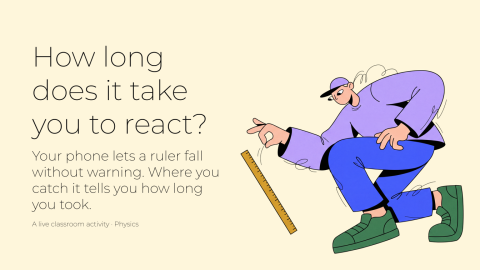
How long does it take you to react?
A ready-to-teach lesson deck: a hook, how it works, the live activity and takeaways for the debrief.
6 slides · 1 activity
What it teaches
Students read a reaction time off a falling ruler, see why its time scale bunches near zero (a falling ruler speeds up), and learn why a paired comparison finds an effect that two overlapping clouds hide. They also meet a censored measurement: a catch that fell through is slower than the ruler can time, not zero and not 50 cm.
- Measurement and uncertainty
- Repeated measurement
- Free fall
- Paired comparison
Debrief, while the boards are still up
- 01
Look at the two clouds on the ruler. Would you say distraction matters? What did the board of differences add?
- 02
Why do the time marks bunch up near zero on the ruler?
- 03
Someone caught it at 4 cm, which is 90 ms. Is that a believable reaction, or something else? How would you check?
- 04
What did the catches that fell through do to the room's middle catch, and why does a middle survive them when an average would not?
- 05
If as many people got faster as slower, or the strip leaned the other way, what would you conclude, and what would you test next?
- 06
A car at 30 mph covers about 13 metres a second. How far does it travel during your distracted reaction time?
How it works
- 01
Add it to your library
Sign up free and pull the activity from Decka's built-in classroom catalog — one click copies it into your own library, ready to run from Decka or inside PowerPoint.
- 02
Students join by QR
Everyone scans from the projector and plays in their phone's browser. No app, no account, nothing to install.
- 03
You run the room
You move the activity phase by phase: collection closes, the boards resolve on the big screen, and the debrief happens while the results are still up.
A reaction time lab built on the room's own catches
Each student's phone holds a 50 cm ruler above their fingers and lets it go after a pause nobody can predict; they tap to catch it. A tap before the drop is too soon and counts nothing. Where the ruler stopped at their fingers is the reading, to the millimetre, and a ruler that falls right through is recorded as exactly that, “Fell through”, never as zero or as 50 cm. Two practice catches come first, then three that count, each sent as it is made.
The big screen draws a tall ruler whose left edge is the centimetre scale and whose right edge is a clock: the time a ruler falling from rest takes to fall that far, t = √(2d/g). Its marks bunch near zero and spread out further down, because a falling ruler starts slow and speeds up. When catching closes, each person's middle catch of three lands as one mark beside the ruler, so one lucky grab cannot fill the cloud, and the room's middle catch is inked across it with its time.
Then the room catches again while counting backwards in threes, out loud. That cloud lands on the other side of the same ruler, with the first one outlined over it, and the two usually overlap so much that distraction looks harmless. A second board sets each person against themselves: their distracted time less their focused one, with anything within 5 ms counted as the same, and its verdict falls on whichever side the data does. A last round after ten quick practice catches adds a second strip. Anyone who did not record both is counted, not hidden.
Every time on the screen and on the phones is labelled a model: it is read from the catch through the physics of a falling ruler, ignoring air, using standard gravity. Each phone shows its owner's own catches, middle catch and differences beside the room's middle; the screen shows counts only. Try the screen-and-phone preview, where the phone is yours to catch with and fictional classmates catch through the same runtime as the lesson, and to feel a catch on your own first, use Decka's free reaction time test.
FAQ
Reaction time lab questions, answered
What do I need besides phones?
Only a projector or big screen, which draws the room's ruler. Each phone draws its own 50 cm ruler and drops it, so there is nothing else to hand out.
What happens when the ruler falls through?
The phone records “Fell through”. It counts as slower than the ruler can time, never as zero or 50 cm. Someone with two misses of three has a middle catch that fell through, which lands in its own row past the ruler's end.
Why three catches, and why the middle one?
The middle of three resists one fluke, an early grab or a slip, and unlike an average it still exists when a catch falls through. So each mark on the ruler is a person, not their luckiest try.
Are the milliseconds measured?
Not as such. The phone records each catch as a ruler would, where the ruler stood when the tap came, to the millimetre; each time is what free fall says that length takes, for a ruler falling from rest and ignoring air, and it is labelled a model wherever it appears.
Does a phone's own delay change the result?
Every screen and touchscreen adds a few hundredths of a second between the ruler moving and the tap landing, more on some phones than others, so the room's clouds mix phones. Each person's catches share their own phone's delay, so it largely drops out of their difference wherever both of their middle catches land on the ruler, and the board of differences is where the lesson's answer is. A catch that fell through has no time to subtract, so there the delay cannot drop out: that is why each phone drops a 50 cm ruler, which times a catch, delay and all, to almost a third of a second.
Can students try it alone?
Yes. Decka's free reaction time test drops the same ruler on screen and reads your time where you catch it.
How long does it take?
Three rounds of catches and the reveals between them; the saved default shows under the headline as "About N min", and every timer is a setting you control before you run it.
Do students need an app or an account?
No. Students scan a QR code from the projector (or open a link) and play in their phone's browser. Nothing to install and nothing to sign up for.
Does it work in PowerPoint or Google Slides?
In PowerPoint, yes: open the Decka add-in on a slide and choose the Classroom tile. Google Slides is not supported yet; there you present from Decka itself. Students play from their phones either way.
How many students can play at once?
Up to 50 participants per live activity on the free plan, 150 on Pro, and 300 on Badass.
Ready to make your
presentations interactive?
Start free. No credit card required.