A fishbowl game the whole room plays from their phones
Fishbowl is the fishbowl game, also called salad bowl, for the big screen. Everyone drops names into the bowl from their phone, then teams race the clock to get the same slips across three times: describe it, one word only, then act it out.
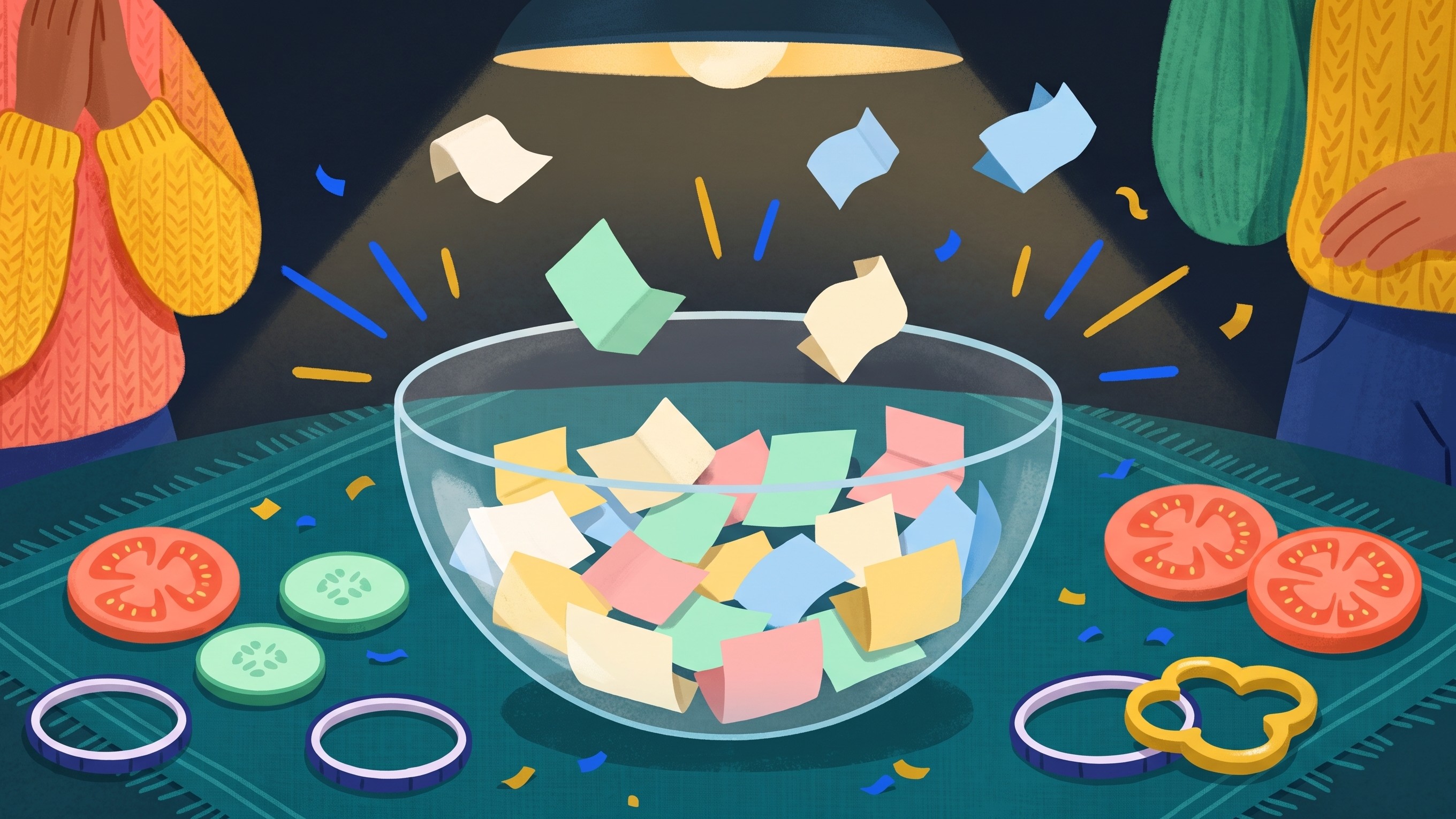
How to play the fishbowl game
Everyone drops a few names into the bowl: famous people, characters, things, actions. Then teams take turns against a one-minute clock. One player gives clues from a slip on their phone, and their team shouts guesses.
The trick is that the bowl never changes. The same slips come back for three rounds, and each round makes them harder to get across:
- Describe it. Say anything except the words on the slip.
- One word only. Give one single word as your clue. Nothing else.
- Act it out. No words and no sounds.
By round three, the room remembers what worked. A clue-giver who rowed a boat for George Washington in round one only has to row again.

Points carry over from round to round. After the last round the big screen crowns the team with the most slips.
Fishbowl game words: everyone writes, or use a built-in bowl
By default every phone writes its own slips in the lobby, three each, and taps Drop it in for each one. The big screen counts the slips and who is done. Two slips that differ only by case, accents or punctuation count once, so a bowl never holds Beyoncé twice.
You can also fill it yourself. Choose My own list on the create form and type your slips there, up to 200 of them. Or pick A built-in bowl:
- Famous people, 66 slips
- Characters from stories and screens, 52 slips
- Things, animals and places, 68 slips
- Things people do, 60 slips, made for round three
- A mix of everything, all four at once
A built-in bowl also tops up a bowl the players leave with fewer than 12 slips. For slips to write yourself, see fishbowl game ideas.
A turn: the clue-giver's phone, Got it and Skip
When a team is up, its clue-giver's phone says You're up, and they tap I'm ready. Their phone shows one slip at a time under Get them to say. Got it scores the slip and brings the next one. Skip sends it to the bottom of the bowl.

Teammates see no slip. Their phones say Shout it out, and every slip they get lands on their screen as it scores.
Skipping has four settings on the create form:
- One free skip a turn, the default
- Skip any time, it costs a point
- Skip any time, free
- No skips
Other teams watch for fouls
Every phone not on the clock sees the slip too, and a Foul button that names the round's rule: They said the word, More than one word, or They spoke. In a small room one tap lands a foul. In a bigger one it takes more phones, so one player can't send every slip back.
A foul sends the slip back into the bowl, and the clock keeps running. If the call was wrong, your panel's Overrule the foul (+1) counts the slip for the team after all. You can turn fouls off on the create form.
The salad bowl game, with salad teams
Salad bowl is another name for the same game, and this one leans into it. The teams are the Tomatoes, the Onions, the Peppers and the Cucumbers, and both screens draw each team's slice as its mark.
Players are dealt into teams by seat as they join. Choose two to four teams on the create form; a small room plays fewer.
When the bowl empties mid-turn
A round ends when the last slip is guessed, and every slip goes back in for the next one. The clue-giver who empties the bowl keeps their leftover seconds, five or more, and starts the next round with them. Both screens say so.
For a longer game, Add a fourth round: sounds only is on the create form. Its rule is no words, only noises, hums and sound effects. The fishbowl game rules cover the paper version and the house rules groups argue about.
What the host does
Players join by scanning the code on the big screen. Press Start once at least two are in. From there your panel keeps the pace:
- Start the turn starts the clock if the clue-giver hasn't tapped I'm ready. A turn also starts by itself after twenty seconds.
- Pick another clue-giver hands the turn to a teammate.
- End this turn stops the clock early.
- Overrule the foul (+1) undoes the newest foul.
- Finish saves the report, with the scores, each round's bars, the best clue-givers and the most skipped slips.
- New bowl, play again keeps the teams and starts fresh slips with scores at zero.
Turns last a minute by default. Anything from 30 seconds to two minutes is a setting.
A fishbowl game for a big group
Fishbowl starts at two players. Two players race the clock together as one team. Three play two teams, and the team of one borrows a guesser. A crowd splits into as many as four teams.
In a big room, the bowl holds 30 slips by default and up to 80. Slips are drawn from everyone in turn, so every player gets at least one in before anyone gets a second.
In a classroom room
A classroom room sends no names, and it can hold typed text for review. So in a classroom room no phone types a slip. The bowl is your own list, or a built-in bowl when your list is empty, and phones show a seat number instead of a name.
The Classroom: science words quick start plays 20 words, such as Photosynthesis, Friction and Orbit, with four teams. Swap in this week's vocabulary on the create form. There's more in the fishbowl vocabulary game.
FAQ
Fishbowl, explained
What is the fishbowl game?
A team party game played over three rounds with the same slips of paper. The clue-giver describes each slip in round one, gives one word in round two and acts it out in round three.
Is the fishbowl game the same as the salad bowl game?
Yes. Fishbowl, salad bowl, the hat game and celebrity are names for the same game. This one keeps the fishbowl name and plays salad teams.
How many slips does each player write in the fishbowl game?
Three by default, and anything from one to five is a setting. The bowl holds up to 30 slips by default.
What happens to a skipped slip?
It goes to the bottom of the bowl, so the team that just saw it rarely draws it next. A slip still in hand when time runs out goes there too.
Can we play the fishbowl game with two people?
Yes. Two players play as one team, taking turns to give clues against the clock, and the report counts the slips they got across together.
Can players write their own slips in a classroom room?
No. A classroom room can hold typed text for review, so it plays your own list, or a built-in bowl when your list is empty.