A Socratic seminar that maps itself: observers tap each move and every turn becomes an arc across the circle
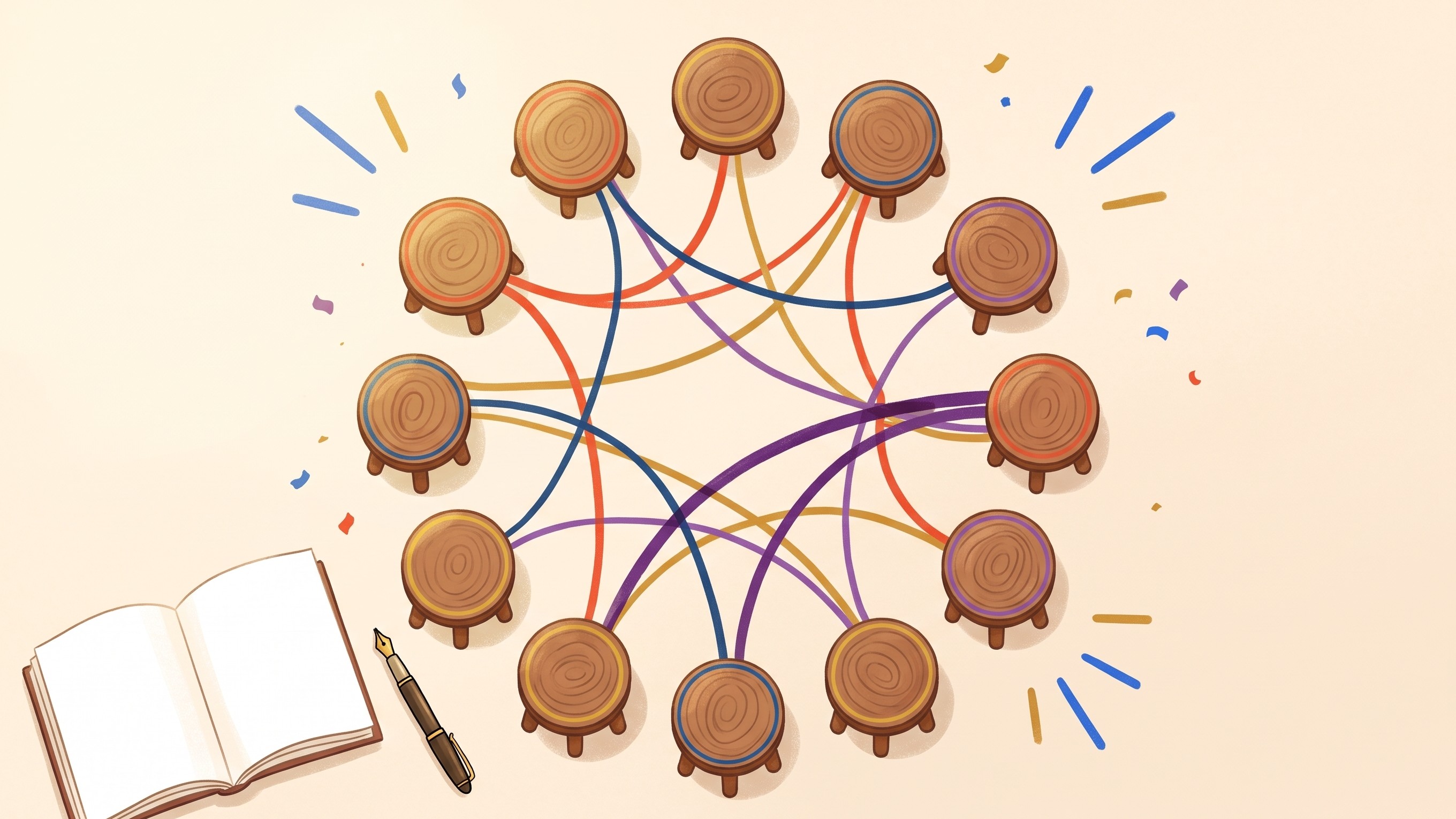
Socratic Seminar runs a Socratic seminar on the big screen. Observers tap each move on their phones, and the screen draws the talk as arcs across the circle: who spoke to whom, who asked, who cited the text, and whose voice we haven't heard.
How to run a Socratic seminar with a live talk map
A Socratic seminar is a discussion where the room, not the host, does the talking. A circle reads one text, answers one open question, and argues from the page.
This version adds observers and a big screen. Here's how a session runs:
- Number the chairs. Number the circle's chairs 1, 2, 3 clockwise. Nobody types a name.
- Observers join on their phones. They scan the code on the big screen, and each phone is given a seat to watch.
- Start the seminar. Press Start the seminar and read the opening question aloud. The clock starts with it.
- The circle talks, and observers tap. When their seat speaks, an observer taps what kind of turn it was.
- The map draws itself. Every hand-over from one speaker to the next becomes an arc across the circle on the big screen.
When the talk has run its course, press Debrief. The map replays the whole conversation, and the room talks about how it went.
The five moves observers tap
Each observer's phone has one button for the seat speaking and four for the kind of turn:
- Spoke: the seat took a turn.
- Asked a question: the turn put a question to the circle.
- Cited the text: the turn pointed at a line or a page.
- Built on an idea: the turn picked up what someone else had said.
- Invited someone in: the turn asked another person to speak.

Tapping them live means nobody tallies on paper, and every count is ready for the debrief.
A phone that watches several seats shows each one as a button, so an observer taps the seat that spoke, then its move. With fewer observers than seats, the circle is shared out in runs of neighbouring seats. A single observer can map the whole circle.
The talk map: who spoke to whom
The big screen shows the circle from above. Each arc runs from one speaker to the next, with an arrowhead at the seat that spoke next, in the colour of what that seat did.

The newest arcs stay strong while older ones fade, so the room can see where the talk is now. Each seat's ring grows as it speaks, banded by the kinds of turn it took.
Beside the map, the Talk balance card counts the voices heard, such as 7 of 10 voices heard. A meter runs from A few voices to Everyone equally, with a verdict in words: Fairly shared, Shared widely or A few voices lead.
Fishbowl or one circle
Choose how the room sits under How the room sits:
- Fishbowl: inner and outer circles. Circle A talks inside while circle B observes from behind. Press Switch circles and they change places, and the phones change hands. Each circle gets a map of its own.
- One circle, with observers outside it. The whole circle talks, and observers sit outside it where they can see their seats.
In a fishbowl, the inner circle's phones go face down. Each observer is told to take the outer chair behind the seat they watch, and can pick a partner's chair instead. For the format itself, see the fishbowl discussion guide.
Socratic seminar questions: the opening question and more
Type an Opening question, which goes on the big screen and every phone. Add up to eight More questions, and Next question moves to each in turn.
The defaults work with any text: What is the text really asking of us, and do we agree? Then: Which line in the text matters most, and why? And: What would the author say to someone who disagrees?
Put the reading under What the room is reading, such as a play's title and its lines, and it shows on the big screen. For questions by book and sentence starters for each move, see Socratic seminar questions.
Socratic seminar tips for shy students
Once a few turns are in, the Talk balance card lists the seats that haven't spoken under Voices we haven't heard yet. It names seat numbers, never people.
That cue is gentle by design, and it is yours to control. Press Hide “not heard yet” to take it off the big screen, and press Show “not heard yet” to bring it back. To leave it off from the start, turn off Show the voices we haven't heard yet when you make the seminar.
A seat that invites someone in gets that move counted. It gives the circle a way to bring a quiet voice in without the host doing it.
The debrief and the report
Press Debrief and the map replays turn by turn, then settles. Every path between two seats becomes one arc, as thick as the number of times the talk took it, and each seat shows its count of turns.

The screen names the two seats with the most back-and-forth, the seat at the centre of the talk and, if the cue is on, the seats not heard this time. In a fishbowl, both circles' maps sit side by side.
Each observer's phone shows its seats' moves, with a prompt for feedback: one thing done well, and one thing to try next time.
Press Finish and save the report to keep it. The report holds turns taken, voices heard, the talk balance out of 100, and each seat's count of every move. For turning those counts into a grade, see the Socratic seminar rubric.
What the host does
You start the talk and move it on. The circle and the observers do the rest. Your panel offers:
- Next question when a question has run its course.
- Switch circles: B goes in in a fishbowl, then Start circle B now to skip the short countdown.
- Pause, then Resume, which carries on where you were.
- Hide “not heard yet” and Show “not heard yet” for the cue.
- Debrief, then Finish and save the report, Replay the map or Back to the seminar.
Minutes on the clock is 10 by default, and it restarts with each question and each switch. Nothing stops at zero: the clock reads Finish the thought, and you decide when to move on. Set it to 0 for no clock.
Ready-made Socratic seminars
The seminar ships five quick starts:
- Fishbowl, 10 seats plays the defaults.
- One circle, 16 seats seats the whole circle, with observers outside it.
- Letter from Birmingham Jail opens with When, if ever, is it right to break a law?
- The Allegory of the Cave opens with Why might someone choose to stay in the cave?
- Short rounds, 6 minutes plays 8 seats on a shorter clock.
Each one can be changed before you run it, down to the last question.
When an observer taps the wrong thing
Each observer's phone lists its last three taps, each with Undo. A phone that watches several seats can also move its newest tap with Change seat, keeping its moment in the talk.
Observers often tap late, so every tap carries the moment it was made. A late tap slots in where it belongs and the arcs redraw around it.
Pause stops the clock and the map together, for a fire drill or a reading break.
In a classroom room
A classroom room sends no names, and this seminar never asks for one: seats are numbers, and the map, the cue and the report all use them.
Observers can add a short typed note about their seat, such as a strong claim or a line someone used. A classroom room can hold typed text for review, so the phone says a note may be read first. The map never needs notes, and Observers can add a short typed note can be turned off.
FAQ
Socratic Seminar, explained
What is a Socratic seminar?
A discussion where a circle reads one text and talks through an open question, building on each other's ideas and citing the page. The host asks the opening question and then mostly listens.
How do you run a Socratic seminar?
Number the chairs, give the circle one text and an open question, and let them talk. Here, observers tap each move on their phones and the big screen maps the conversation.
What is the difference between a Socratic seminar and a fishbowl?
A Socratic seminar is the discussion. A fishbowl is a way of seating it: an inner circle talks while an outer circle observes, then they switch.
How many observers do you need?
One is enough. A single observer can map the whole circle, and with more observers the seats are shared out among them.
Does the circle need phones?
No. Only observers use phones. In a fishbowl, the inner circle's phones go face down while it talks.
Can I use my own text and questions?
Yes. Type the opening question, up to eight more, and what the room is reading.
Does the map show anyone's name?
No. Chairs are numbered, and the map, the cue and the report use seat numbers only.