A timeline game where every phone drags to the year
Year Line is a timeline game for the big screen. Each player drags a marker along a timeline on their phone to the year they think an event happened. Then every guess drops as a pin, the wall sweeps to the true year, and the three closest pins take medals.
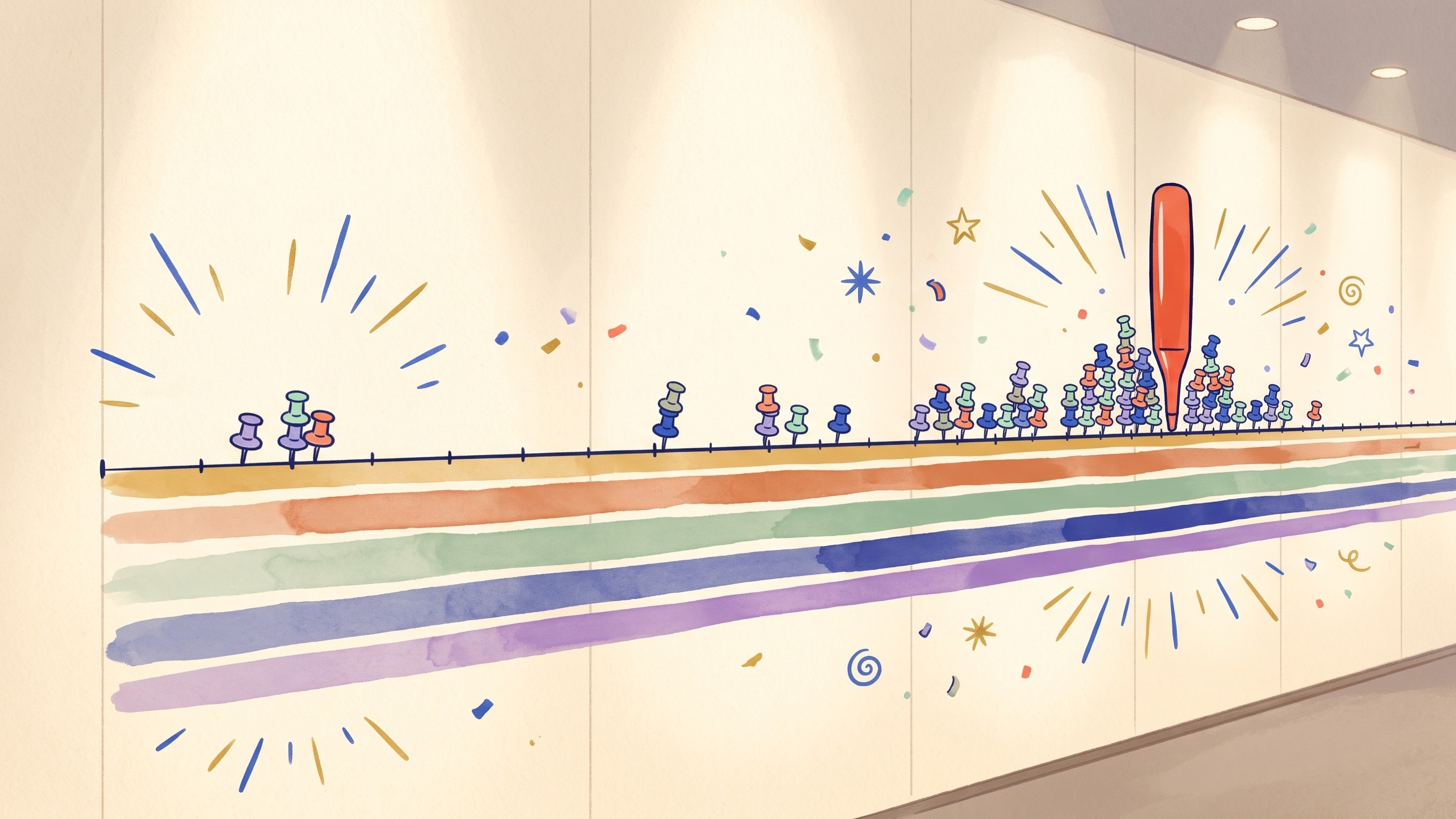
How to play the timeline game
Players scan the code on the big screen, and each phone gets its own coloured pin. While they wait, every phone can warm up on the timeline. Press Start once everyone is in. Each event then runs the same way:
- The big screen shows the event, such as "The Battle of Hastings", and asks "When did it happen?"
- Each player drags the marker on their phone to the year they think it happened, then presses Lock in.
- When the time runs out, or everyone has locked in, every guess drops onto the wall as a pin.
- The wall sweeps to the true year, and a line under it says something about the event.
- The three closest pins take gold, silver and bronze, and the scores follow.
Eight events make a game by default. After the last one, the wall lays out the game's events in year order, beside the winner and the sharpest guess of the game.
A timeline that zooms from millennia to single years
The phone's timeline covers thousands of years and still lets a player land on one. Touch it to place the marker. Hold still and it zooms in around your thumb, from Millennia to Centuries, Decades and then Years. Push an end and it travels.
The year rolls over in a readout as you move, and the button reads it back: Lock in 1066. Zoom out takes you back to the whole line. On a keyboard, the arrow keys step a year at a time.

A lock is final. A pin that's placed but never locked still counts when the time runs out.
How a guess the year game is scored
The exact year scores a thousand points. Every guess further off scores less, and how fast it falls depends on how old the event is.
Points halve every few years for a recent event, and every few decades for an ancient one. That distance is 2 years plus a year for every 20 since the event:
- about 4 years for an event in 1990;
- about 50 years for the Battle of Hastings in 1066;
- about 128 years for an event in 500 BCE.
So a guess 30 years off is a fine answer for Hastings and a poor one for the first iPhone. The big screen says the rule out loud for each event: "For an event this old, a guess 50 years off scores half."

The verdict also shows how close the whole room was. It gives the middle guess, how many pins landed within the half-points distance, and the average score. A tie goes to whoever locked in first.
A history timeline game, or science, pop culture and sport
Choose the Exhibition on the create form. There are 144 built-in events, each with its own fact for the reveal:
- World history, 42 events from the Great Pyramid to the euro.
- Science and invention, 36 events from Copernicus to the James Webb Space Telescope.
- Pop culture, 35 events from the Mona Lisa to Fortnite.
- Sport, 31 events from the first Olympic Games at Olympia to the 2022 World Cup.
- A bit of everything, which mixes all four.
A game picks its events from different eras, so it never sits in one century. Every event in an exhibition opens on the same stretch of line, so the starting view gives nothing away.
Set Events per game from 3 to 15, and Time to place each event from 10 to 90 seconds. The defaults are 8 events and 25 seconds.
For lists to quiz from, try these world history trivia questions, pop culture trivia questions or sports history trivia questions.
A timeline game with your own events
Set Exhibition to Your own events, and type up to 60 of them. Each one is What happened, its Year, and an optional Note for the reveal. Tick BCE for years before year 1.
It works for anything with dates: a company's milestones, a class topic or a family's story. "We open our first office" is the form's own example.
Your events play shuffled, or in the order you typed them if you turn off Shuffle your own events. The timeline opens on the span your events cover, so a list from one decade isn't lost on a line of five thousand years.
If the list is empty when you press Start, the game plays a mix instead and says so on the big screen.
Running it from the big screen
Once you press Start, the game runs itself on its timers. A few buttons let you change the pace:
- Reveal now ends the placing early. Add 15 seconds gives the room more time.
- Show the verdict skips the rest of the sweep to the true year.
- Hold this view stops the clock on the verdict, so the room can argue about it. Hold the scores does the same between events.
- Next event moves on. After the last event, Final results opens the final screen and Finish closes the game.
Afterwards, the report lists every event with the room's middle guess and the closest player, and charts how close the room came on each one.
In a classroom room
A classroom room sends no names. Each phone shows its seat number, and the big screen lists players as Seat 1, Seat 2 and so on. Players only ever send a year, never typed text, so there's nothing to hold for review.
FAQ
Year Line, explained
What is a timeline game?
A game where players put events in time. In Year Line, each player drags a marker on their phone to the year an event happened, and the closest guesses score most.
How do you play a guess the year game with a group?
Show an event on the big screen and let every player place their own year at once. Year Line drops every guess as a pin, sweeps to the true year and gives the closest three medals.
How is the timeline game scored?
The exact year scores a thousand points. Points halve every 2 years plus a year for every 20 since the event, so being a decade off matters far more for 1990 than for 500 BCE.
Can I make a history timeline game with my own events?
Yes. Choose Your own events and type up to 60, each with its year and an optional note. Tick BCE for years before year 1.
How many events are in a game?
Eight by default, and anything from 3 to 15. Each built-in exhibition holds more than 30, so two games can play different events.
What happens with dates nobody knows exactly?
The big screen marks them with a c., as in c. 2560 BCE for the Great Pyramid. Scoring is scaled to an event's age, so a few decades off an ancient date still scores well.